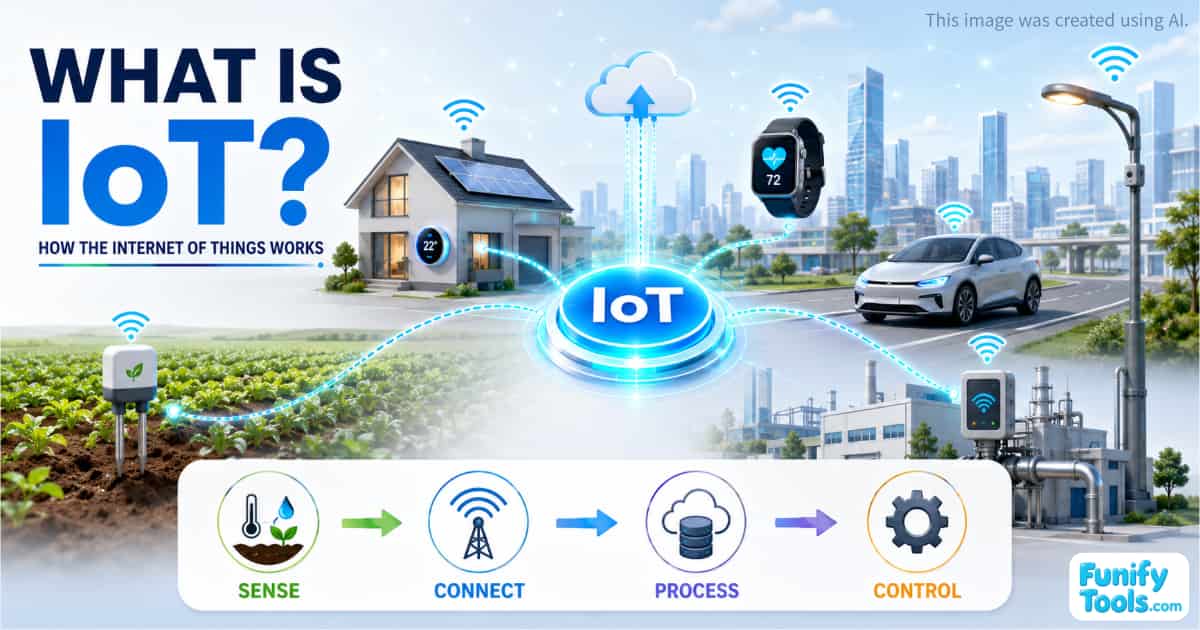
You suddenly wonder whether you locked the front door, so you check its status on your smartphone. Before arriving home, you turn on the air conditioner remotely. Meanwhile, the watch on your wrist automatically records your steps and heart rate.
These no longer feel like scenes from the distant future. They have become part of everyday life.
In the past, people had to check and control each device manually. Today, connected devices can exchange data and respond automatically. At the center of this change is a concept known as IoT.
What Does IoT Mean?
IoT stands for the Internet of Things.
The term may sound technical, but the basic idea is relatively simple. Internet connectivity is no longer limited to computers and smartphones. It now extends to physical objects such as lights, refrigerators, cars, sensors, door locks and industrial equipment.
In other words, the internet no longer connects only people and digital information displayed on screens. It can also connect physical objects, spaces and real-world conditions.
A connected device can detect what is happening around it, transmit that information and respond according to instructions or predefined conditions.
Why Is It Called the “Internet of Things”?
The most interesting word in the name may be “things.”
Why do we call it the Internet of Things instead of the Internet of Devices or the Internet of Machines?
The reason is its broad scope.
The word “device” usually suggests an electronic product, while “machine” brings to mind equipment with moving parts. “Thing” is much more inclusive.
It can refer to:
- A consumer electronic device
- A shipping box in a warehouse
- A component moving through a factory
- A sensor placed in agricultural soil
- A parking barrier
- A vehicle
- A medical monitor
- Almost any physical object whose condition can be identified or controlled
The term therefore describes more than the growing number of smart electronic products. It represents a world in which physical objects themselves become part of a network.
Where Did the Term IoT Come From?
The term “Internet of Things” is widely associated with British technology pioneer Kevin Ashton, who used it in 1999 while discussing the use of RFID technology in supply chains.
The idea behind the phrase reflected an important limitation of the early internet.
Traditional internet systems depended heavily on people to create and enter information. Someone had to type, upload, edit or record the data before a computer could process it.
IoT introduced a different approach.
Instead of relying on people to enter every piece of information manually, connected objects could use sensors to observe their surroundings and generate data automatically.
Temperature, humidity, location, brightness, motion, vibration and electricity usage could all be detected without constant human input. That data could then be analyzed and used to trigger an action.
From this perspective, IoT is more than a connectivity technology. It is a system that reads the physical world digitally and then uses digital decisions to create a response in the real world.
How Does IoT Work?
The basic IoT process can be summarized in four stages:
Sensing → Communication → Processing and Decision-Making → Control
Although real IoT systems can become highly complex, the underlying workflow is relatively easy to understand.
1. Sensors Detect What Is Happening
The process begins with a sensor or control module attached to a physical object.
Different sensors collect different types of information:
- Temperature sensors measure heat.
- Motion sensors detect movement.
- Light sensors measure brightness.
- GPS modules determine location.
- Vibration sensors monitor equipment movement.
- Smartwatches record heart rate and physical activity.
- Electricity meters measure power consumption.
The sensor converts a real-world condition into data that a digital system can process.
This is the first essential role of IoT: translating the physical world into digital information.
2. The Data Is Transmitted
Once the data has been collected, it must be sent somewhere.
The device may communicate through:
- Wi-Fi
- Bluetooth
- Ethernet
- LTE or 5G
- Low-power wide-area networks
- Other short- or long-range wireless technologies
The appropriate connection depends on the device, operating environment, required range, power consumption and amount of data being transmitted.
A smart light inside a home may use Wi-Fi or Bluetooth. A vehicle or remote monitoring system may rely on a cellular network. An industrial sensor might use a specialized low-power connection designed to operate for years on a small battery.
The important point is that the device does not simply operate in isolation. It exchanges information with another device or system.
3. The System Processes the Data
The collected data may be processed by a cloud server, a local server or an edge computing device positioned close to where the data was generated.
Sometimes the data is simply stored for later review. In many cases, however, the system compares it with predefined conditions and decides whether action is required.
For example:
- If the room temperature rises above a set level, the air conditioner turns on.
- If the temperature inside a refrigerator becomes unusually high, the user receives an alert.
- If a factory machine produces an abnormal vibration pattern, the system identifies a possible fault.
- If a motion sensor detects someone at the front door, a camera begins recording.
- If soil moisture falls below a certain level, an irrigation system activates.
AI is increasingly being added at this stage. Instead of responding only to simple rules, the system may learn patterns, identify unusual behavior and make more sophisticated predictions.
4. The Device Responds
After the system makes a decision, it sends an instruction back to the relevant device.
The device may then:
- Turn on or off
- Lock or unlock
- Change its operating mode
- Adjust a temperature
- Activate a motor
- Send a warning notification
- Record additional information
The full process can therefore be described in plain language:
The device senses, sends, decides and acts.
That is the basic operating principle behind many IoT systems.
A Simple Smart Home Example
Imagine a smart home equipped with a temperature sensor and a connected air conditioner.
The sensor measures the indoor temperature and sends the reading to an app, local controller or cloud service. The system compares the value with the user's preferred setting.
If the room is too warm, the air conditioner starts automatically. The user can check its current status through a smartphone and make adjustments remotely if necessary.
The process is:
Temperature detection → Data transmission → Condition check → Air conditioner control
To the user, the result may look as simple as the air conditioner switching on. Behind that action, however, several connected stages are working together.
Where Is IoT Used?
IoT is not limited to smart homes. Its applications now extend across everyday life and many industries.
Smart Homes
Connected lights, thermostats, door locks, cameras, appliances and energy meters can be monitored or controlled through apps and automated routines.
Healthcare
Smartwatches and medical devices can continuously collect information such as heart rate, activity levels and other health measurements.
This data may help users understand their habits or allow healthcare professionals to monitor patients more effectively when appropriate systems are in place.
Logistics
Connected tracking devices can provide information about the location and condition of goods.
Warehouses can use sensors and identification technologies to manage inventory, monitor storage conditions and improve the movement of products.
Agriculture
Sensors can measure soil moisture, temperature, humidity and greenhouse conditions.
Irrigation, ventilation and other equipment can then be controlled automatically based on those readings.
Manufacturing
Industrial IoT systems can monitor machinery in real time.
Unusual vibration, heat or power consumption may indicate that equipment is beginning to fail. Detecting these warning signs early can help prevent unexpected downtime.
Transportation
Vehicles contain numerous sensors and connected systems. Data can be used for navigation, diagnostics, maintenance, fleet management and safety features.
Smart Cities
Cities can connect parking systems, traffic signals, streetlights and environmental sensors to improve efficiency and monitor changing conditions.
These examples explain why the term IoT appears so frequently. It does not describe one product or function. It refers to a broad technological structure that can be applied throughout everyday life and industry.
IoT Is More Than Remote Control
At first glance, an IoT device may appear to be nothing more than an appliance that can be switched on or off from a smartphone.
Remote control is only one part of the technology.
A complete IoT system typically involves:
- Detecting a real-world condition
- Transmitting the resulting data
- Processing and interpreting the information
- Making a decision
- Controlling a device or notifying a person
The action visible to the user may be simple, but it is supported by an interconnected system of sensing, communication, processing and control.
That is what distinguishes a genuinely connected IoT system from a basic remote-controlled device.
Cloud and Edge Computing in IoT
Not all IoT data needs to travel to a distant cloud server.
In cloud-based processing, information is sent to remote servers where it can be stored, analyzed and accessed from different locations. This approach is useful when the system needs substantial computing power or centralized management.
Edge computing processes data closer to the device.
For example, an industrial controller may analyze sensor readings inside the factory rather than sending every measurement across the internet. This can reduce delays, lower network usage and allow essential functions to continue even when the external connection is unstable.
Many modern IoT systems combine both approaches:
- Immediate decisions are made locally.
- Long-term analysis and management take place in the cloud.
Why IoT Security Matters
As the number of connected devices increases, security becomes more important.
Every device connected to a network can potentially become another point of attack. A poorly protected camera, router, sensor or smart appliance may expose information or provide unauthorized access to other parts of the network.
IoT security concerns include:
- Weak or default passwords
- Outdated device software
- Unencrypted communication
- Poor access controls
- Devices that no longer receive security updates
- Insecure cloud accounts
- Unauthorized remote control
Users should change default passwords, install available updates and avoid connecting unnecessary devices to sensitive networks.
Manufacturers also need to provide secure designs and reasonable support periods.
Privacy, Compatibility, and Reliability
Security is not the only challenge.
IoT devices may collect sensitive information about a person's location, daily routine, health or energy use. This creates important privacy questions about what data is collected, where it is stored and who can access it.
Compatibility is another practical concern. Products from different manufacturers may use different apps, communication methods or smart-home platforms. A device may work well within one ecosystem but have limited compatibility with another.
Network reliability also matters. If an IoT product depends entirely on an internet connection or cloud service, some features may stop working during a network outage or after the manufacturer ends support.
IoT therefore involves a trade-off. Greater connectivity can deliver convenience and efficiency, but security, privacy, compatibility and long-term reliability must also be considered.
IoT Is Already All Around Us
The Internet of Things can sound like a grand technology from the future. In reality, it is already present throughout daily life.
The watch on your wrist, the lock on your front door, the sensors in your car, an unmanned store system and a package-tracking device may all operate using IoT principles.
The most important point is not simply that an object is connected to the internet.
The real significance of IoT is that connected objects can detect changes in the physical world, share that information and respond to it.
Take a look around your home or workplace. You may discover that you are already surrounded by more IoT devices than you expected.
Thank you for reading. Stay happy!
This article is also available in Korean: Read the Korean version