Today, we are going to explore the concept of a digital twin and look at how the technology is being used across different industries.
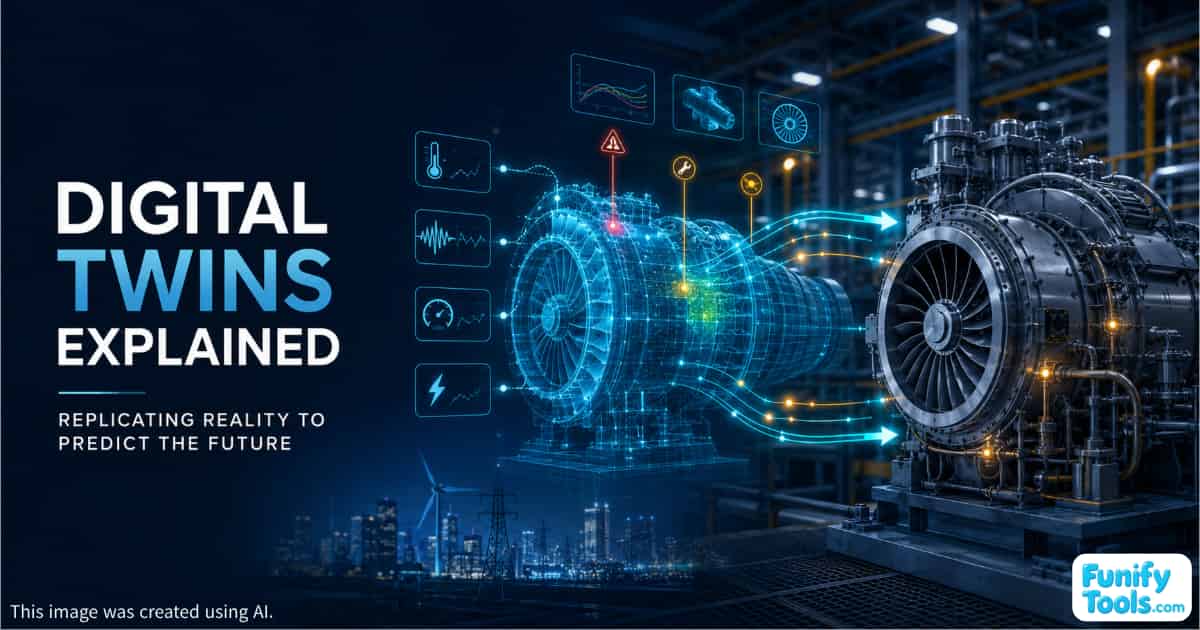
A digital twin is a virtual replica of a real-world object, process, or system. It continuously receives data from its physical counterpart, allowing users to monitor its current condition and simulate what might happen in the future.
The key point is that a digital twin is not simply a static 3D model. Sensors and Internet of Things devices continuously send real-world data to the digital model, allowing it to change alongside the physical system. In that sense, it is a living virtual representation of something that exists in the real world.
The Origins of Digital Twin Technology
The roots of the digital twin concept go back further than many people realize.
During the Apollo program, NASA created detailed ground-based replicas and simulations of spacecraft systems. Engineers used these “living models” to recreate possible emergencies and test potential responses without placing astronauts or equipment at additional risk.
This approach reportedly played an important role during the Apollo 13 accident, when engineers used modeling and simulation to develop strategies for bringing the crew home safely.
Modern digital twins build on the same basic principle. The difference is that today's systems benefit from much greater computing power, advanced sensors, cloud platforms, and real-time data connections. As a result, digital twins can represent physical systems with far more detail and update them much more quickly.
Why Digital Twins Are So Powerful
The greatest strength of a digital twin is its ability to support prediction.
Suppose a factory creates a digital twin of a critical machine. Sensors can continuously collect information such as temperature, vibration, pressure, and electricity consumption.
As more data accumulates, the system can identify patterns that often appear before a failure. Maintenance teams can then inspect or replace components before the machine breaks down. This approach is known as predictive maintenance.
A company can also create a digital twin of an entire production line. Before changing the real process, engineers can test the proposed change virtually and examine whether it might create a bottleneck, reduce output, or introduce a safety issue.
The technology has become important enough in manufacturing that international standards now define common frameworks for developing and operating digital twins.
ISO 23247
ISO 23247 is an international standard that defines a digital twin framework for manufacturing.
It provides general principles, a reference architecture, and guidelines for creating digital representations of manufacturing elements. These elements may include products, production processes, equipment, and other resources.
The standard helps organizations create and maintain multidimensional models that describe the current condition of physical manufacturing systems.
Standards such as ISO 23247 are important because a digital twin often needs to combine data from many different machines, sensors, software platforms, and vendors. A shared framework makes it easier for those components to exchange information consistently.
Digital Twins in Manufacturing
Manufacturing remains one of the most practical areas for digital twin technology.
A factory can create virtual representations of individual machines, production lines, or even an entire facility. These models can then be used to monitor performance, test changes, and identify potential problems before they affect real production.
Common applications include:
- Predicting equipment failures
- Optimizing maintenance schedules
- Detecting production bottlenecks
- Testing changes to factory layouts
- Reducing energy consumption
- Improving product quality
- Training workers in simulated environments
- Evaluating safety procedures
Instead of stopping a production line to test every idea, engineers can first examine the likely outcome inside the digital twin.
This does not eliminate the need for real-world testing, but it can reduce unnecessary downtime, lower costs, and help teams identify risks earlier.
Digital Twins in Energy
Digital twins are also becoming increasingly important in the energy industry.
Power plant turbines, boilers, transformers, and other essential equipment often need to operate continuously. Even a small decline in efficiency or a minor abnormality can lead to financial losses, safety risks, or an unexpected shutdown.
By creating a digital twin of critical equipment, operators can continuously monitor data such as:
- Temperature
- Vibration
- Pressure
- Power output
- Fuel consumption
- Efficiency
- Component wear
The twin can show whether the equipment is operating within its normal range and identify where performance may be gradually deteriorating.
Once enough historical data has been collected, the model may detect patterns that repeatedly appear before a failure. It can then issue an early warning or estimate when a particular component is likely to reach the end of its useful life.
This makes it possible to schedule maintenance when it is actually needed rather than relying only on a fixed timetable.
In the energy sector, the digital twin is becoming a real-time optimization tool designed to extend equipment life, increase availability, improve safety, and reduce operating costs.
Digital Twins for Cities
Digital twin technology is also expanding beyond factories and industrial equipment.
At the city level, digital twins can bring together transportation, disaster-response, environmental, population, infrastructure, and energy data to create something resembling an urban operations simulator.
The goal is not simply to display the city's current condition. A city-scale digital twin can also be used to test possible future scenarios.
For example, planners may be able to simulate:
- Which neighborhoods would flood first during heavy rainfall
- How nearby traffic would change if a major road were closed
- Whether a new traffic signal system would reduce congestion
- How emergency evacuation routes would perform
- Where rescue personnel and equipment should be positioned
- How air pollution may spread at different times of day
- Which areas are most vulnerable to the urban heat island effect
- How new buildings may affect wind, shade, and energy use
Seoul has also been exploring highly detailed urban digital twins to improve disaster response and transportation policy.
Emergency evacuation routes and the placement of rescue resources can be tested in advance. Changes to traffic signals in frequently congested areas can also be evaluated virtually before they are introduced on real roads.
Another example is Naver's work on digital twin platforms for major cities in Saudi Arabia. Projects like this show that the technology is moving beyond individual factories and companies into national infrastructure and large-scale urban planning.
Cities are too complex to use as uncontrolled testing environments. A digital twin allows planners to test ideas in a virtual setting, identify risks, and search for better solutions before making changes in the real world.
Digital Twins in Healthcare
The potential use of digital twins in healthcare is also growing rapidly.
This goes far beyond creating a simple 3D image of the human body. A medical digital twin may combine a patient's CT scans, MRI images, blood test results, genetic information, medical history, and real-time biological signals to create a personalized virtual model of an organ or body system.
For a patient with heart disease, for example, doctors could create a digital model of the heart's structure and blood flow. They could then simulate how different medications or procedures might affect blood pressure, circulation, and the workload placed on the heart.
In cancer treatment, researchers are studying whether digital models can help simulate tumor growth and predict how an individual patient may respond to different therapies.
The long-term goal is to move away from treatment based only on an average patient and toward care designed around a virtual representation of one specific person.
For this reason, digital twins are frequently discussed as a potentially important foundation for personalized medicine.
Medical applications, however, require an especially high level of accuracy, privacy protection, clinical validation, and professional oversight. A digital twin may support a doctor's decision, but it should not be treated as a guaranteed prediction or a replacement for medical judgment.
A Rapidly Growing Market
The digital twin market is expanding alongside the technology's range of applications.
McKinsey and other research organizations have projected strong growth over the coming years, with the market expected to reach many billions of dollars. Estimates vary significantly depending on how researchers define a digital twin and which industries they include.
The precise number is therefore less important than the broader direction.
Across manufacturing, energy, transportation, healthcare, construction, and urban planning, organizations are increasingly adopting the same basic approach: test reality in a virtual environment before making costly or dangerous changes in the physical world.
That approach could become standard practice in many industries.
Digital Twins Depend on Reliable Data
A digital twin can be useful only when its data and connections are reliable.
If sensor readings are inaccurate, the virtual model will not correctly represent the physical system. If real-world changes are reflected too slowly, the twin may make predictions based on outdated conditions.
Organizations therefore need to pay close attention to:
- Sensor accuracy
- Data quality
- Update frequency
- System integration
- Model validation
- Access control
- Cybersecurity
- Data ownership
- Operational responsibility
- Long-term maintenance
Security is particularly important because digital twins may be connected to critical infrastructure.
If an attacker gains access to a twin, the exposed information could reveal how a factory, power facility, transportation network, or medical system operates. In some cases, a compromised connection could also affect the physical equipment linked to the model.
Clear governance is therefore essential. Organizations need to define who may access the twin, who verifies the data, who approves operational changes, and who is responsible when a prediction proves inaccurate.
More Than a Beautiful Virtual Copy
A digital twin should not be understood as an impressive-looking 3D replica.
Its real value comes from the continuous connection between the physical and digital worlds. That connection makes it possible to understand current conditions, test alternative decisions, predict potential failures, and improve real-world operations.
Without trustworthy data and a meaningful operational purpose, a detailed 3D model is still only a model.
A true digital twin becomes valuable when it helps people answer practical questions:
- What is happening now?
- Why is it happening?
- What is likely to happen next?
- What would change if we made a different decision?
- How can we reduce cost, risk, or downtime?
Final Thoughts
Digital twin technology is evolving beyond simply reproducing the physical world in a virtual environment. It is becoming a way to manage reality more effectively and predict what may happen next.
Factories can use digital twins to prevent equipment failures. Energy companies can optimize essential machinery. Cities can test transportation and disaster-response plans. Medical researchers can explore more personalized approaches to treatment.
In the future, increasingly complex systems—including weather, climate, ecosystems, and even the Sun—may be studied through digital twin technology.
Understanding this concept can therefore help us follow some of the most important changes taking place across technology and industry.
A digital twin is ultimately not just a virtual copy. It is a tool for learning from the real world, experimenting more safely, and making better-informed decisions about the future.
Thank you for reading, and I hope you have a wonderful day!
This article is also available in Korean: Read the Korean version