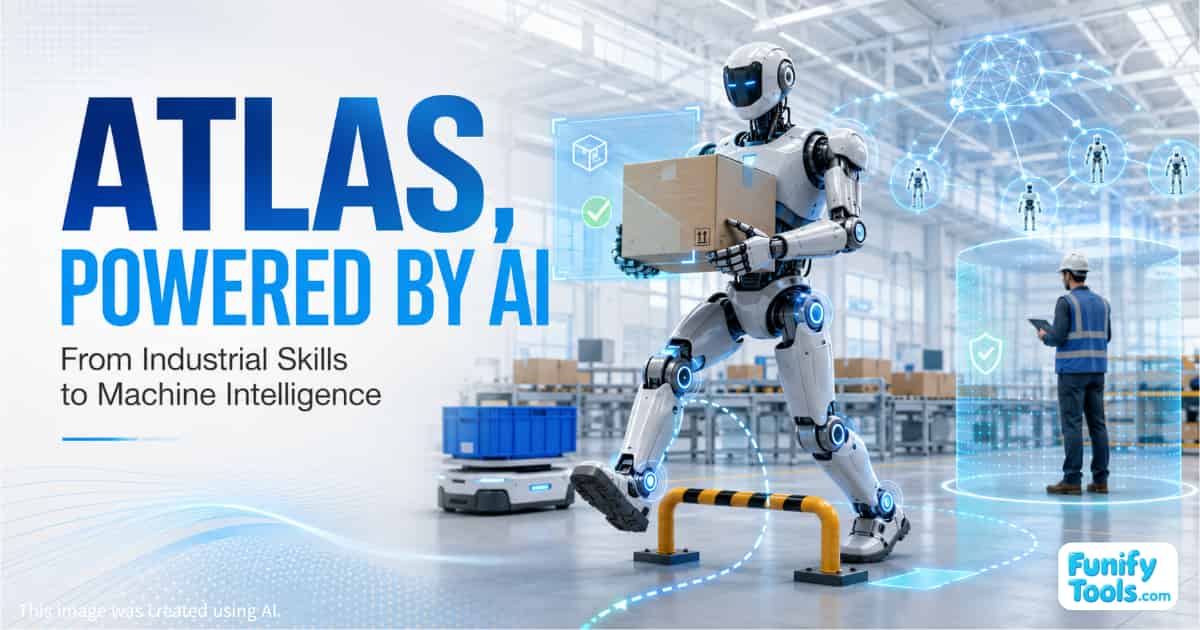
Most people have a similar reaction the first time they see Boston Dynamics' humanoid robot Atlas :
“Can a robot really move like that?”
Videos of Atlas performing backflips, running, twisting its body, and recovering its balance have circulated widely online. But these demonstrations were about much more than showing that a robot could walk on two legs.
They demonstrated that a machine could use its entire body to maintain balance.
When people slip, they do not correct their footing alone. They swing their arms, rotate their hips, lower their upper body, and shift their center of gravity. Atlas was designed to perform this kind of coordinated whole-body movement mechanically.
From Research Demonstrations to Industrial Work
The direction of Atlas has recently become even more interesting.
Earlier versions of Atlas were best known as the stars of robotics demonstrations. The latest version, however, appears much more closely aligned with practical industrial applications.
The move from a hydraulic system to an all-electric design is particularly significant. Hydraulic systems can generate tremendous power, but they may also create additional maintenance and operational demands.
In an industrial environment, the important question is not simply, “Did it work?” It is:
“Can it keep working reliably every day?”
The transition to electric actuation therefore appears to be more than a technical showcase. It suggests that Atlas is being prepared for environments where reliability, maintenance, energy efficiency, and repeatability matter.
Making a robot perform an impressive movement once is difficult. Making it repeat that movement thousands of times without failure is much harder—and far more commercially valuable.
What Changes When Atlas Gets AI?
This naturally leads to a fascinating question:
What would happen if Atlas were equipped with sufficiently capable AI?
The short answer is that the robot could become increasingly capable of learning and adapting in real working environments.
Many traditional industrial robots are called robots, but they function more like automated machines. They repeatedly follow predefined paths, timings, and instructions programmed through a process commonly known as teaching.
These systems work extremely well when everything remains predictable:
- The object is always in the same position.
- The angle never changes.
- The component always has the same shape.
- The surrounding environment stays clear.
Real factories, however, are rarely that consistent.
A cardboard box may be dented. A component may be slightly rotated. Floor friction may change. An employee may walk beside the work area. An object may slip or appear somewhere unexpected.
AI changes the nature of the robot's behavior. Instead of being a machine that accurately repeats a predefined movement, it can become a system that observes its surroundings, evaluates the situation, and selects an appropriate action.
Better visual recognition could help it locate objects more quickly. Improved grasping intelligence could reduce the chances of dropping slippery or irregular packaging. If an action failed, it could choose a more appropriate way to try again.
In simple terms, it might respond in a way that resembles:
“That angle did not work. I should adjust my hand position and try again.”
That ability to adapt is one of the most important differences between traditional automation and AI-powered robotics.
One Robot's Experience Could Improve an Entire Fleet
Perhaps the most revolutionary possibility is that learning would not have to remain inside one individual robot.
Suppose one Atlas robot discovered a better way to perform a task in a particular factory. That experience could potentially be converted into software, validated, and distributed to other Atlas robots.
It would be similar to one employee discovering a useful technique and instantly transferring that practical knowledge to every worker in the company—without requiring each person to learn it independently.
If this model becomes practical, the way companies deploy robots could change dramatically.
In the past, each factory often required lengthy customization, teaching, testing, and commissioning. In the future, robots may be able to learn within a new environment relatively quickly, while validated improvements are distributed across the entire fleet.
This would make industrial automation easier to scale. A capability learned in one location could eventually improve performance in warehouses and factories elsewhere.
Of course, transferring learned behavior is not as simple as installing an ordinary software update. Differences in factory layouts, tools, components, lighting, and safety requirements would still need to be considered. New behaviors would require careful testing before being widely deployed.
Even so, fleet-level learning could become one of the most important advantages of intelligent robots.
Greater Intelligence Requires Stronger Safety Systems
The more adaptable a robot becomes, the more important its safety systems become.
In a factory, a single incorrect movement can result in damaged equipment or a serious accident. AI-generated actions therefore cannot simply be executed without restrictions.
An industrial humanoid would need several independent layers of protection, including:
- Speed and force limits
- Collision detection and avoidance
- Restricted operating zones
- Emergency-stop systems
- Continuous equipment monitoring
- Human oversight
- Fail-safe behavior during sensor or communication failures
The most realistic near-term model is therefore probably not complete autonomy. It is supervised autonomy.
Under this approach, robots would operate independently within clearly defined boundaries established by people, equipment, and workplace safety systems. Their permitted range of actions could gradually expand as the technology proves itself.
Even within those constraints, the changes could be enormous.
The Three Laws of Robotics—and Their Limits
At this point, it is difficult not to think about the film I, Robot and Isaac Asimov's famous Three Laws of Robotics.
The principles can be summarized as follows:
- A robot must not harm a human or allow a human to be harmed through inaction.
- A robot must obey human instructions unless doing so would conflict with the first rule.
- A robot must protect itself as long as that protection does not conflict with the first two rules.
These laws are compelling because they make robot safety appear simple and logically ordered. In reality, however, physical environments are filled with ambiguity.
What should a robot do if preventing one person from being injured increases the risk to someone else? How should it interpret a vague instruction? What qualifies as harm? Who becomes responsible if the robot acts on incomplete or misleading information?
Real robotic safety cannot depend on three natural-language rules alone. It requires engineering safeguards, clearly defined authority, continuous verification, legal accountability, and limits on what the AI is allowed to do.
Could a Robot Develop a Sense of Self?
This leads to an even more difficult question: Could a robot eventually possess a sense of self?
The answer depends heavily on what we mean by “self.”
A robot that behaves as though it has a self is certainly possible. Many of the necessary capabilities already exist in early forms, and development roadmaps increasingly point in that direction.
A robot could maintain an internal model of its own condition. It could accumulate experiences as memories, establish goals, revise its plans, and explain the reasons behind its decisions.
If a robot said:
“I made a mistake just now. Next time, I will approach the object differently.”
people could easily begin to feel as though there were someone inside the machine.
The more naturally it communicates, the stronger that impression would become.
But behaving as though it has a self is not the same as having subjective experience.
A robot may speak and act convincingly without actually feeling anything. At the same time, it is difficult to prove conclusively that it has no internal experience whatsoever.
Science and philosophy still do not have a universally accepted test for consciousness. We do not yet have a reliable method for determining whether a sufficiently advanced artificial system genuinely experiences the world or merely produces behavior that resembles conscious experience.
The most honest conclusion may therefore be:
Robots that appear to possess a sense of self will increasingly become a reality, but we still lack sufficient evidence to say that they are genuinely conscious.
That does not mean machine consciousness is impossible. It simply means that there is not yet enough evidence to make such a claim—and no decisive proof that completely rules it out.
Atlas May Become a Mirror for Humanity
The story of Atlas is unlikely to end with industrial automation.
Once the goal becomes creating a robot that moves more like a person, the robot naturally begins to reflect human abilities back at us.
Maintaining balance, recovering from a misstep, manipulating objects with precision, and adjusting movement in response to changing conditions are all remarkable achievements in mechanical engineering.
But people will quickly look beyond movement and begin asking about intention.
Was a particular action merely the result of sensors, control software, and statistical prediction? Or did the robot understand the situation and make a meaningful choice?
As robotic technology becomes more advanced, the larger question may not be whether machines can behave intelligently. It may be whether we can agree on what counts as thought, consciousness, and identity.
Is a self defined by continuity of memory? Is it the ability to feel pain and pleasure? Is it the ability to set independent goals? Does it require empathy and an understanding of other minds? Or is consciousness some combination of all these qualities?
Without clear standards, it becomes difficult to decide where responsibility belongs, what deserves protection, and where the boundary between a tool and an autonomous agent should be drawn.
When Humanoid Robots Become Part of Everyday Work
We may soon begin seeing humanoid robots quietly working in factories and logistics centers.
They may carry boxes alongside employees wearing safety helmets, adjust their routes to avoid narrow passages, retrieve fallen objects, and respond to unexpected changes in their surroundings.
When that becomes an ordinary sight, industrial workplaces will begin to feel very different. People may benefit from safer and less physically demanding work, while also feeling increasingly uncertain about the machines operating beside them.
The more naturally a robot performs its job, the more likely people will be to ask:
“Is that robot actually thinking?”
Depending on how we define thought and identity, Atlas may remain an extremely sophisticated machine—or eventually be viewed as a new kind of coworker.
If that day arrives, it will be exciting, transformative, and perhaps a little unsettling.
Thank you for reading, and I hope you have a wonderful day!
This article is also available in Korean: Read the Korean version