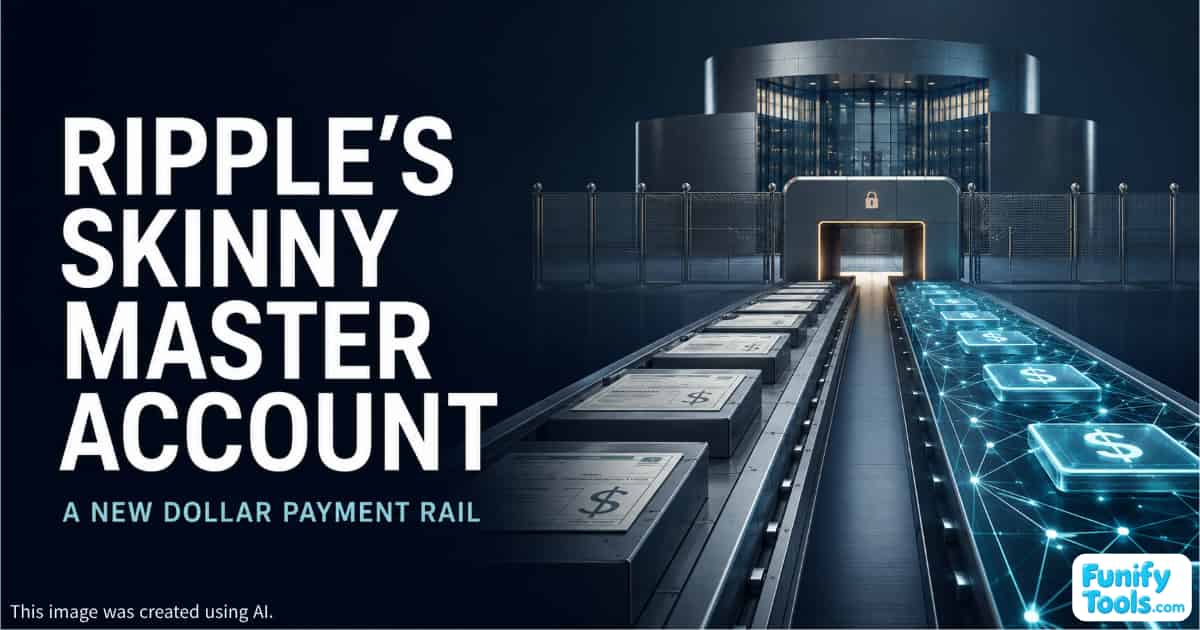
A New Payment Rail That Could Run Alongside the Existing US Dollar System
Warning
This article discusses the subject from a technology and payment-infrastructure perspective. It is not investment advice and should not be used to make investment decisions.
In a Reuters interview published on November 6, Ripple—the company closely associated with XRP—expressed support for the idea of a so-called “skinny” master account for nonbank institutions.
Ripple's argument is that even limited direct access to the Federal Reserve's payment infrastructure could significantly improve the speed and cost of redeeming RLUSD, its US dollar-backed stablecoin.
Ripple applied for a Federal Reserve master account in July. If the skinny-account model becomes a reality, the company believes it could convert reserve assets, including US Treasuries, more quickly and process redemptions more efficiently without depending as heavily on intermediary banks.
What Is a Skinny Master Account?
The central idea comes from a prototype proposed by Federal Reserve Governor Christopher Waller on October 21.
A skinny master account would give eligible institutions access to the Federal Reserve's payment rails while withholding many of the benefits available to traditional banks. These accounts would not earn interest, could be subject to balance limits, and would not have access to the discount window. Daylight overdrafts and other forms of central-bank credit would also be restricted or prohibited.
Put simply, the model would allow an institution to make payments more directly without turning it into a bank.
This distinction is important. The proposal is not intended to grant nonbanks the full privileges of federally regulated banking institutions. Instead, it would create a narrower form of access focused primarily on settlement and payment processing.
Why It Matters for RLUSD
Ripple has recently placed greater emphasis on operating within regulated financial frameworks.
The company presents RLUSD as fully backed by cash and cash-equivalent reserve assets, issued on both the XRP Ledger and Ethereum, and redeemable for US dollars on a one-to-one basis.
If Ripple gained access to a skinny master account, it could potentially move reserve assets through Federal Reserve payment systems without routing every transaction through an intermediary bank. This could increase the speed, reliability, and efficiency of RLUSD redemptions.
In that environment, XRP's potential function as a bridge could become clearer. It could help connect regulated dollar liquidity with digital-asset liquidity on the XRP Ledger.
In other words, the policy focus would shift toward infrastructure that can connect a stable, tokenized dollar payment rail with a broader crypto-asset rail.
A Tokenized Dollar Rail Alongside the Existing System
If skinny master accounts are introduced, regulated stablecoins such as RLUSD could become more directly connected to Federal Reserve payment infrastructure.
That connection could make reserve management and redemptions more efficient. Users might be able to send and receive dollar-linked tokens with lower costs and shorter settlement times, without relying entirely on card networks or conventional money-transfer systems.
The result would not necessarily be a replacement for the existing dollar system. Instead, a tokenized dollar rail could begin operating alongside the cash and deposit-based rails that already dominate the economy.
Banks would continue to perform essential functions such as holding retail deposits, providing deposit insurance, and creating credit through lending. Tokenized dollars, however, could introduce stronger competition within the payment layer through immediate redemption and on-chain transferability.
This would not create a new currency that replaces the dollar. It would create another container—and another delivery system—for the same dollar value.
What Should We Watch?
Several policy and market questions will determine whether this model becomes practical.
1. How Narrow Will the Access Be?
The first issue is scope.
Balance limits, the absence of interest payments, and restrictions on overdrafts could significantly affect the operating costs and commercial viability of stablecoin issuers.
If the limits are too restrictive, direct access may provide only modest benefits. If they are too broad, regulators and banks may argue that nonbank institutions are receiving bank-like advantages without being subject to the same obligations.
The final design will therefore need to establish a careful boundary between payment access and banking privileges.
2. Will Reserve Transparency Keep Pace?
As redemption infrastructure becomes stronger, expectations surrounding reserve transparency and governance will rise as well.
Stablecoin issuers will need to disclose what assets support their tokens, where those assets are held, and how frequently they are independently verified. Users and regulators will also want clear procedures explaining what happens during periods of unusually high redemption demand.
Direct access to central-bank payment infrastructure could improve technical efficiency, but it would also bring greater scrutiny. Faster settlement cannot compensate for unclear reserve management.
3. How Will Banks Respond?
The reaction of the banking industry will be another major factor.
Allowing nonbanks to access Federal Reserve payment systems directly has already raised concerns about competition, financial stability, regulatory consistency, and the possible movement of funds away from traditional bank deposits.
The skinny model is intended to reduce those concerns by limiting the privileges available to participating institutions. Whether those safeguards are sufficient may determine whether the proposal moves from a prototype to an operational system.
Ripple's Strategy Is Increasingly About Regulation
Ripple's approach now appears to place as much emphasis on institutional design as it does on technology.
A skinny master account could allow the company to participate in core payment infrastructure without receiving all the privileges of a traditional bank. That could improve settlement and redemption while preserving a distinction between stablecoin issuers and deposit-taking institutions.
The US dollar has long maintained trust through a system that separates different responsibilities across the Treasury, the Federal Reserve, commercial banks, and other regulated institutions. Tokenized dollars could potentially develop along similar lines if payment access, reserve obligations, and institutional privileges are clearly separated.
The central questions are where regulators draw the safety boundaries and how much transparency they require from issuers.
If regulation catches up with the technology, the liquidity connection between XRP and RLUSD could support more real-world payments. The likely outcome would not be a dollar replacement, but an additional payment rail capable of moving dollar-denominated value across blockchain networks more quickly.
Thank you for reading, and I hope you have a wonderful day!
This article is also available in Korean: Read the Korean version