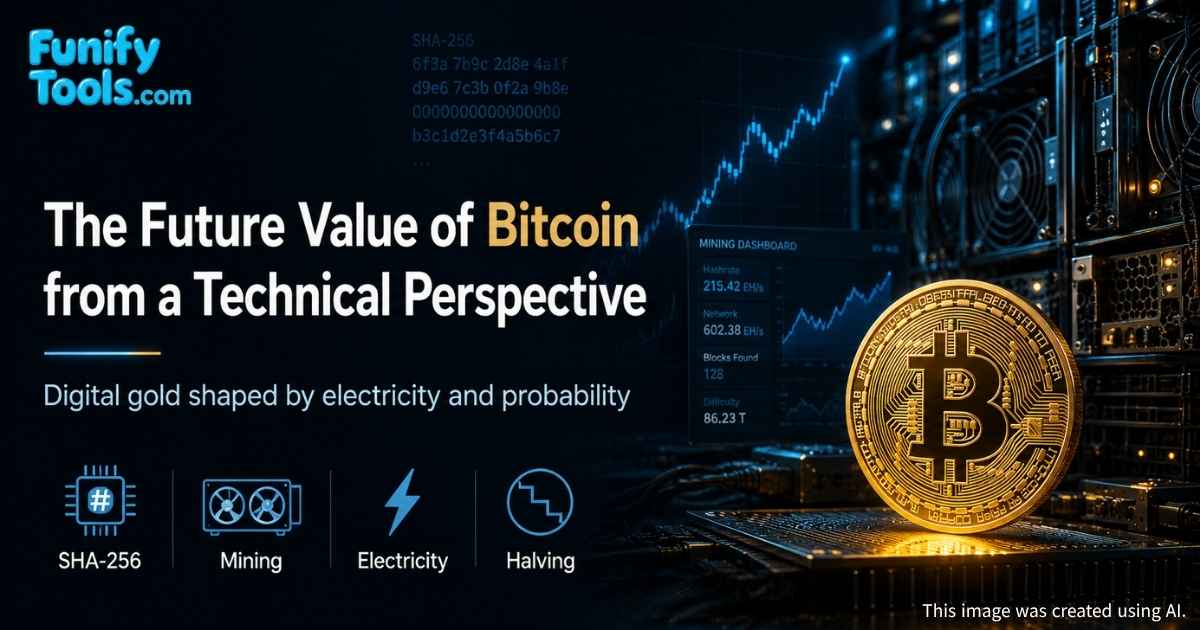
Bitcoin as a Technological System
Today, let us explore Bitcoin not as an investment, but as a technological system. Recently, Bitcoin (BTC) broke past $125,000, setting a new all-time high in the original context of this article.
Price naturally attracts attention, but Bitcoin is more than a price chart. If we take a closer look at how its system is sustained, we can understand why people often describe it as digital gold, a settlement network, an energy-based security system, or a probability machine.
This article is not financial advice. I am not recommending that anyone buy, sell, or hold Bitcoin. In fact, as I said in the original note, I have never made a single cent trading crypto. Please read this purely as a technical observation about how Bitcoin works and why its design creates certain economic pressures.
The interesting part of Bitcoin is that its value story is connected to code, electricity, incentives, and trust. Unlike a normal app, Bitcoin does not depend on one company server. It depends on many independent participants choosing to keep the system running because the rules reward them for doing so.
Bitcoin Is Not Solving Math Problems
Many people describe Bitcoin mining as "solving mathematical problems." That phrase is common, but it can be misleading.
In reality, Bitcoin mining is not about calculating a logical answer in the way we solve an equation at school. It is closer to randomly guessing until one guess happens to satisfy the network's difficulty target.
Each guess produces a SHA-256 hash. A hash is like a digital fingerprint generated from input data. Miners repeatedly change a small value called a nonce and run the data through SHA-256 again and again. Most results fail. One result eventually fits the required pattern.
That is why mining is often compared to a lottery. The miner does not become smarter with each attempt. The miner simply makes more attempts. The more computing power a miner controls, the more lottery tickets that miner effectively buys every second.
In other words, Bitcoin mining is a lottery with far worse odds than winning Powerball. A successful block requires an astronomical number of random attempts, but the network keeps trying because countless machines around the world participate at the same time.
I will write another article later explaining SHA-256 in more detail.
A Miracle Every Ten Minutes
Mining success probability is often described with numbers so large that they stop feeling real. The original article used an example around 1 in 83,000,000,000,000, or approximately 1.2 x 10^-14. The exact odds shift with network difficulty, but the point remains the same: a single attempt is almost hopeless.
Yet on average, a new block is mined every 10 minutes. That means someone finds a valid hash about every 10 minutes, even though each individual guess has nearly impossible odds.
How is that possible? Because Bitcoin is not one person rolling dice slowly. It is a global network of specialized machines making billions or trillions of guesses per second. The miracle is not magic. It is scale.
The network adjusts the difficulty so that blocks keep arriving around the same rhythm. If more miners join and total computing power rises, the puzzle becomes harder. If miners leave and computing power falls, the difficulty adjusts downward. This feedback loop is one of Bitcoin's most important design features.
That steady 10-minute rhythm is what allows Bitcoin to keep a predictable issuance schedule. New coins are not released because a central manager decides to print more. They are released according to rules enforced by software and economic participation.
Bitcoin Runs on Electricity
The Bitcoin network functions because miners, computers performing proof-of-work, keep operating. Those machines need hardware, cooling, maintenance, physical space, network connections, and most importantly, electricity.
Simply put, Bitcoin lives on electricity. Proof-of-work converts electrical energy into computational attempts, and those attempts secure the chain by making attacks expensive. To rewrite history, an attacker would need enormous computing power and energy. That cost is part of the security model.
If the cost of electricity becomes unbearable and miners shut down, the network does not instantly disappear, but hash rate can fall and difficulty eventually adjusts. The system is designed to adapt, yet miners still need economic motivation. They must earn enough from block rewards and transaction fees to justify operating costs.
This is why Bitcoin is often discussed as an energy-backed digital ecosystem. The electricity is not stored inside each coin like a battery, but energy expenditure is deeply connected to how blocks are produced and secured.
Why the Design Creates Price Pressure
As more miners join, competition rises. Higher competition often means more hardware, more electricity, and thinner margins. To restore profitability, either miners must become more efficient, electricity must become cheaper, fees must rise, or Bitcoin's market price must support the cost of mining.
That is why the original article says Bitcoin's economic design naturally creates upward price pressure. This does not mean the price must always rise in a straight line. Markets can fall sharply, sentiment can change, regulations can shift, and miners can be forced out. But structurally, the system rewards miners only if the block reward and fees are valuable enough to cover real-world costs.
Over time, electricity prices, mining hardware efficiency, hash rate competition, and the halving schedule all interact. The breakeven price for miners is not fixed. It moves with technology and market conditions.
This is the important nuance: Bitcoin's design may encourage a higher long-term valuation if demand and trust remain, but it does not guarantee short-term price movement. Technology explains pressure and incentives, not certainty.
The Countdown to the Last Satoshi
Bitcoin's total supply is capped at 21 million coins. Every four years or so, mining rewards are cut in half through the famous halving. This means the amount of new Bitcoin entering circulation gradually decreases.
This process will continue until around the year 2140, when the final Bitcoin is expected to be mined. After that, there will be no new Bitcoin block rewards. Miners will only earn transaction fees for confirming blocks.
Example: Block #917,892
3.125 BTC base reward + 0.00811197 BTC fees = 3.13311197 BTC total
In the far future, the base reward disappears. That means the security budget must come from transaction fees alone. This is one of the biggest long-term questions in Bitcoin's design.
If transaction fees are too low, miners may have less incentive to secure the network. If fees are high enough, users must decide whether Bitcoin settlement is valuable enough to pay for. The system can still work, but it depends on whether people continue to treat Bitcoin block space as something worth buying.
For miners to stay online in a fee-driven future, those fees must be worth enough to cover operating costs. That can happen through higher fee volume, higher Bitcoin value, more efficient mining, or a combination of all three. Only if the network's total value and usefulness remain meaningful can the ecosystem stay sustainable.
Technically Speaking: It Is Built to Rise, But Not Guaranteed
If two conditions hold true:
- People continue to care about Bitcoin
- Its security model remains trustworthy, with no fatal hacks or design failures
Then, regardless of short-term volatility, Bitcoin's structure can support a long-term upward argument. Scarcity, halvings, energy cost, miner incentives, and global liquidity all contribute to that narrative.
However, the word "built" should be used carefully. Bitcoin is built with scarcity and proof-of-work. It is not built with a guaranteed future price. A system can have strong incentives and still face market cycles, political pressure, technological disruption, or changes in public attention.
A better way to say it is this: Bitcoin's structure creates conditions where value must be meaningful for the system to remain secure and attractive. Whether the market continues to assign that value is the open question.
But There Are Wildcards
Of course, reality is never simple. Several potential disruptions could alter the path entirely:
- A sudden collapse in public interest
- A catastrophic failure that undermines trust
- Quantum computers or future cryptographic threats requiring protocol adaptation
- A new technology changing how proof-of-work economics are understood
- Regulatory pressure that limits access or liquidity
- Energy politics that reshape where and how mining can operate
Any one of these could destabilize Bitcoin's delicate balance. That is why rather than predicting price with confidence, we should continually study how the structure evolves.
The most interesting question is not only "How high can Bitcoin go?" It is also "What conditions must remain true for Bitcoin to keep functioning as a trusted global network?" That question is more technical, and in many ways, more useful.
Bitcoin as an Energy-Backed Digital Ecosystem
In the end, Bitcoin is not just a speculative asset. It is an ecosystem sustained by probability, energy, mathematics, incentives, and social trust.
Its design seems to encourage each coin's value to remain above a certain threshold, because mining, security, and settlement all depend on economic incentives. The value is not only a number on an exchange. It is connected to the total energy, hardware, time, and coordination invested into maintaining the network.
No one knows how high that value might go, and no technical explanation can remove risk. But one thing is clear: Bitcoin's worth lies not merely in price, but in the total system of energy, computation, scarcity, and trust it embodies.
Thank you for reading, and may your day be full of positive energy.
This article is also available in Korean: Read the Korean version