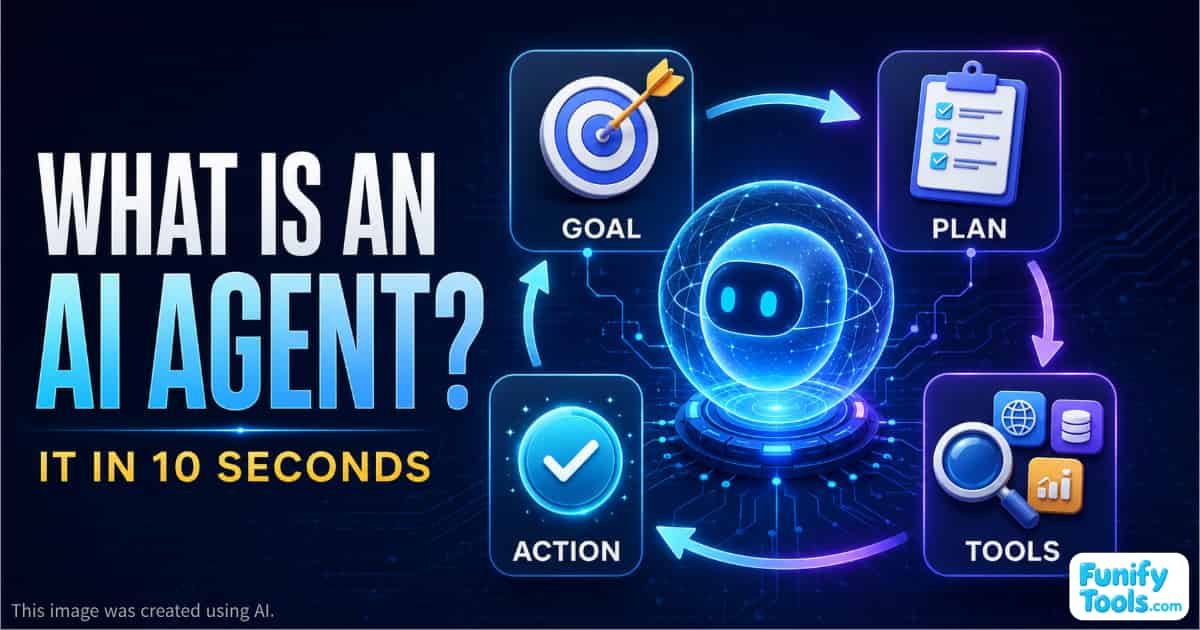
The 10-Second Explanation
An AI agent is more than an AI that answers questions.
Give it a goal, and it can plan the necessary steps, gather information, make decisions and carry out tasks using available tools.
A chatbot mainly responds.
An AI agent works toward an outcome.
What Is an AI Agent?
An AI agent is a system that can understand a goal, decide what needs to be done and take a series of actions to complete the task.
A conventional AI chatbot usually waits for a user to ask a question and then generates an answer. An AI agent can go beyond that response. Depending on the tools and permissions available to it, it may search for information, organize data, create documents, update schedules or interact with other software.
For example, imagine asking an AI to help you prepare for a business trip.
A regular chatbot might provide a checklist of things you should do. An AI agent could potentially take the request further by researching transportation, comparing possible schedules, organizing the findings and preparing an itinerary.
The important difference is that the agent works toward a goal instead of producing only a single response.
How Is It Different from a Chatbot?
Chatbots and AI agents often use similar AI models, but they are designed to work differently.
A chatbot is mainly optimized for conversation. It answers questions, explains concepts, summarizes text and helps users develop ideas.
An AI agent is more action-oriented. It can determine which steps are required, choose an appropriate tool, evaluate the result and continue to the next step.
The distinction can be summarized simply:
- A chatbot tells you how to do something.
- An AI agent may help carry it out.
- A chatbot responds to a prompt.
- An AI agent works toward a goal through multiple steps.
The boundary is not always completely clear. Modern chatbots can also use tools and perform tasks. When a conversational AI begins planning and completing connected actions with some independence, it starts behaving more like an agent.
How Does an AI Agent Work?
An AI agent generally follows a process similar to this:
1. It Understands the Goal
The agent first identifies what the user wants to accomplish.
A request such as “Help me prepare for tomorrow's meeting” is not a single action. It may involve checking the meeting topic, finding related documents, summarizing recent updates and creating a list of important questions.
2. It Creates a Plan
The agent breaks the goal into smaller, manageable steps.
Instead of attempting everything at once, it may decide to gather the necessary information first, organize it and then produce the final result.
3. It Uses Tools
An AI model cannot automatically access every source of information or perform every action. It needs connected tools and appropriate permissions.
Depending on its environment, an agent may be able to use:
- Search tools
- Calendars
- Databases
- Documents
- Company software
- Coding environments
- Customer service systems
These tools allow the agent to move beyond conversation and interact with digital systems.
4. It Reviews the Results
After completing an action, the agent checks whether the result moves it closer to the original goal.
If the information is incomplete, it may search again. If an error occurs, it may try a different method or ask the user for clarification.
5. It Continues to the Next Action
The agent repeats this process until the task is complete or human input is required.
This ability to connect multiple actions is one of the most important characteristics of an AI agent.
Where Can AI Agents Be Used?
AI agents can be applied to many types of work, particularly tasks that involve repeated digital processes.
Email and Communication
An agent can summarize incoming messages, identify important requests, prepare draft replies and organize follow-up tasks.
Sending a message should still require appropriate authorization, especially when the content is sensitive or business-critical.
Scheduling
An agent can compare calendars, identify available time slots, prepare meeting agendas and remind participants about required materials.
Research
It can search multiple sources, compare information, extract key findings and organize the results into a report.
Human review remains important because sources may be outdated, incomplete or inaccurate.
Customer Service
AI agents can classify customer requests, find relevant information and prepare responses. More complicated or sensitive issues can then be escalated to a human employee.
Software Development
Coding agents can inspect source code, identify possible causes of errors, suggest changes, run tests and help prepare documentation.
They can reduce repetitive work, but important changes still need careful verification.
Business Operations
Agents may also help process forms, organize records, monitor routine workflows and transfer information between systems.
Does an AI Agent Work Completely on Its Own?
Not necessarily.
The word “agent” can make the technology sound fully independent, but most practical AI agents operate within clearly defined limits.
What an agent can do depends on:
- The tools connected to it
- The permissions granted to it
- The quality of the available information
- The rules established by the organization
- The level of human approval required
For example, an email agent may be allowed to prepare a draft but not send it without confirmation. A financial agent may analyze transactions but require a human to approve any transfer of money.
This distinction is important because increased autonomy also creates increased responsibility.
What Are the Limitations and Risks?
AI agents can make mistakes just as other AI systems do. The difference is that an agent may be capable of acting on those mistakes.
An incorrect chatbot response can mislead a user. An incorrect agent action could alter a schedule, send the wrong message, change data or affect a business workflow.
Several risks therefore need to be managed carefully:
- Incorrect information or reasoning
- Actions based on misunderstood instructions
- Excessive permissions
- Exposure of private information
- Unreliable external data
- Errors spreading across connected systems
- Difficulty identifying who is responsible for a decision
For this reason, important actions should include permission controls, activity records and human approval where necessary.
The goal is not to give an agent unlimited freedom. It is to give it enough authority to be useful while keeping important decisions under appropriate supervision.
Why Are AI Agents Important?
AI agents are changing AI from a tool that produces information into a system that can participate in actual workflows.
Traditional software requires users to understand menus, commands and fixed procedures. An AI agent allows people to describe the result they want in ordinary language. The system can then help determine how to reach that result.
This could reduce the time spent on repetitive administrative work and allow people to focus more on judgment, creativity, relationships and responsibility.
However, AI agents are unlikely to replace every employee or operate every process independently. Their more realistic role is to become digital assistants or colleagues that handle clearly defined parts of a workflow.
The Ability to Delegate Will Matter
In the past, using AI effectively often meant knowing how to ask a good question.
In the age of AI agents, another skill becomes equally important: knowing how to delegate a task clearly.
A useful instruction should explain:
- The goal
- The available information
- The required result
- The important constraints
- Which actions need approval
- How success should be evaluated
The future advantage may not come simply from using AI. It may come from knowing what to delegate, what to review and what should always remain a human decision.
AI agents are turning artificial intelligence from a conversational tool into a practical digital collaborator.
The technology is still developing, but the direction is becoming clear: AI will increasingly move beyond answering questions and begin helping people complete real work.
Thank you for reading. Stay happy!
This article is also available in Korean: Read the Korean version