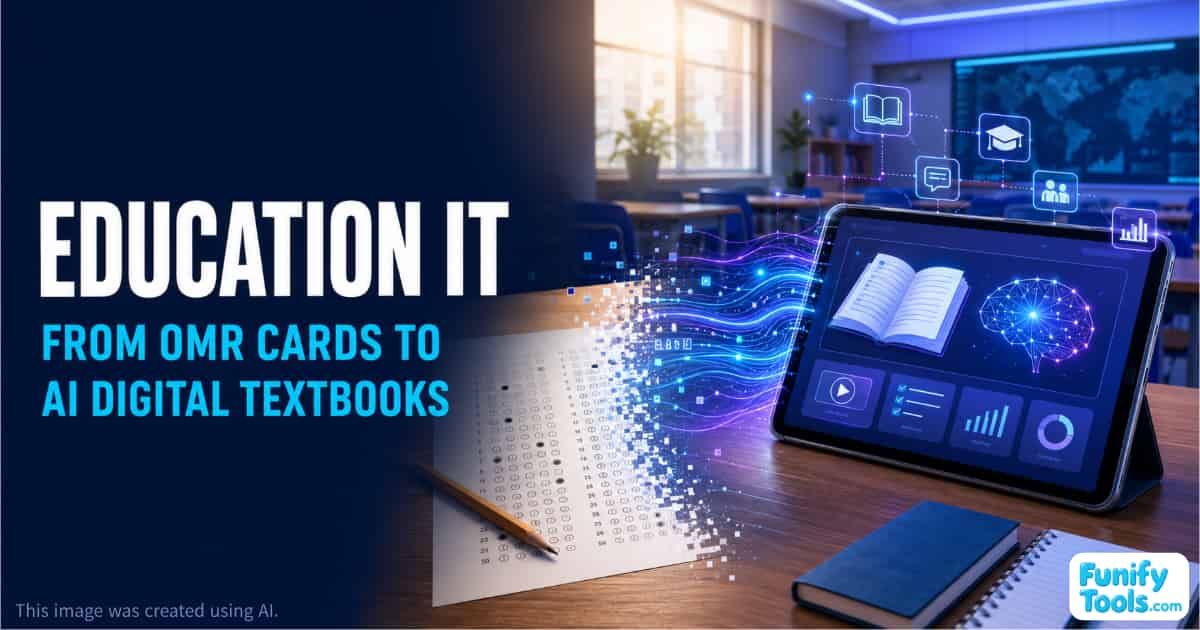
Many people will remember taking IT certification exams with printed question papers and OMR answer sheets—forms that use optical mark recognition to read filled-in answers. Despite being exams for technology-related qualifications, the testing process itself was still remarkably analog.
Then, little by little, examination rooms began to change. Test-takers started sitting in front of monitors, selecting answers with a mouse, and receiving their results much sooner after completing an exam.
This change meant more than simply making tests more convenient. It marked the beginning of a much broader transition in which education and assessment started moving into a fully digital environment.
From a Supporting Tool to the Center of Education
For many years, IT played a supporting role in education.
Schools opened computer labs, launched websites, and gradually introduced electronic attendance and digital grade-entry systems. At the time, technology was largely seen as a tool that helped schools perform their existing tasks more efficiently.
The situation today is clearly different.
IT has moved from the edges of education to its center. Technology now influences not only what students learn, but also how they learn, how they are assessed, and how their academic progress is recorded.
Beginning in 2025, South Korea started introducing AI-powered digital textbooks for English, mathematics, and information technology classes. The initial rollout targeted students in the third and fourth grades of elementary school, the first year of middle school, and the first year of high school. The Ministry of Education presented these textbooks as a key tool for delivering more personalized education.
Student Devices Are Only One Part of the System
One of the most visible signs of this transformation is the growing distribution of digital devices to students.
It is now common to see students using iPads, tablets, laptops, and Chromebooks in school. Some schools provide these devices free of charge, while others operate lending programs.
The important point, however, is that distributing devices is not the final objective. Education offices and schools are not simply building an environment in which every student owns or borrows a device. They are creating an entire digital learning ecosystem.
The Seoul Metropolitan Office of Education's 2026 policy plan, for example, includes the operation of DiBut—its one-device-per-student program—as well as broader school digital transformation initiatives. It also includes the placement of digital tutors to reduce the workload involved in managing student devices.
Behind every tablet distribution program is a much larger IT industry that includes learning platforms, account management, application deployment, cybersecurity, device repair, and technical support for teachers.
Education IT Is More Than a Hardware Industry
For this reason, education IT cannot be viewed as a hardware industry alone.
It includes software, cloud services, networks, device management solutions, cybersecurity, and digital content. For a student's tablet to function properly in the classroom, the school needs reliable Wi-Fi infrastructure and a learning management system. Teachers must be able to distribute materials easily, while student accounts and access permissions must also be managed securely.
The COVID-19 pandemic accelerated the development of this infrastructure.
Working with EBS and the Korea Education and Research Information Service, or KERIS, South Korea's Ministry of Education expanded public learning management systems and established operational guidelines for remote classes.
Platforms such as e-Hakseupteo and EBS Online Class became central to the country's remote-learning infrastructure. The government also issued guidance covering managed online learning, attendance, and assessment.
That experience effectively brought forward the digital classroom systems now used in schools. Today's education IT is therefore not a single application. It is the underlying infrastructure that allows teaching, learning, and assessment to continue without interruption.
Digital Tools Are Changing the Classroom
Changes in teaching methods are also worth examining.
The traditional classroom was built around a familiar scene: a teacher explaining a lesson at the blackboard while students listened and took notes. That model has not disappeared, but a much wider range of activities is now possible within the same classroom.
Teachers can use live quizzes, collaborative documents, video-based flipped learning, exercises adjusted to different ability levels, and instant feedback. These approaches work much more effectively when supported by digital tools.
This is one reason AI-powered digital textbooks have attracted so much attention.
The Ministry of Education has described them not simply as replacements for printed textbooks, but as tools that support classroom teaching and enable more personalized learning.
Even when students in the same class are studying the same subject, they may understand it at different speeds and benefit from different types of explanation. IT makes it possible to respond to those differences in a more detailed and systematic way.
From Recording Test Results to Analyzing the Learning Process
The transformation of assessment may be even more significant.
With a conventional paper examination, schools often retain little more than the student's final answers and score. In a digital environment, however, the learning process itself can become data.
A digital system may show how long a student spent on a particular question, which types of problems they repeatedly answered incorrectly, and at what point they stopped progressing through a lesson.
This does not mean that collecting more data automatically produces better education. Data alone cannot understand every learner, replace a teacher's judgment, or solve every problem in the classroom.
It can, however, give teachers a more detailed view of how each student is learning. This may help them adjust supplementary explanations, assignments, and learning activities more effectively.
As a result, the education IT industry is expanding beyond interface and application development into areas such as learning analytics, data visualization, and personalized recommendations.
The Ministry of Education's emphasis on personalized learning through AI-powered digital textbooks reflects this trend. KERIS also treats digital literacy as a broad set of capabilities that includes using information and data, communicating and collaborating digitally, creating digital resources, maintaining digital safety and well-being, and solving real-world problems.
Digital literacy is therefore no longer limited to knowing how to operate a computer. It involves understanding how to find, evaluate, create, communicate, and act responsibly with digital information.
Technology Is Also Changing the Teacher's Role
The scale of the transformation is equally significant from a teacher's perspective.
Public discussion often focuses on the devices given to students, but changes in the teacher's role may have an even greater effect on daily school life.
In the past, teachers could prepare printed materials, distribute them to the class, and write the main points of a lesson on the board. Today, they may also be expected to create digital materials, operate classroom platforms, manage online assignments, check copyright restrictions, guide the use of student devices, and teach digital citizenship.
This is why education offices are deploying digital tutors and strengthening professional training for teachers. These measures are becoming less of an optional extra and more of a practical necessity.
Paradoxically, the more technology enters the classroom, the more important people become.
Education IT is not simply an industry that sells devices and software. It also functions as a service industry that helps teachers and schools use technology effectively.
A technically impressive platform has limited value if it adds administrative work, interrupts lessons, or is too complicated for teachers and students to use comfortably. The quality of implementation and support can be just as important as the technology itself.
Schools Are Becoming Part of a Large EdTech Market
Another important development is the growth of education into a major EdTech market.
Schools are no longer places that simply purchase and use printed textbooks. Educational software, learning platforms, AI-based study tools, assessment systems, classroom management solutions, coding education services, and content platforms are all entering the classroom.
In 2025, KERIS invited companies to participate in higher-education EdTech Softlab programs and field demonstrations. It also published a directory of tested EdTech products and a collection of successful implementation cases.
This suggests that schools are becoming more than customers. They are also serving as real-world environments in which new educational technologies can be tested, evaluated, and improved.
To say that IT is becoming more important to education also means that schools themselves are becoming part of a growing digital services market.
Where Is Education IT Headed Next?
I believe three directions will become even more prominent in the future.
1. Personalization
Education will gradually move away from providing every student with exactly the same textbook, schedule, and set of exercises.
Systems will increasingly support learning experiences adapted to each student's level, pace, strengths, and areas of difficulty.
Personalization should not mean isolating students or allowing an algorithm to make every educational decision. Instead, technology should provide teachers with more useful options for helping different learners within the same classroom.
2. Integration
Lessons, assignments, assessments, counseling records, academic progress, and information about future education pathways are often managed separately.
In the future, these elements are likely to become more closely connected within integrated systems. Ideally, this could reduce repeated administrative work and help teachers, students, and parents understand the overall learning journey more clearly.
At the same time, greater integration will require careful decisions about who can access each type of information and how long that information should be retained.
3. Accountability
As technology becomes more deeply embedded in the classroom, questions about responsibility will become increasingly important.
Schools and technology providers will need to address privacy protection, excessive screen time, the digital divide, algorithmic bias, accessibility, copyright, and the reliability of AI-generated content.
Education IT is entering a stage in which companies must demonstrate more than impressive features. They must also show that their products can support education safely, fairly, and sustainably.
A Much Larger Transformation Than It First Appeared
Looking back, the move from paper exams to computer-based testing may have seemed like a minor change.
At the time, it may have felt as though the only difference was that questions appeared on a screen instead of a sheet of paper. In retrospect, however, it marked an important turning point.
Education was beginning to use data, rely on networks, and operate through digital platforms.
Schools are now moving beyond the simple distribution of tablets. They are building new educational environments that include AI-powered digital textbooks, learning platforms, management systems, digital literacy education, and real-world EdTech trials.
The education IT industry is not merely an industry that teaches people how to use computers. It is an industry that is changing the way learning itself takes place.
It is replacing paper tests with digital assessment, turning textbooks into interactive platforms, transforming classrooms into spaces where data moves continuously, and reshaping schools into digital ecosystems.
The changes now taking place in education are therefore not a passing trend. They are important signals of what the future of teaching and learning may look like.
Thank you for reading. Have a wonderful day!
This article is also available in Korean: Read the Korean version