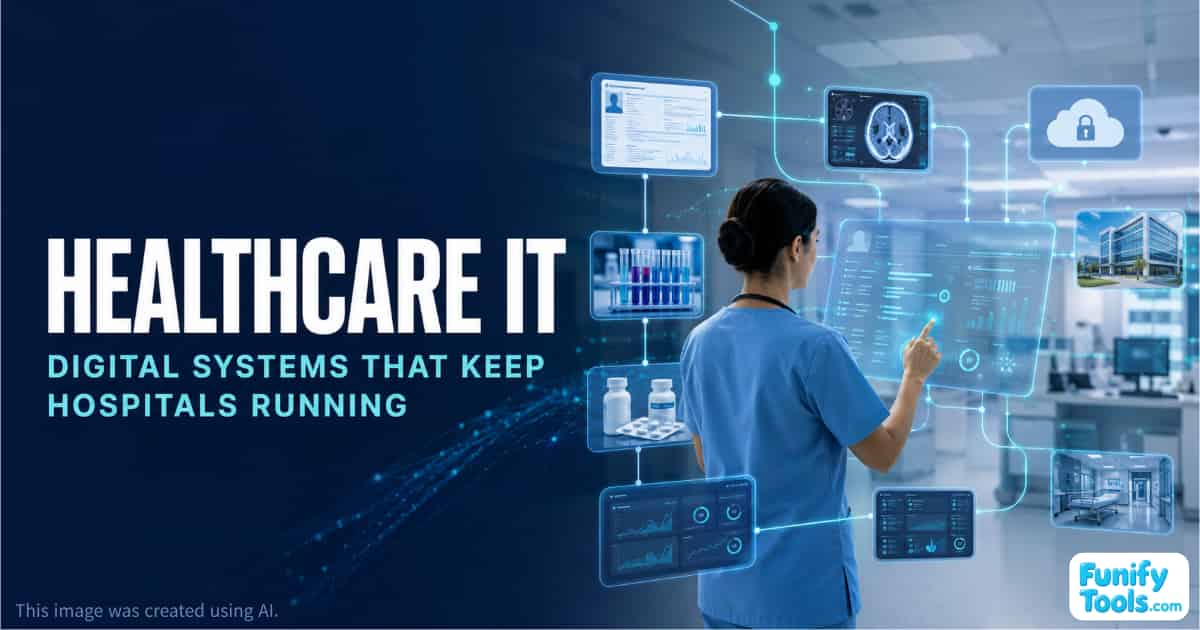
In my previous article, I explored the role of IT in the nuclear power industry. Just as nuclear IT systems must be carefully designed to support safety, facility operations, and data traceability, healthcare IT goes far beyond routine administrative work. It provides the essential infrastructure for an environment in which technology can directly affect people's lives.
A hospital is not simply a place where doctors and nurses treat patients. It is a highly complex organization in which countless processes operate simultaneously—from registration, appointments, examinations, diagnostic testing, and medical imaging to prescriptions, billing, admission and discharge, record management, and information security.
For that reason, discussing healthcare IT requires more than looking at hospital computer systems. We also need to understand how clinical environments operate and how technology fits into their workflows.
Healthcare IT Is More Than EMR
When people hear the term “hospital IT,” many immediately think of electronic medical records, or EMRs. EMRs are certainly one of the central components of healthcare IT.
As patient records moved from paper charts to digital systems, medical professionals gained faster access to patients' current conditions and medical histories. Hospitals also fundamentally changed the way they store, retrieve, and manage clinical information.
In practice, however, healthcare IT covers a much broader range of functions.
Patient registration and appointment scheduling, physician orders, laboratory results, medical imaging, medication information, insurance claims, hospital administration, statistics, and research data must all be connected in a continuous flow. A hospital cannot operate properly when each of these functions remains isolated.
Healthcare IT is therefore not merely a collection of separate software applications. It is closer to a digital nervous system running throughout the entire hospital.
The Korea Health Information Service, for example, works on EMR certification, healthcare information standardization, FHIR, and health information exchange. It describes the goals of EMR standardization as improving patient safety and the quality of care while establishing a foundation for producing and using high-quality healthcare data.
What Is an EMR?
An EMR, or Electronic Medical Record, is a digital version of the traditional paper chart used by healthcare providers. EMRs became increasingly common as personal computers spread throughout workplaces in the mid-1990s.
An EMR may contain a patient's personal information, medical history, examination findings, treatment results, surgical records, admission and discharge history, outpatient records, and health screening results.
The term EHR, or Electronic Health Record, is also widely used. Although EMR and EHR are sometimes used interchangeably, an EHR generally refers to a broader record designed to be shared across different healthcare organizations and services.
What Is FHIR?
FHIR stands for Fast Healthcare Interoperability Resources. It is a healthcare data standard developed to help systems represent and exchange electronic health information.
FHIR defines standardized resources and provides API-based methods through which different healthcare systems can communicate. In simple terms, it gives hospitals, applications, and medical devices a common framework for exchanging data.
If you would like to learn more about APIs, you may also find my article, “What Is an API? A Guide to Its Meaning, Definition, and Real-World Uses,” helpful.
Connectivity Is the Key to Healthcare IT
One of the most important concepts in healthcare IT is connectivity.
Hospitals contain many departments, and each department works with different types of information. Outpatient clinics and inpatient wards have different needs. Clinical laboratories and radiology departments use different data formats. Administrative staff and medical professionals may also use different terminology.
A patient, however, experiences all these departments as parts of a single healthcare journey.
From the patient's perspective, a test completed today should be immediately available to the physician in the consultation room. Medical records created at another institution should also be accessible when they are needed and when the patient has granted permission.
In this context, the core purpose of healthcare IT is not simply to store data. It is to connect the right information at the right time and exchange it securely.
HIMSS—the Healthcare Information and Management Systems Society—defines interoperability as the ability of different information systems, devices, and applications to access, exchange, integrate, and cooperatively use data.
The competitiveness of a hospital's IT infrastructure therefore depends less on how impressive its screens look and more on how naturally its different systems work together.
Why Healthcare Data Standardization Matters
This is why standardization has become such an important topic in healthcare IT.
If every hospital uses a completely different system and data structure, medical information may accumulate without being able to move or be meaningfully reused.
The Korea Health Information Service describes FHIR as a next-generation healthcare information standard that can represent different types of health data and support broad interoperability by mapping existing data to standardized structures.
South Korea's Ministry of Health and Welfare is also pursuing a healthcare data interoperability technology development program from 2025 to 2029. The initiative aims to develop technologies that support the standardization of different hospital information systems, expand the exchange of clinical information, and reduce the cost of preparing healthcare data for research.
Standardization may sound like a technical issue, but its effects are highly practical. It can reduce repeated data entry, prevent information from being lost between departments, improve the speed of clinical decisions, and make it easier for patients to receive continuous care across different medical institutions.
Giving Patients Greater Control Over Their Health Data
Healthcare IT is no longer focused only on improving internal hospital efficiency. Another major trend involves giving patients greater control over their own health information.
South Korea's My Healthway initiative is designed to allow individuals to view health information scattered across multiple institutions in one place. With the individual's consent, that information can then be provided to and used by the healthcare providers or services of their choice.
The Ministry of Health and Welfare has described My Healthway as a network hub that serves as a kind of highway for health information. In 2022, the platform entered a pilot phase involving approximately 240 medical institutions in Seoul and Busan.
This initiative demonstrates how healthcare IT is expanding beyond internal hospital systems and moving toward a patient-centered data ecosystem.
In the future, the value of healthcare IT may depend less on how much information a hospital possesses and more on how effectively that information can be used—with patient consent, common standards, and secure connections in place.
Cybersecurity Is Essential to Patient Safety
Convenience is only one side of healthcare IT. Hospitals handle extremely sensitive information, and system failures can immediately disrupt patient care.
The Office of Inspector General at the U.S. Department of Health and Human Services has warned that ransomware, destructive malware, insider threats, and human error continue to threaten both hospital operations and electronically protected health information.
South Korea's Ministry of Health and Welfare has also supported medical institutions through services such as the Healthcare Information Security Center, malware detection, ransomware response guidelines, and 24-hour security monitoring.
In a hospital, cybersecurity is not an optional feature added after a system has been built. It is a fundamental requirement for protecting continuity of care and patient safety.
When an ordinary online service stops working, users may experience inconvenience. When a hospital system fails, medical professionals may lose access to patient records, prescriptions, test results, or imaging data. The disruption can affect the delivery of medical care itself.
For this reason, hospitals must prepare not only to prevent cyberattacks but also to continue essential clinical operations when systems become unavailable. Data backups, access controls, network separation, incident-response procedures, and downtime plans are all part of modern healthcare IT.
Technology Must Fit the Clinical Workflow
When I look at healthcare IT, I believe that integrating technology without disrupting clinical workflows is more important than simply introducing the latest system.
Unlike a factory, a hospital cannot standardize every process completely. Every patient's condition is different, emergencies occur without warning, and healthcare professionals often need to make critical decisions within a very short period.
Healthcare IT should therefore reduce the workload placed on medical staff and deliver the information they need more quickly and accurately.
A well-designed hospital system allows healthcare professionals to concentrate on patient care without constantly thinking about the technology behind it. A poorly designed system may add more screens, alerts, menus, and administrative steps while making the clinical environment even more complicated.
That difference can ultimately affect both a hospital's competitiveness and the quality of the patient experience.
Good healthcare IT is not necessarily the system with the most features. It is the system that provides the right information at the right moment, minimizes unnecessary work, prevents avoidable mistakes, and continues operating reliably under pressure.
Healthcare IT as a Core Part of the Hospital
Healthcare IT is no longer limited to the responsibilities of a hospital's computer support department. It is the infrastructure that connects clinical care, hospital operations, medical research, patient experience, data use, and cybersecurity.
It may begin with record systems such as EMRs, but its true value lies in connectivity, standardization, and the safe use of information.
As healthcare becomes increasingly digital, IT will no longer be merely a supporting tool. It will become one of the central factors determining the overall quality of a hospital.
If IT in the nuclear power industry demonstrates how technology supports safety and the precise operation of complex facilities, healthcare IT shows how technology can stabilize and connect an equally complex—but deeply human-centered—environment.
Thank you for reading. Wishing you health and happiness.
This article is also available in Korean: Read the Korean version