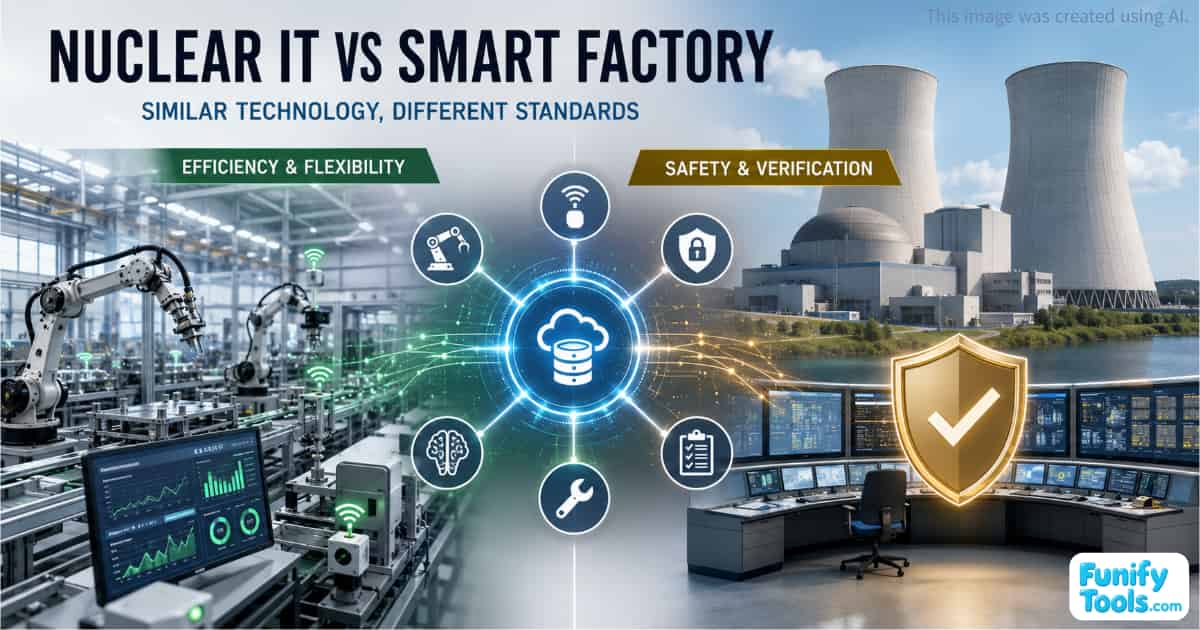
At first glance, a smart factory and a nuclear power plant may appear to belong to completely different worlds. Look more closely, however, and the two have a surprising amount in common.
Both use sensors and control systems. Both collect operational data, monitor equipment, detect abnormal conditions and develop maintenance strategies. Digital twins, predictive maintenance, cybersecurity and operational optimization are important in both environments.
In that sense, a nuclear power plant can also be viewed as one enormous smart factory.
The fundamental differences become clear, however, when the two are compared directly.
For a smart factory, the main priorities are usually productivity, quality, cost, delivery performance and operational flexibility. Nuclear power adds much stricter requirements for safety, regulatory compliance and long-term reliability.
The technologies may look similar, but the purpose of adopting them, the acceptable implementation methods, the required level of verification and the consequences of failure are entirely different.
That is the most important point to understand when comparing smart-factory technology with nuclear IT.
Smart Factory vs. Nuclear IT
Digital transformation in manufacturing generally aims to improve visibility across the production floor, control equipment more precisely and use data to increase productivity and quality.
Typical projects include:
- Collecting equipment data in real time
- Detecting process abnormalities
- Integrating MES, SCADA and PLC systems
- Connecting operational dashboards
- Reducing unplanned downtime
- Improving equipment utilization
- Minimizing quality variation
- Operating facilities more efficiently with fewer manual interventions
From a structural perspective, a nuclear power plant does many of the same things.
Instrumentation signals are collected, control logic is executed, operators monitor system conditions and established procedures are followed when an abnormality is detected. Equipment monitoring, historical data management, maintenance planning, remote diagnostics, simulation and cybersecurity are all essential.
The difference is that these functions are not merely tools for improving operational efficiency. In nuclear power, they form part of a much broader system for maintaining safety.
In a smart factory, a control system helps stabilize production. In a nuclear power plant, the control system helps make operation possible within a safety framework.
Instrumentation and Control
The difference is especially clear when we examine instrumentation and control, commonly abbreviated as I&C.
In a smart factory, I&C directly affects process quality, production yield, equipment efficiency and the level of automation. Accurate sensors, fast control responses and reliable data flows ultimately improve competitiveness.
Nuclear I&C must do more than control a process accurately and efficiently. It must behave in a predictable manner under normal, abnormal and accident conditions.
Precision and efficiency alone are therefore insufficient. Nuclear systems must also account for principles such as:
- Conservative design
- System independence
- Redundancy
- Diversity where required
- Fail-safe behavior
- Deterministic operation
- Traceability
- Testability
- Verification and validation
- Controlled configuration and change management
This is why the word “digitalization” carries a somewhat different meaning in the two industries.
Smart factories often seek greater connectivity, faster feedback and more operational flexibility. The more data they collect and the more closely their systems are integrated, the more opportunities they may find for improvement.
Nuclear facilities take a more controlled approach. Digital technology is introduced only within carefully defined boundaries, and decisions about what should be connected or separated are made conservatively.
Smart-factory digitalization can therefore be described as relatively expansion-oriented, while nuclear digitalization is more controlled and compartmentalized.
Data Collection and Use
Data becomes increasingly valuable in a smart factory as more of it is collected.
Small changes in vibration, temperature trends, production histories, defect patterns and operating conditions can be analyzed to identify potential problems. Manufacturers can adjust maintenance schedules, improve process parameters and reduce quality variation.
The competitive advantage does not come from collecting data alone. It also depends on how quickly that data can be interpreted and incorporated into operational decisions.
Data is equally important in nuclear power, but the standards governing its interpretation and use are much stricter.
An action is not taken simply because an analytical pattern appears convincing. Operators and engineers must also consider:
- The possible effect of the decision
- The procedure that authorizes the action
- The reliability and provenance of the data
- Whether the method has been verified
- How much confidence can be placed in the analysis
- Whether the result affects a safety-related function
- Who is responsible for the final decision
In nuclear operations, data is not merely a tool for efficiency. It is also a matter of responsibility.
More data is not automatically better. It becomes valuable only when it is collected securely, interpreted accurately and used through a process that can be verified and audited.
Predictive and Condition-Based Maintenance
Predictive maintenance provides another useful comparison.
In a smart factory, predictive maintenance helps reduce unexpected downtime, use components more efficiently and optimize maintenance costs.
Rather than opening equipment according to a fixed schedule regardless of its condition, teams can monitor warning signs and perform maintenance when the data indicates that it is actually needed.
The primary objectives are often to:
- Increase production-line availability
- Prevent unplanned shutdowns
- Reduce unnecessary maintenance
- Extend component life
- Optimize spare-parts inventory
- Lower operating costs
This approach can lead directly to substantial cost savings and improved productivity.
Condition-based maintenance and anomaly detection are also important in nuclear power, but they are applied more cautiously.
The objective is not simply to reduce maintenance costs. It is to preserve equipment integrity and long-term reliability while remaining within approved technical and regulatory requirements.
A maintenance recommendation cannot necessarily be adopted solely because an algorithm predicts that it will be more economical. Engineers must also consider equipment classification, licensing requirements, surveillance obligations, operating experience and the potential effect on plant safety.
Predictive maintenance is therefore a tool for competitive improvement in many factories, while in nuclear power it becomes part of a broader strategy for maintaining reliability and safety.
The two industries both value data-driven maintenance, but the acceptable decision-making methods and speed of implementation can differ considerably.
Cybersecurity
Cybersecurity is an area where the similarities and differences between the two industries are visible at the same time.
As IT and operational technology become more closely connected, cybersecurity is no longer optional in a smart factory.
A ransomware infection or unauthorized intrusion can cause:
- Production shutdowns
- Quality problems
- Delivery delays
- Damage to equipment
- Loss of intellectual property
- Manipulation of process data
- Safety risks for workers
For that reason, security by design is becoming just as important as automation itself in modern manufacturing.
Nuclear cybersecurity goes one step further because security is treated as an integral part of safety and operational assurance.
Protection extends beyond installing firewalls or controlling user accounts. Cybersecurity considerations must be incorporated into:
- Network architecture
- System separation
- Access control
- Configuration management
- Software and hardware changes
- Removable-media controls
- Supplier management
- Incident response
- Personnel procedures
- Continuous monitoring
- Regulatory compliance
In a smart factory, an OT security failure can stop production and cause serious financial damage. In a nuclear environment, the potential consequences demand an even more rigorous and systematic approach.
Technology remains important, but principles, procedures and governance often come first.
Areas Protected by U.S. Nuclear Cybersecurity Requirements
The following table summarizes major areas addressed by nuclear cybersecurity programs based on the U.S. Nuclear Regulatory Commission's background information on cybersecurity.
| Protected area | Meaning |
|---|---|
| Safety-related functions | Digital assets directly associated with nuclear safety functions |
| Security functions | Digital systems supporting physical and operational security |
| Emergency preparedness functions | Communication and response systems used during emergencies |
| Important support systems | Supporting equipment and systems needed to maintain safety and security functions |
The scope illustrates how nuclear cybersecurity extends beyond ordinary office IT. It includes digital systems that support safety, security and emergency response throughout the facility.
Digital Twins and Simulation
Digital twins and simulation are becoming increasingly important in both industries.
In a smart factory, a digital twin can be used to examine:
- Production-line layouts
- Material and logistics flows
- Process bottlenecks
- Equipment loads
- Energy consumption
- Production scheduling
- Potential process changes
Engineers can evaluate changes in a virtual environment before modifying the real production floor. This reduces trial and error and allows potential problems to be identified earlier.
Digital twins in nuclear power can serve an even broader purpose over a much longer period.
Possible applications include:
- Operational simulation
- Operator education and training
- Maintenance planning
- Review of work in hazardous or high-radiation areas
- Equipment-life assessment
- Outage preparation
- Remote inspection support
- Plant modification planning
- Decommissioning preparation
A manufacturing digital twin is often used as an optimization tool. In the nuclear industry, it may be more accurately described as a tool for preparation, evaluation and verification.
This difference reveals what each industry expects from digital technology.
Artificial Intelligence
The approach to AI also provides an interesting contrast.
In smart manufacturing, AI is rapidly expanding into areas such as:
- Quality prediction
- Visual inspection
- Process anomaly detection
- Demand forecasting
- Maintenance recommendations
- Production scheduling
- Energy optimization
- Worker assistance
In many manufacturing environments, once an AI system reaches an acceptable level of accuracy, it can be introduced in a limited area and improved gradually using operational feedback.
This allows AI to become an increasingly practical tool.
AI also has considerable potential in nuclear power, but its application must be much more conservative.
It may provide meaningful value in supporting roles such as:
- Detecting abnormal data patterns
- Assisting with equipment diagnostics
- Analyzing operational data
- Reviewing documents
- Identifying maintenance candidates
- Searching technical knowledge
- Supporting simulations
- Helping operators interpret large volumes of information
Allowing AI to make a critical safety decision directly would require an entirely different level of examination.
Questions would include:
- Can the result be explained?
- Can the model be independently verified?
- Will it behave predictably outside its training data?
- Can changes to the model be strictly controlled?
- Who is responsible for an incorrect decision?
- Can regulators evaluate and accept the method?
- Is there an approved fallback if the AI becomes unavailable?
- Can the system demonstrate consistent performance over time?
For now, the more realistic role of AI in nuclear power is not to replace human decision-makers but to improve the quality of human judgment.
Automation and Human Responsibility
Smart factories often aim to reduce manual intervention wherever automation can improve consistency, speed or cost.
Nuclear power also uses extensive automation, but its relationship with human operators is carefully structured.
Some functions must operate automatically because a system may need to respond faster than a person can. Other decisions remain procedural and human-controlled because they require operational judgment, accountability or regulatory authorization.
This creates a deliberate balance:
- Automation handles predefined and verified functions.
- Operators monitor system conditions and follow approved procedures.
- Engineers evaluate complex technical questions.
- Management and regulatory structures control important changes.
The goal is not maximum automation. It is the appropriate degree of automation for each function.
Change Management
Another major difference is the speed at which technology can be changed.
A smart factory may test a new dashboard, analytical model or production algorithm on a limited line. If the trial is successful, the system can be expanded relatively quickly.
Nuclear facilities generally require a more formal process.
Even an apparently small digital change may require:
- Technical impact analysis
- Safety classification
- Cybersecurity review
- Independent verification
- Testing in a controlled environment
- Documentation updates
- Configuration control
- Operator training
- Regulatory review or notification where applicable
This does not mean nuclear technology cannot evolve. It means that change must remain traceable, controlled and justified throughout the system's long operating life.
Manufacturing often rewards the speed of improvement. Nuclear power places greater value on the assurance that the change will behave exactly as intended.
The Different Meanings of Failure
The consequences of failure help explain nearly every difference between the two industries.
In conventional manufacturing, an IT or automation failure may cause production loss, defective products, missed deliveries or financial damage. These outcomes can be extremely serious, especially in industries such as chemicals, pharmaceuticals or transportation equipment.
In nuclear power, however, a failure may also affect nuclear safety, radiological protection, emergency preparedness or public confidence.
The acceptable level of uncertainty is therefore much lower.
This is why a technology that is considered “good enough” for a non-critical manufacturing application may be unacceptable for a nuclear safety-related function.
The distinction is not necessarily the quality of the underlying technology. It is the level of evidence required before that technology can be trusted in a particular context.
Key Similarities and Differences
| Area | Smart factory | Nuclear IT |
|---|---|---|
| Primary objective | Productivity, quality, cost and flexibility | Safety, reliability and compliant operation |
| Connectivity | Broad integration is often encouraged | Connections are carefully limited and controlled |
| Control systems | Optimize and stabilize production | Support operation within a safety framework |
| Data use | Fast analysis and operational improvement | Verified analysis with procedural accountability |
| Predictive maintenance | Reduce downtime and optimize cost | Preserve equipment integrity and long-term reliability |
| Cybersecurity | Protect production and business continuity | Protect safety, security and emergency functions |
| Digital twins | Optimize layouts and processes | Support preparation, training, verification and lifecycle management |
| AI | Rapidly expanding into operational applications | Primarily used as a carefully controlled decision-support tool |
| Change management | Iterative improvement can be relatively fast | Changes require extensive testing, documentation and control |
| Failure impact | Production, quality and financial loss | Potential safety, regulatory and public consequences |
What These Industries Can Learn from Each Other
Comparing smart factories with nuclear IT leads to one important conclusion: the value of digital technology does not come from connectivity or automation alone.
What matters is the environment in which the technology is used, the responsibility attached to it and the consequences of failure.
Smart factories demonstrate the value of rapid improvement, flexibility and data-driven optimization.
Nuclear power demonstrates the importance of reliability, disciplined change, verification and technological responsibility.
Neither approach is universally correct for every situation. Every industry must find the right balance between innovation and assurance.
The connected systems, data analysis and optimization techniques used in smart factories are not fundamentally different from many technologies found in nuclear IT. At the same time, the nuclear industry's emphasis on safety, conservative design and verification can help manufacturing organizations take a more mature view of digital transformation.
Understanding both fields does more than broaden our technical knowledge. It gives us a deeper standard for evaluating industrial IT.
Knowing a technology is important. Understanding the context in which it will operate—and applying it appropriately—is even more important.
Smart factories and nuclear power plants demonstrate that principle with unusual clarity.
Thank you for reading. Stay happy!
What should a smart-factory professional study first when learning about nuclear IT?
Four useful starting points are:
- Digital instrumentation and control
- OT cybersecurity
- Condition-based maintenance
- Digital twins
The digital technologies themselves will often feel familiar. The most important additional question is why nuclear applications require stricter verification, controlled change and a much stronger safety philosophy.
Is nuclear IT similar to smart-factory technology?
The basic structures have many similarities. Both rely on sensors, control systems, data collection, equipment monitoring and maintenance strategies.
The difference is that nuclear power requires much stricter safety assurance and verification. Even when the same underlying technology is used, the implementation method and level of responsibility are substantially different.
Will AI become widely used in nuclear power?
There is considerable potential for AI in areas such as anomaly detection, predictive maintenance, data analysis and simulation support.
Adoption is likely to be more conservative than in conventional manufacturing. AI will probably become established primarily as a tool that supports human judgment rather than completely replacing human decision-makers.
This article is also available in Korean: Read the Korean version