Hello, everyone.
I'm definitely not a professional food blogger, but today I thought I'd try writing a food review. After talking about IT, technology and calculators all the time, I occasionally need to write something that smells like burger sauce to keep life balanced.
For dinner, I chose the eternal companion of developers and one of the first foods that comes to mind when work gets busy: a hamburger.
Ordering the Chef Hu Deok-juk Thigh Burger
I stopped by a nearby Mom's Touch and ordered the Chef Hu Deok-juk Thigh Burger.
A poster for the Mom's Touch Chef Collection featuring Chef Hu Deok-juk greeted me at the entrance. Before I had even stepped inside, it seemed to be announcing, “Tonight's dinner will be anything but ordinary.”
I had only gone there to buy a burger, but the poster somehow made it feel as though I had just spotted a celebrity.
The staff were busy preparing orders, so I quietly placed mine and waited.
There was also an advertisement for the Smoke Deluxe Burger featuring an idol group. I stared at it blankly for a moment because I had no idea who they were. A quick search told me it was LE SSERAFIM.
My apologies for not recognizing them immediately. My knowledge of Korean girl groups seems to have stopped somewhere around Fin.K.L and Baby V.O.X. I have now reached the age where I need to search for the answer.
Time can be rather cruel.
While waiting, I looked through the menu and considered what I might order next time. There is surprisingly a lot to think about when you are waiting alone for a hamburger.
“Maybe I should try that one next.”
“No, the original is probably still the best.”
“Should I have ordered a set?”
“Maybe I should have changed the drink.”
Before I could reach any meaningful conclusion, my order was ready. I failed to choose my next burger, but I successfully collected the one I had come for and hurried home. A burger should be eaten while it is still warm, so my walking speed naturally increased.
People are simple creatures. Then again, perhaps that simplicity is part of what keeps us moving through life.
Price and First Impressions
The Chef Hu Deok-juk Thigh Burger set cost 8,900 won, while the burger on its own appeared to be around 6,400 won.
To be honest, I do not watch much television, so this was also when I discovered that “Hu Deok-juk” was the chef's name. Apparently, eating a burger can increase both your culinary knowledge and your general education.
When I unwrapped it, my first impression was quite positive.
It had the confident appearance of a burger saying, “Yes, I'm properly filled.”
First impressions matter for burgers too. A burger that looks too flat is immediately disappointing, and discovering an empty interior after opening the wrapper can leave your heart feeling just as empty.
Fortunately, this one had a satisfying weight to it. It seemed determined to live up to its name.
The All-Important Cross-Section
I cut the burger in half before eating it.
Cutting a burger down the middle always feels slightly ceremonial. It is the final inspection before the tasting begins—the moment when you examine its internal structure.
A developer opens the source code. I inspect the burger cross-section.
Once divided, the inside looked reassuringly full. That alone put me in a good mood. A poorly filled burger begins losing your trust before you even taste it, but this one seemed to say, “Everything is in order. You may proceed.”
How Did It Taste?
The sauce had a mild Chinese-inspired flavor with a subtle sweetness. It coated the ingredients smoothly without becoming overly heavy.
The chicken patty provided a strong foundation, while the sauce added flavor without overpowering everything else. It was not the kind of burger that hits you with intense spice or a sharp, aggressive taste. Instead, the flavors developed gently and worked together in a fairly balanced way.
I also enjoyed the crunchy texture of the gungchae, or stem lettuce, that appeared between bites. It added a pleasant contrast to the softer ingredients.
Overall, it was better than I expected. I genuinely enjoyed it.
I could end the review here, but then I would hardly be an IT blogger.
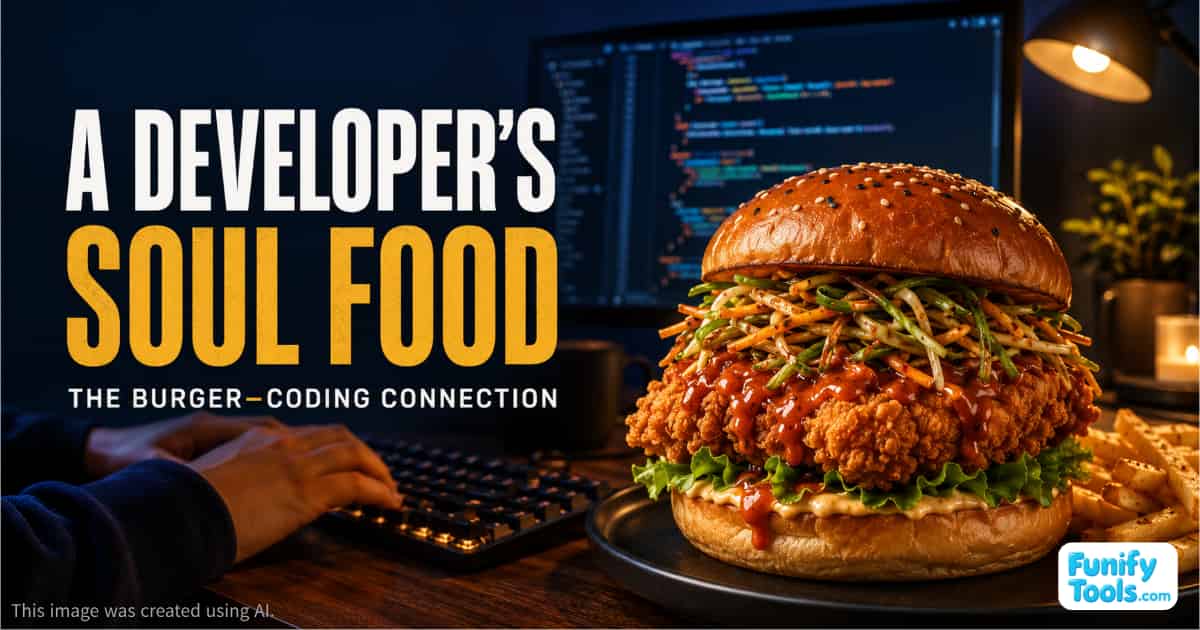
So let us pause for a much more important question: Why did hamburgers become the soul food of developers?
Pizza belongs in the same category, of course.
Why Burgers Became a Developer's Soul Food
Calling hamburgers a developer's soul food may sound like a joke, but there are practical reasons behind it. Burgers happen to fit remarkably well with the habits and culture surrounding software development.
Over time, they have become something of a symbol in the programming world.
Developers Do Not Want to Break Their Focus
Once programmers enter a state of deep concentration, they may remain focused for hours.
They often keep the structure of a program, its logic and several unresolved problems in their heads at the same time. Leaving the desk for a long meal can break that flow. When they return, they may spend quite a while simply trying to remember exactly what they were thinking before they left.
A hamburger is almost ideal in this situation.
You can eat it with one hand, it takes little time to prepare or order, and there is not much to clean up afterward. There is no need to set the table, prepare side dishes or wash multiple plates.
From a developer's perspective, it is food that can be eaten quickly before returning to work.
There is a reason burgers have a reputation for being convenient coding food.
Silicon Valley and Startup Culture Played a Major Role
All-night development sessions were common in early startup and hacker culture.
Staying awake before a product launch or working until dawn to fix bugs has become an almost symbolic image of the technology industry. Pizza, burgers and soda were rarely far away.
Developers would code through the night, order food in the early hours of the morning and then return to their monitors. As this pattern repeated, burgers and pizza naturally became associated with programmers.
Even today, when people picture a hackathon or a young startup, the same collection of objects tends to appear: monitors, coffee, pizza and hamburgers.
The burger eventually became more than a convenient meal. It became part of the visual language of developer culture.
The 1995 film The Net captured a similar image, with Sandra Bullock eating pizza while working at her computer. Apparently, even cinematic hackers needed something convenient to eat.
Burgers Provide Energy Quickly
Programming is not physically demanding in the traditional sense, but intensive mental work consumes more energy than people sometimes realize.
Solving problems, designing logic and tracing errors for hours can be surprisingly exhausting. The brain needs fuel too.
In that respect, a hamburger is certainly efficient. The bun provides carbohydrates, the patty provides protein, and the sauce and other ingredients add fat, calories and flavor in a single package.
I would not necessarily describe it as the healthiest possible meal. However, if the goal is to eat quickly and restore energy, it does the job rather well.
Developers do not choose burgers purely because of the culture surrounding them. They are also genuinely convenient fuel.
Overtime Culture Strengthened the Connection
Late-night work culture at IT companies helped reinforce the image even further.
When development teams work overtime, hamburgers and pizzas often appear for very practical reasons. They are easy to order for a large group, widely available for delivery and quick to eat.
I once spent about a month on a business trip in the United States. There was a lot of overtime, and I ate burgers or pizza for dinner almost every evening. In that particular area, there simply were not many other foods available for delivery.
As a result, burgers became familiar as “food for working late” or “food shared by a team struggling through a difficult deadline.”
When people repeatedly see burger boxes stacked in the corner of a meeting room and developers taking hurried bites in front of their laptops, the association becomes difficult to escape.
Developers and hamburgers eventually merge into a single cultural image.
Are Younger Developers Changing the Tradition?
That is my explanation of how the burger became a developer's soul food.
However, I would like to end with one interesting observation: younger developers these days may actually be more likely to choose a salad.
Perhaps developer culture is becoming healthier after all.
Thank you for reading. Stay happy—and may all your burgers be properly filled!
This article is also available in Korean: Read the Korean version