Why power usage matters
Electricity bills are based on energy, not just the wattage printed on a device. A high-wattage appliance used briefly can cost less than a lower-wattage device that runs all day. The useful question is how many kilowatt-hours (kWh) the device consumes over time. Understanding power usage is the first step toward controlling monthly energy expenses, reducing unnecessary consumption, and making informed purchasing decisions when upgrading household electronics or appliances.
Every household has a unique mix of devices that contribute to the total bill. A refrigerator running 24 hours a day, a gaming PC used for several hours in the evening, a space heater turned on during cold months, and always-on networking equipment all add up in different ways. By breaking down each device individually, you can identify which ones drive the highest cost and decide whether adjusting usage patterns or upgrading to more efficient models makes financial sense. For a broader view of how appliances compare, search results for how to calculate appliance electricity cost from kWh can help connect the wattage label, daily use, and bill rate used in this calculator.
Core formulas
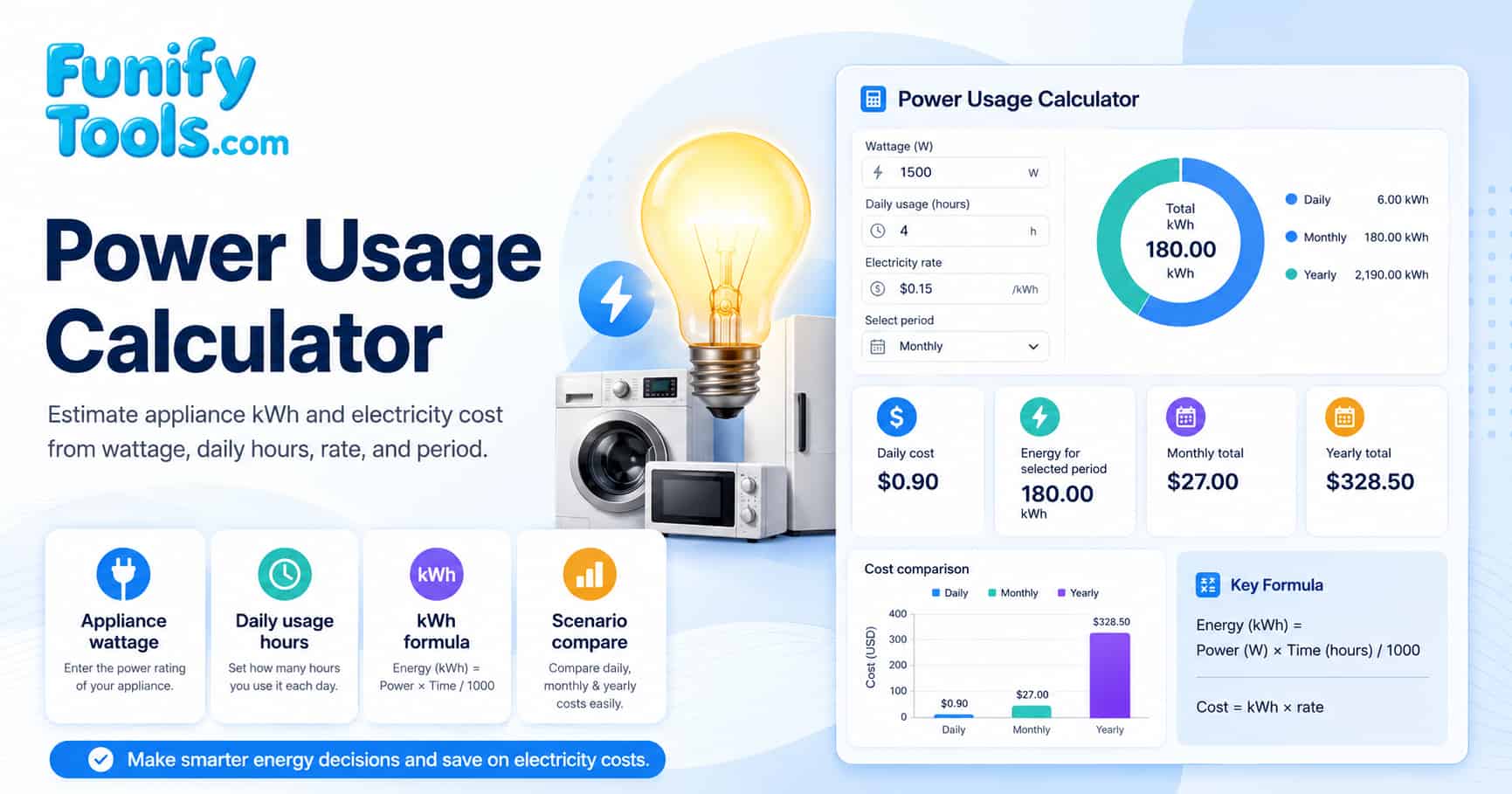
Energy (kWh) = Power (W) x Time (hours) / 1000
Cost = Energy (kWh) x Rate
Period kWh = Daily kWh x Period days
Period cost = Period kWh x Rate
The calculator uses 1 day for a daily total, 30 days for a monthly total, and 365 days for a yearly total. If your billing cycle has a different number of days, use the result as a close planning estimate. These formulas form the foundation of every electricity cost calculation, whether you are estimating a single light bulb or an entire home energy system. For a deeper look at how the kWh formula applies to different types of equipment, search results for kWh energy consumption formula explained for appliances provide additional context and examples.
Units and tariffs
Watts (W) measure power at an instant. Kilowatt-hours (kWh) measure energy over time. A 1,000 W appliance running for 1 hour uses 1 kWh. A 100 W appliance running for 10 hours also uses 1 kWh. The distinction between power and energy is essential: power tells you how fast a device consumes electricity, while energy tells you how much total electricity it uses over a given period.
For simple bills, use the stated price per kWh. For bills with many line items, divide variable electricity charges by total kWh to create an effective rate. For example, if variable charges are 540 and usage is 3,000 kWh, the effective rate is 0.18 per kWh. Utility tariffs vary widely by region and provider. Some plans charge a flat rate per kWh regardless of usage, while others use tiered pricing where the rate increases after a certain consumption threshold. Time-of-use plans charge different rates depending on the time of day, with peak hours costing significantly more than off-peak hours.
For utility plans with tiered or time-of-use pricing, compare your bill with search results for how to find electricity rate per kWh on a utility bill before deciding which rate to enter.
| Device type | Example wattage | Daily hours | Daily kWh | 30-day kWh |
|---|---|---|---|---|
| LED bulb | 10 W | 5 | 0.05 | 1.5 |
| Laptop | 65 W | 6 | 0.39 | 11.7 |
| Gaming PC setup | 430 W | 3 | 1.29 | 38.7 |
| Space heater | 1,500 W | 4 | 6.00 | 180.0 |
Worked examples
To see how different appliances compare in real-world settings, search results for typical appliance wattage chart for household electricity consumption provide a handy reference for common devices and their typical power ratings.
- LED desk lamp: 10 W for 5 hours per day gives 0.05 kWh per day. Over 30 days that is 1.5 kWh, and at 0.15 per kWh the cost is about 0.23.
- Space heater: 1,500 W for 4 hours per day gives 6 kWh per day. Over 30 days that is 180 kWh, and at 0.18 per kWh the cost is 32.40. Reducing use by one hour per day saves about 8.10 per month.
- Gaming PC and monitor: 350 W plus 80 W equals 430 W. Used 3 hours per day at 0.22 per kWh, it uses 38.7 kWh per month and costs about 8.51. A 300 W setup under the same use costs about 5.94.
- Air conditioner: 2,000 W for 6 hours per day over a 90-day summer uses 1,080 kWh. At 0.20 per kWh, the seasonal cost is 216. One hour less per day saves about 36 over that season.
Reading your bill
The calculator is most useful when the rate matches your actual bill. If your utility separates delivery, energy, fuel adjustment, or taxes, decide whether you want a pure energy-rate estimate or a blended estimate that includes variable charges. Many utility bills include a summary table showing total kWh used during the billing period, the rate applied, and the total charge. Locating these three numbers is all you need to use this calculator effectively.
When an appliance cycles on and off, the label wattage may be higher than its average draw. For refrigerators, air conditioners, and heaters, search results for appliance average power draw vs rated wattage can help you choose a more realistic input.
| Appliance | Rated wattage | Estimated average draw | Duty cycle | Notes |
|---|---|---|---|---|
| Refrigerator (modern) | 150 W | 40 to 60 W | ~30% | Compressor cycles on/off |
| Window AC unit | 1,200 W | 600 to 900 W | ~50 to 75% | Depends on thermostat |
| Clothes dryer | 3,000 W | 2,500 to 3,000 W | ~85 to 100% | Heating element runs most of cycle |
| Dishwasher | 1,200 W | 300 to 800 W | ~25 to 65% | Heating element cycles |
| Electric oven | 3,000 W | 1,500 to 2,500 W | ~50 to 80% | Cycles to maintain temperature |
Common mistakes
- Mixing W and kW: the form asks for watts, so enter 1,500 for a 1.5 kW heater.
- Using monthly hours as daily hours: if a device runs 60 hours per month, enter about 2 hours per day for a monthly estimate.
- Ignoring standby power: devices with a small constant draw can matter when they run all year.
- Over-reading rounded numbers: estimates are useful for planning, not exact bill reconciliation.
- Forgetting tariff differences: time-of-use, tiered, and demand-based plans can change real costs.
| Standby device | Standby wattage | Annual kWh | Annual cost at $0.15/kWh |
|---|---|---|---|
| Smart TV (off but plugged) | 2 W | 17.5 | $2.63 |
| Game console (idle/standby) | 8 W | 70.1 | $10.51 |
| Wi-Fi router + modem | 15 W | 131.4 | $19.71 |
| Desktop PC (sleep mode) | 5 W | 43.8 | $6.57 |
| Smart speaker | 3 W | 26.3 | $3.94 |
Useful saving scenarios
For practical strategies to lower your electricity bills at home, search results for reduce home electricity bill with practical appliance tips offer actionable advice that complements the estimates from this calculator.
- Compare an old appliance with a newer efficient model.
- Test different thermostat, brightness, or performance settings.
- Estimate how much reducing daily hours changes a monthly or yearly cost.
- Separate one device from a category, such as one heater within a winter bill.
Typical uses
- Checking whether replacing a refrigerator is likely to pay back.
- Estimating how much a portable heater adds to winter bills.
- Planning server, home lab, or mining rig electricity cost.
- Comparing office equipment, displays, lighting, and small appliances.
- Teaching the difference between watts, kilowatts, and kilowatt-hours.
References
Kilowatt-hour overview | Electric power | Electricity pricing