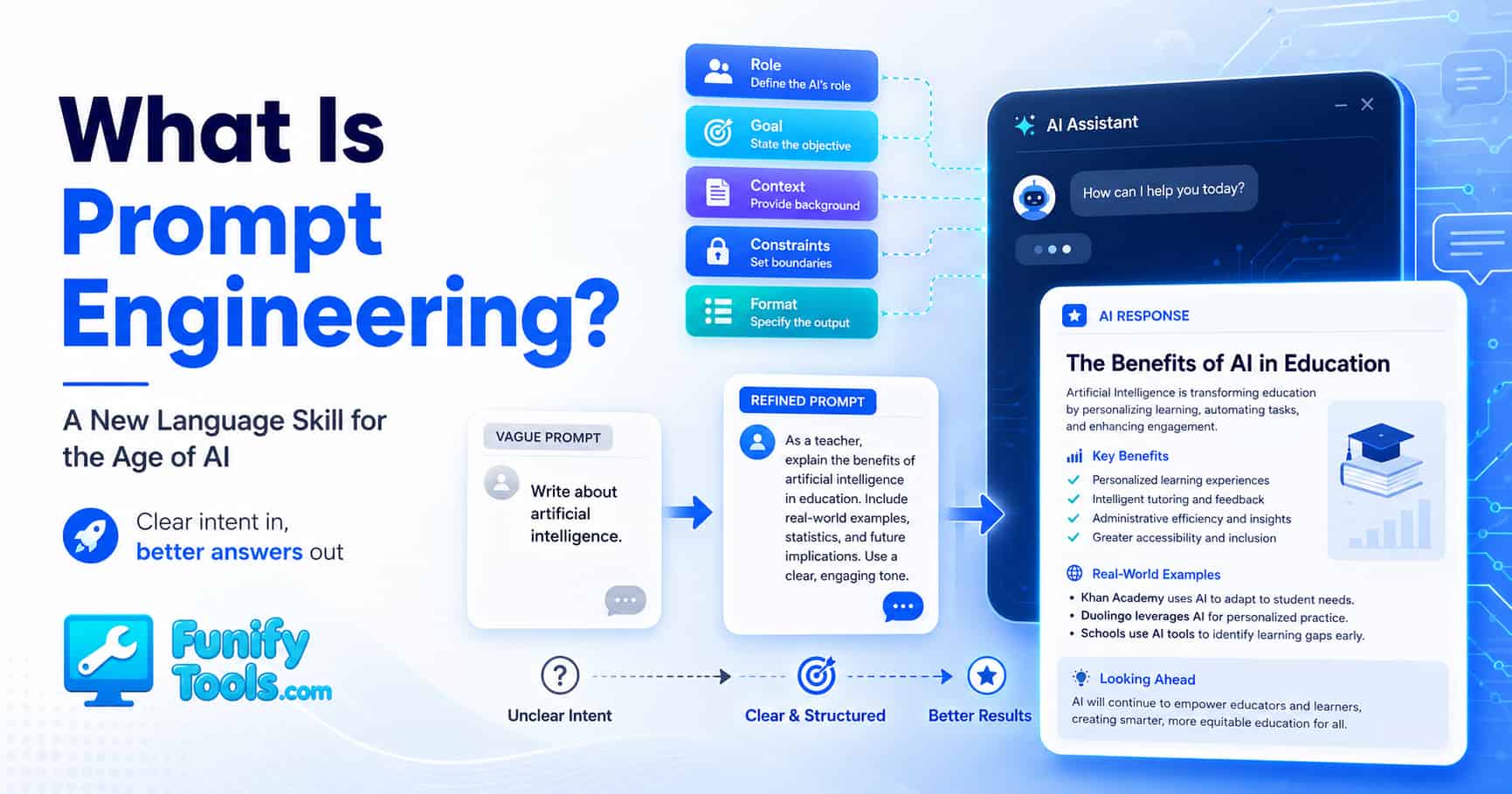
Prompt Engineering: The Language Skill for the AI Era
Hello. 😊
These days, almost everyone has tried at least one AI tool. Maybe it was ChatGPT. Maybe it was Claude, Gemini, Copilot, Perplexity, or another tool built into a phone, browser, document editor, or search engine.
At first, using AI feels almost too easy. You type a question, press enter, and a few seconds later you get an answer. But after using it for a while, you start noticing something interesting.
Some people seem to get incredibly useful answers from AI with just a short request. They ask for a plan, a summary, a piece of code, a rewrite, or an idea, and the result looks polished right away. Other people ask what sounds like the same thing, but the answer comes back vague, generic, too long, too short, or simply not what they had in mind.
The difference is not always the AI model. A lot of the time, the difference is the way the request is written.
That is where Prompt Engineering comes in.
It sounds technical, and the name can make it feel like something only developers or AI researchers need to know. But in real life, prompt engineering is much more practical than that. It is basically the skill of explaining what you want in a way that gives AI enough direction to be useful.
It is not about writing magic words. It is not about tricking AI. It is not about memorizing a secret formula. It is about learning how to communicate your goal, your situation, and your expectations clearly.
What is Prompt Engineering?
Prompt Engineering is the practice of giving AI a clear request, useful context, and specific instructions so it can produce the kind of result you actually want.
In simple terms, it means telling the AI what to do, why you need it, how it should respond, and what limits it should follow.
A prompt can be as short as one sentence:
“Summarize this article.”
That is a prompt. But it is a very open-ended one. The AI does not know whether you want a one-line summary, a bullet list, a beginner-friendly explanation, a professional abstract, or a casual recap for social media.
Now compare that with this:
“Summarize this article for a beginner. Keep it under 150 words, use plain English, and end with three key takeaways.”
The second version is still simple, but it gives the AI much more to work with. It tells the model who the audience is, how long the answer should be, what style to use, and what structure to follow.
That is the basic idea behind prompt engineering. You are not just asking a question. You are shaping the task.
Here is another example. If you just say:
“Tell me how to study English.”
The AI might give you a very general list: learn vocabulary, practice speaking, watch movies, read books, use flashcards, and so on. Nothing is wrong with that answer, but it is the kind of advice you have probably seen a hundred times already.
But if you say:
“You are an English education coach. Create a realistic 3-month learning plan in table format for a working adult who has 30 minutes per day and wants to improve conversational English.”
Now the answer becomes much more useful. The AI knows the role it should take, the kind of learner it is helping, the time limit, the goal, and the output format.
The first request is vague. The second request gives a role, a goal, a user situation, and clear constraints. With that extra information, AI can act less like a random answer machine and more like a focused assistant.
This is why prompt engineering matters. AI is powerful, but it still needs direction. A better prompt gives the model a better path to follow.
Why This Matters
AI does not think like humans. It can sound natural, but it does not actually read your mind. It does not automatically know your background, your real goal, your preferred tone, your audience, or the small details you forgot to mention.
When people say, “AI gave me a bad answer,” sometimes the model really did make a mistake. That happens. But sometimes the prompt was too unclear for the model to know what kind of answer would be useful.
For example, imagine asking a person, “Can you make this better?” That person would probably ask, “Better how?” Shorter? More polite? More professional? More emotional? More persuasive? Easier to read? More SEO-friendly? More natural for a native speaker?
AI has the same problem. It needs direction. If you do not explain what “better” means, the model has to guess.
That is why the way you phrase your request can change the quality of the answer so much. A prompt is not just a command. It is the bridge between your intent and the AI’s output.
In other words, using AI well is not only about having access to a good model. It is also about learning how to describe the work clearly.
This is especially important because AI is now being used for many everyday tasks: writing emails, planning trips, creating study schedules, debugging code, brainstorming business ideas, comparing products, summarizing long documents, translating text, organizing notes, and even generating images or videos.
For simple questions, a simple prompt is fine. But for work that requires judgment, tone, structure, accuracy, or creativity, the prompt starts to matter a lot more.
Prompt Engineering helps you turn AI from a tool that “answers something” into a tool that helps you move closer to the result you actually had in mind.
Core Elements of a Good Prompt
A well-designed prompt usually contains four important parts: context, role, goal, and constraints.
You do not always need all four. For a quick question, one sentence can be enough. But when the task is more complex, these four elements make the prompt much stronger.
| Element | Description |
|---|---|
| Context | Explain the background so AI understands the situation |
| Role | Assign AI a specific persona or area of expertise |
| Goal | Clearly state the outcome you want |
| Constraints | Define limits such as tone, format, length, audience, or style |
Let’s look at each one in a more practical way.
1. Context: Give the AI the Situation
Context is the background information the AI needs before it can give a useful answer.
For example, if you ask:
“Write a product description.”
The AI has no idea what the product is, who will buy it, where the description will be used, or what tone would fit.
But if you add context:
“I’m selling a simple online calculator tool for students and office workers. Write a short product description for a website landing page.”
Now the AI can give a much better answer because it understands the situation.
Context can include your audience, the problem you are solving, the current draft, the platform, the business goal, the user’s skill level, or anything else that helps the model understand the task.
2. Role: Tell the AI How to Think
Role is the perspective you want AI to use.
For example, there is a big difference between these two prompts:
“Review this paragraph.”
“Review this paragraph as a native English-speaking editor who focuses on natural blog writing.”
The second prompt gives the AI a clearer direction. It tells the model what kind of judgment to apply.
You can ask AI to act as a teacher, editor, developer, travel planner, product manager, SEO reviewer, customer support agent, language tutor, data analyst, or beginner-friendly guide. The role does not make the AI perfect, but it helps shape the answer.
3. Goal: Say What You Actually Want
The goal is the result you are trying to get.
A lot of weak prompts fail because they describe the topic but not the desired outcome.
For example:
“Prompt engineering.”
This is not really a request. The AI may explain the concept, list examples, write an essay, or ask for clarification.
A clearer goal would be:
“Explain prompt engineering to beginners in a blog-style article.”
Now the AI understands the output you want.
A good goal often starts with verbs like explain, summarize, compare, rewrite, translate, organize, generate, debug, review, classify, brainstorm, or create.
4. Constraints: Set the Rules
Constraints are the boundaries that keep the answer useful.
Without constraints, AI may give you something technically correct but not suitable for your purpose.
For example, you might say:
“Keep it under 300 words.”
“Use a friendly but not overly excited tone.”
“Format the answer as a table.”
“Do not use technical jargon.”
“Write it for someone who has never used AI before.”
These instructions help the AI avoid the wrong kind of answer. They also save time because you do not have to keep asking for revisions.
By combining context, role, goal, and constraints, you give AI a much clearer map. The result is usually more consistent, more relevant, and closer to what you imagined.
A Simple Prompt Formula
Here is a simple formula you can use when you are not sure how to write a prompt:
“Act as [role]. I need [goal]. Here is the context: [context]. Please follow these rules: [constraints].”
For example:
“Act as a friendly writing coach. I need help improving this blog introduction. Here is the context: the article is for beginners who are curious about AI but feel intimidated by technical terms. Please make it sound natural, human-written, and easy to read. Keep the meaning the same.”
This kind of prompt works because it gives the AI a clear job. It does not leave everything open to guesswork.
You can make it shorter or longer depending on the task. The point is not to write a huge prompt every time. The point is to include the information that actually affects the answer.
For a small request, one clear sentence is enough. For a bigger task, a little structure helps a lot.
Good Prompt vs. Weak Prompt
One of the easiest ways to understand prompt engineering is to compare weak prompts and stronger prompts side by side.
| Weak Prompt | Stronger Prompt |
|---|---|
| “Write about AI.” | “Write a beginner-friendly blog introduction about how AI tools are changing everyday work.” |
| “Make this better.” | “Rewrite this paragraph so it sounds more natural, less formal, and more like a human blog writer.” |
| “Give me ideas.” | “Give me 10 blog post ideas for a small utility website. Focus on topics beginners might search for.” |
| “Explain cookies.” | “Explain web cookies to someone with no programming background. Use a simple real-life analogy.” |
The stronger prompts are not complicated. They just remove unnecessary guessing.
That is the whole trick. When AI has to guess less, it can focus more on doing the work.
Why It Is Becoming More Important
Many people ask, “If AI keeps getting smarter, do we really need prompt engineering?”
It is a fair question. AI tools are improving quickly. They are better at understanding messy requests than they used to be. They can infer missing details, ask follow-up questions, remember context inside a conversation, and produce more polished answers.
But even as AI becomes smarter, clear communication still matters.
A smarter AI can do more, but it still cannot know your exact intention unless you express it. It cannot automatically know whether you want a casual answer or a professional one. It cannot know whether your audience is a beginner, a developer, a student, a customer, or a general reader. It cannot know whether your goal is SEO, clarity, persuasion, humor, accuracy, speed, or simplicity unless you tell it.
In fact, the more capable AI becomes, the more useful good prompting becomes. When a tool can do many different things, your instruction determines which direction it takes.
Think of AI like a very fast assistant. If you say, “Help me with this,” it may help, but it has to guess what kind of help you want. If you say, “Review this for clarity, keep the tone casual, and point out only the parts that sound unnatural,” the assistant can work much more effectively.
That is why prompt engineering is becoming a practical communication skill. It is not only for programmers. It is useful for students, writers, marketers, small business owners, teachers, designers, office workers, creators, and anyone who uses AI to get things done.
Good questions lead to good answers. Clear instructions lead to useful output. That basic idea will not disappear just because AI gets better.
Prompt Engineering Is Not About Perfect Prompts
One thing worth mentioning: prompt engineering does not mean every prompt has to be perfect on the first try.
In real use, working with AI is often a back-and-forth process. You ask for something, look at the answer, notice what is missing, and then adjust your request.
For example, you might start with:
“Write a short introduction about prompt engineering.”
Then after seeing the result, you might say:
“Make it sound less formal and add a simple everyday example.”
Then you might continue:
“Now make the opening feel more personal, like a blog post written by someone who actually uses AI tools.”
This is still prompt engineering. You are guiding the model step by step.
Sometimes the best prompt is not a single perfect paragraph. Sometimes the best method is a conversation. You give direction, check the result, and refine it until it matches what you need.
That is also how many real human collaborations work. A designer does not always deliver the final version on the first try. A writer may revise a draft several times. A developer may adjust code after testing. AI is similar. It often works better when you treat the process as iteration, not one-shot magic.
Common Mistakes When Writing Prompts
Prompt engineering becomes easier once you know the most common mistakes.
Being Too Vague
The most common mistake is asking something too broad.
“Explain AI” can go in a hundred directions. “Explain AI to a middle school student using a simple example” is much clearer.
Forgetting the Audience
A good answer depends on who will read it. A technical explanation for developers will not sound the same as a beginner-friendly explanation for general readers.
Adding the audience often improves the result immediately.
Not Giving Enough Context
If you want AI to rewrite something, explain where it will be used. A homepage headline, a blog paragraph, a tweet, an email, and a product description all need different styles.
Asking for Too Many Things at Once
AI can handle complex tasks, but messy prompts can create messy answers. If your request includes five different goals, it may be better to split them into steps.
Not Checking the Result
AI can be helpful, but it can still make mistakes. It may misunderstand your request, invent details, or give advice that sounds confident but needs verification. Prompt engineering improves the output, but it does not remove the need for human judgment.
Where Prompt Engineering Is Useful
Prompt engineering is useful almost anywhere AI is useful.
If you write blog posts, prompts can help you create outlines, improve introductions, rewrite awkward sentences, generate title ideas, or adjust tone.
If you study, prompts can help you turn difficult topics into simple explanations, make flashcards, build study plans, or quiz yourself.
If you code, prompts can help you understand errors, review logic, generate examples, or compare different approaches.
If you work with data, prompts can help you explain charts, summarize patterns, clean text, or create formulas.
If you run a website, prompts can help you draft meta descriptions, explain tools, write FAQ sections, improve UX copy, or create clearer page introductions.
The important part is that AI usually performs better when you give it a clear job. The more specific the task, the easier it is to judge whether the result is good.
A Practical Way to Start
If you are new to prompt engineering, do not try to memorize a huge list of prompt templates. Start with one habit: before you ask AI for help, pause for a few seconds and ask yourself what you really want.
Do you want an explanation, a summary, a rewrite, a plan, a comparison, a checklist, or a table?
Who is the answer for?
What tone should it use?
How long should it be?
What should it avoid?
Those few questions are often enough to turn a weak prompt into a useful one.
For example, instead of writing:
“Write a blog post about AI.”
You could write:
“Write a beginner-friendly blog post about how AI tools are changing everyday work. Use a natural, human tone, avoid hype, include simple examples, and structure it with clear headings.”
That prompt is not fancy. But it gives the AI direction. And direction is what makes the difference.
What’s Next
Today’s post gave a simple overview of what Prompt Engineering is and why it matters.
The main takeaway is this: AI is not just a search box, and a prompt is not just a question. A prompt is a set of instructions that helps AI understand what kind of result you want.
Good prompts usually include context, role, goal, and constraints. They do not have to be long, but they should be clear. The better you explain the task, the less the AI has to guess.
Prompt engineering is quickly becoming one of those quiet digital skills that can save a lot of time. It helps you write better, learn faster, organize ideas, solve problems, and get more useful results from the same AI tools everyone else is using.
In upcoming posts, I will share more practical examples and step-by-step exercises that show how to guide AI more effectively in real situations.
Thank you for reading, and I hope your day is full of great ideas! 🌟
This article is also available in Korean: Read the Korean version