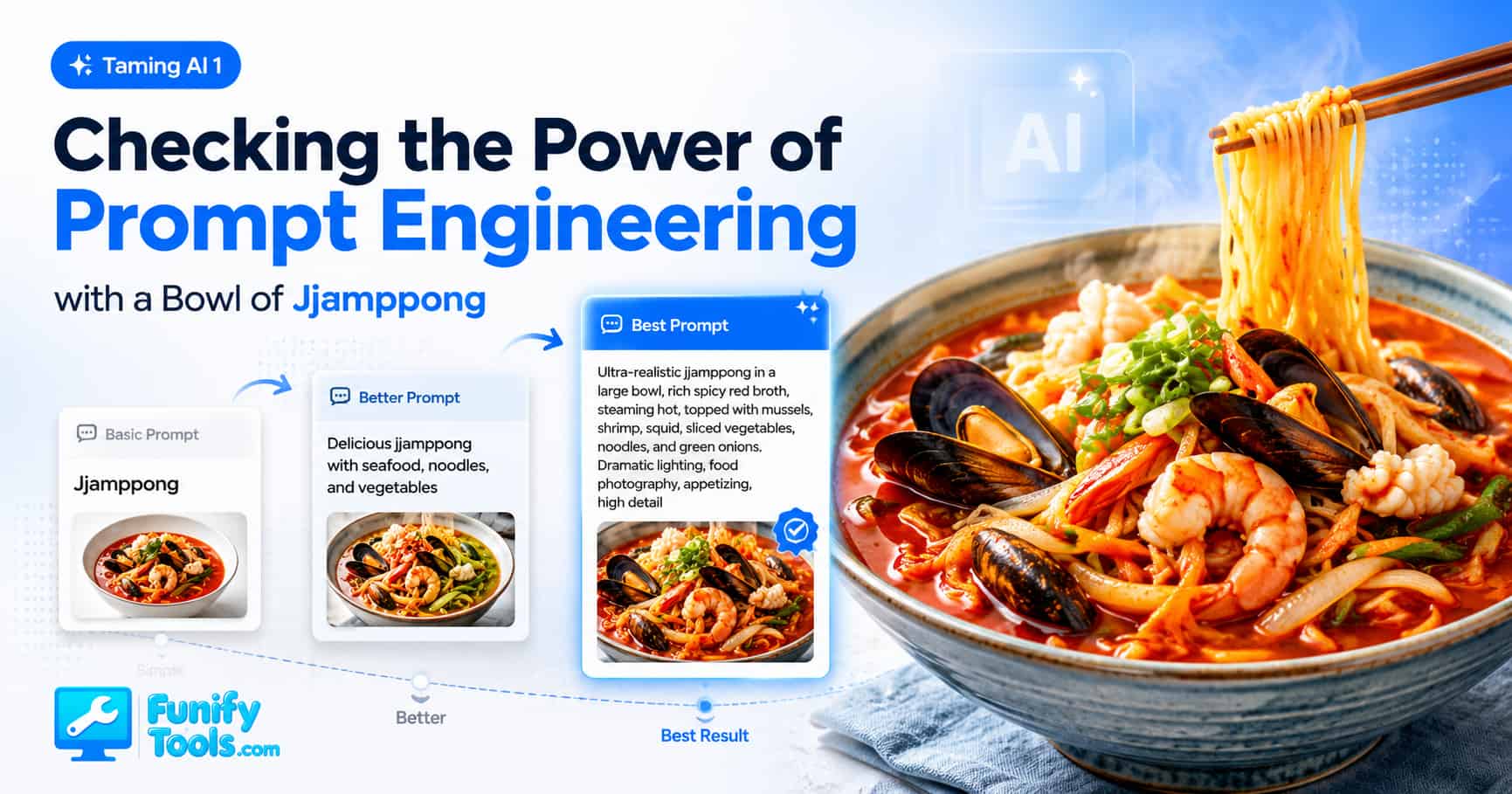
Taming AI 1: Jjamppong Prompt Experiment
Hello everyone 😊
After writing a post about prompt engineering, I opened my blog homepage and then casually checked a few friends’ social media posts. Strangely enough, several of them were talking about jjamppong, Korean-style spicy seafood noodle soup.
Maybe it was because the weather had been cloudy and drizzling all day, but the moment I saw those posts, I could almost imagine the deep red broth, the steam rising from the bowl, and the spicy smell that makes you hungry even when you were not planning to eat.
That gave me a simple idea. Instead of explaining prompt engineering only with abstract examples, why not test it with something very familiar and easy to picture?
So for the first episode of Taming AI, I decided to ask AI to make an image of jjamppong.
The topic is small, but the experiment is useful: how much can the result change when the prompt changes?
Question 1: “Make an image of jjamppong.”
I started with the shortest prompt possible. No style, no mood, no details. Just one direct request.
The AI starts spinning its little thinking wheel.
🍜✨
Ta-da!
.png?type=w800)
Here it is - the most basic form of jjamppong: red broth, seafood, noodles.
It is close to what I had in mind. Nothing fancy, but still amazing to see AI recognize and visualize the concept of jjamppong from such a short sentence.
This is the first small lesson. A simple prompt can work when the subject is already clear, but the result usually stays at the level of a general image. It gives you the answer, but not necessarily the feeling you wanted.
Question 2: “Make an image of delicious jjamppong.”
And again, it starts thinking. About a minute later -
🍜✨
Now this is different!
.png?type=w800)
The photo looks brighter, a pair of chopsticks appeared, and the whole image has more depth. The food shines with a glossy texture that really makes it look appetizing.
One simple word - delicious - made all that difference.
Of course, “delicious” is not a technical instruction. It does not tell the AI exactly where to place the noodles or how much seafood to add. But it changes the direction of the image. The AI seems to interpret the word as brighter lighting, richer color, a cleaner composition, and a more tempting presentation.
That is one of the fun parts of prompt engineering. Some words work like atmosphere buttons. They do not describe an object directly, but they guide the tone of the result.
Question 3: “Generate an image of delicious jjamppong with noodles being lifted, showing realistic steam.”
Back to processing mode again - about 1 to 2 minutes per image.
.png?type=w400)
This time, I gave a more detailed prompt - describing an action and a texture at the same time.
The result? Pretty close. The lifted noodles make the image feel more alive, and the steam helps create the impression that the bowl has just arrived at the table.
But this is also where the limits start to show. I tried adjusting the height of the lifted noodles in new prompts, but most results looked similar.
It seems AI still struggles with concepts like motion or the passage of time.
When we say “noodles being lifted,” humans imagine a short moment: chopsticks moving upward, noodles stretching from the broth, steam floating around them. For AI, that moment has to be converted into a still image. It can imitate the scene, but it does not always understand the exact physical relationship between the bowl, the chopsticks, the noodles, and gravity.
This taught me that detailed prompts are helpful, but details need to be chosen carefully. Adding too many instructions does not always mean the image will become more accurate. Sometimes the important thing is to describe the most visible priority first.
Question 4: “Create an out of focus image of delicious jjamppong in a Chinese restaurant background.”
This time, I added a setting and an out of focus condition.
After about a minute -
🍜🔥 Ta-da!
.png?type=w800)
Now it is much more vivid - dim lighting, Chinese-style decor, tableware barely visible in the background.
Apparently, AI does not just learn taste but also atmosphere.
The phrase “Chinese restaurant background” gave the image a place to live in. Before this, the jjamppong was just a bowl of food. Now it feels like a bowl sitting on a real table, in a specific environment, with light and background objects around it.
The “out of focus” part also matters. It tells the AI that the jjamppong should remain the main subject while the restaurant setting supports it quietly. This kind of camera-language prompt can be very useful when you want a more natural image instead of a flat product shot.
Question 5: “Create an image of delicious jjamppong with noodles being lifted, set in a Chinese restaurant background.”
.png?type=w400)
.png?type=w400)
.png?type=w400)
Now we are combining everything: the background, the lifted noodles, and the steaming detail.
This was the most ambitious prompt in the experiment. I wanted the image to look appetizing, include movement, and also feel like it was taken inside a restaurant.
I tried asking the AI to adjust the noodle height several times. Instead of changing the height, it simply reduced the amount of noodles… 😅
Still, the results definitely looked more realistic and detailed than before - though you cannot quite shake the uncanny feeling when comparing them to a real photo.
Interestingly, one of the later images had a completely different restaurant in the background. Apparently, the AI is not perfectly consistent when regenerating similar prompts.
That inconsistency is important to remember. Even if two prompts look almost the same, AI image generation can produce different lighting, different table settings, and even a different mood. In a way, every generation is a new interpretation rather than a perfect copy of the previous one.
If I were using this for an actual project, I would probably save the best image first, then make small changes from there instead of expecting the AI to reproduce the exact same bowl again and again.
Prompt Engineering Is the Art of Talking to AI
This little experiment reminded me once again: AI does not draw what you say, it draws what it understands.
The clearer and more logical your prompt, the better the result. That is the essence of Prompt Engineering.
AI reacts sensitively to every single word and sentence structure, so to get what you truly want, you must first learn how to express your thoughts precisely in human language.
In this experiment, the subject never changed. It was always jjamppong. But the image changed every time because the intention behind the prompt changed. “Jjamppong” created a basic bowl. “Delicious” made it more appetizing. “Noodles being lifted” added action. “Chinese restaurant background” added context. Each phrase worked like a small steering wheel.
That is why prompt engineering is less about memorizing magic words and more about learning how to explain your intention. You need to know what you want before you ask for it. Is the food supposed to look realistic? Warm? Luxurious? Casual? Homemade? Like a restaurant menu photo? Each answer leads to a different prompt.
💡 Before you tell AI what to do, imagine it yourself first. Imagination is where every prompt begins.
☂️ Final conclusion:
Today’s lunch? Definitely real jjamppong.
Thanks for reading - and as always, stay happy. 😊
This article is also available in Korean: Read the Korean version