10-second lesson
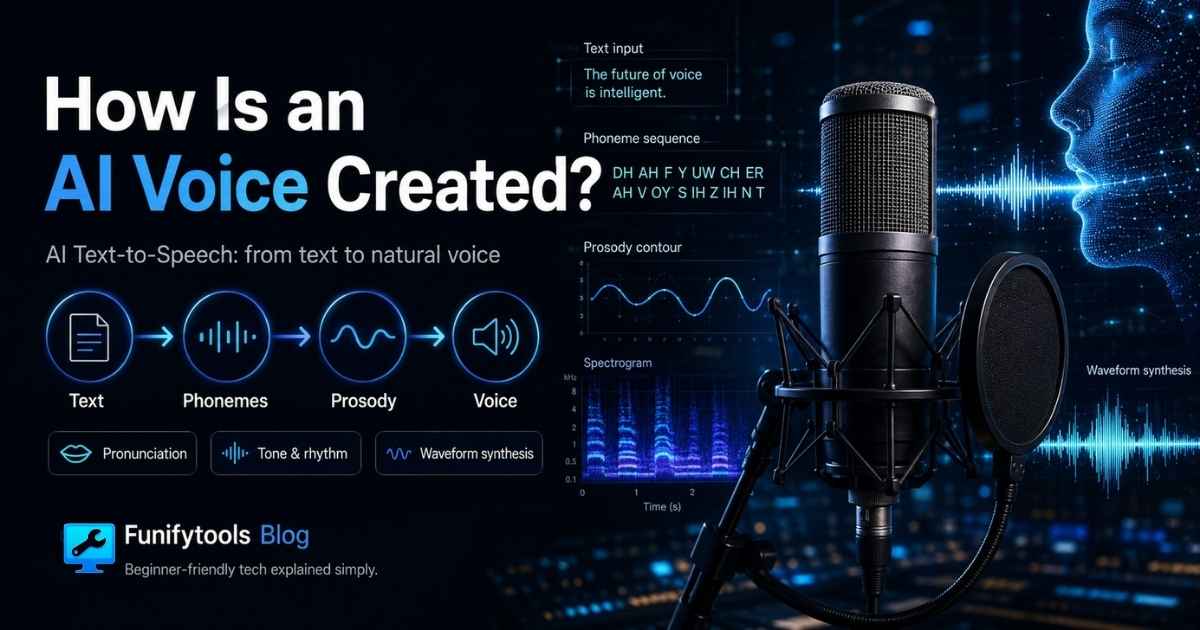
- An AI voice is usually created with text-to-speech, or TTS, which turns written text into spoken audio.
- The system first reads the text and decides how each word should be pronounced.
- It breaks words into smaller sound units, often called phonemes, so the model can build speech sound by sound.
- Modern AI also predicts rhythm, pauses, stress, pitch, and tone so the voice does not sound flat or robotic.
- The model learns from many recordings of real human speech, matching text with the way people actually say it.
- A speech model creates an audio pattern, and a vocoder turns that pattern into a real waveform you can hear.
- Voice cloning works by learning the sound style of a particular speaker, but it raises serious consent and misuse concerns.
- In short, AI voice is not just replayed audio; it is newly generated speech built from language, sound patterns, and learned voice style.
How AI Turns Text Into a Voice
An AI voice can feel almost magical because the result is so familiar. You type a sentence, press a button, and a voice reads it out loud. But the system is not simply pulling a recorded sentence from a library. In most modern tools, the voice is generated fresh from the text you provide.
This process is called text-to-speech, often shortened to TTS. The goal of TTS is simple to describe but difficult to do well: take written language and turn it into speech that sounds natural, clear, and expressive. A good AI voice has to pronounce words correctly, pause in the right places, emphasize the right parts of a sentence, and keep a believable tone from start to finish.
Step 1: Understanding the Text
The first job is text analysis. The system has to read the sentence and decide what the words mean in context. That matters because written text can be ambiguous. The same letters can sound different depending on the word, and the same word can be spoken differently depending on the sentence.
For example, English has many words that do not follow simple spelling rules. A TTS system has to know that read can sound different in past and present tense, that abbreviations may need to be expanded, and that numbers can be spoken in different ways depending on whether they are dates, prices, phone numbers, or measurements.
The model also looks at punctuation and sentence structure. A comma usually means a short pause. A period usually means the thought is finished. A question mark can change the intonation at the end of the sentence. These little written signals help the voice sound less like a machine reading isolated words.
Step 2: Turning Words Into Sounds
After the text is understood, the system needs to convert words into sound units. These sound units are called phonemes. A phoneme is one of the smallest meaningful sounds in a language. The word cat, for example, can be broken into the sounds /k/, /a/, and /t/.
This step is important because computers do not speak by looking at letters the way humans do. They need a sound plan. The model has to know which sounds come first, how long they should last, and how they connect to the sounds before and after them.
Older TTS systems often used rules and small recorded pieces of speech. That approach could work, but it often sounded stiff. Modern neural TTS systems learn speech patterns from data, which lets them handle pronunciation, timing, and transitions more smoothly.
Step 3: Adding Rhythm and Tone
Correct pronunciation is only part of natural speech. A voice also needs rhythm, stress, pitch, and pacing. This is called prosody. Prosody is the reason a sentence can sound excited, calm, serious, friendly, sarcastic, or uncertain even when the words stay the same.
For example, the sentence "Really?" can be curious, surprised, annoyed, or playful depending on how it is said. A natural TTS model tries to predict those speech patterns from the text and from the selected voice style.
This is where modern AI voices have improved dramatically. They do not just pronounce words one by one. They learn how humans stretch some syllables, soften others, pause before an important phrase, and change pitch to keep the listener engaged.
Step 4: Learning From Human Recordings
To build a realistic voice, developers train models on recordings of human speech. The training data usually includes many sentences paired with matching text. The model studies how written words correspond to actual audio: which sounds appear, where pauses happen, how pitch moves, and how the speaker's tone changes across a sentence.
During training, the AI is not memorizing every possible sentence. Instead, it learns patterns. Once it understands those patterns well enough, it can generate speech for sentences it has never heard before. That is why a TTS model can read a brand-new paragraph in a consistent voice.
The amount and quality of training data matter a lot. Clean recordings, accurate transcripts, consistent pronunciation, and varied sentence examples help the model sound more natural. Noisy data or poor alignment can make the voice sound unstable, unclear, or emotionally strange.
Step 5: Creating the Audio
Many modern systems generate an intermediate audio representation first, such as a spectrogram. A spectrogram is a visual-like map of sound over time, showing which frequencies are present and how strong they are. It is not the final sound yet, but it describes the shape of the speech.
Then another model, often called a vocoder, turns that representation into a waveform. The waveform is the actual audio signal that speakers or headphones can play. This is the moment when the model's speech plan becomes sound you can hear.
Different architectures handle these steps in different ways, and newer systems can be much faster and more expressive than older ones. Some can generate speech almost in real time. Some can adjust style, emotion, speed, or speaker identity with only a few settings.
What About Voice Cloning?
Voice cloning is a related idea. Instead of making a general synthetic voice, the system learns the vocal style of a specific person. It may study the person's tone, accent, pacing, pitch range, and pronunciation habits, then generate new speech that sounds similar.
This can be useful for accessibility, localization, games, films, education, and personal voice preservation. But it also has obvious risks. A cloned voice can be misused for scams, impersonation, misinformation, or fake consent. That is why responsible AI voice tools need clear permission, disclosure, and safeguards.
The key point is that voice cloning is not just a fun audio trick. A voice is part of a person's identity. Using someone's voice without permission can be harmful even if the technology works well.
Why AI Voices Still Sometimes Sound Strange
Even strong AI voices can make mistakes. They may stress the wrong word, pause in an odd place, misread a name, flatten an emotional line, or pronounce a rare term incorrectly. These mistakes happen because speech is more than sound. It depends on meaning, culture, emotion, context, and expectation.
Humans are extremely sensitive to voice. We notice tiny changes in timing, breath, emphasis, and emotion. That is why a voice can be technically clear but still feel slightly unnatural. The closer AI gets to human speech, the more noticeable the small imperfections become.
Still, the progress has been remarkable. Modern AI voices can narrate articles, assist people with visual impairments, power virtual assistants, create draft voiceovers, localize content, and make software feel more approachable.
The Simple Version to Remember
An AI voice is created through a chain of steps. The system reads the text, predicts pronunciation, adds rhythm and tone, generates an audio pattern, and turns that pattern into sound. Behind the smooth voice is a model trained on real speech and designed to recreate the patterns of human speaking.
So when you hear an AI voice, you are not hearing a person reading that exact sentence. You are hearing a machine generate new speech based on what it has learned about language, sound, and human vocal style. That is what makes AI voice both useful and powerful, and also why it needs to be used carefully.
This article is also available in Korean: Read the Korean version