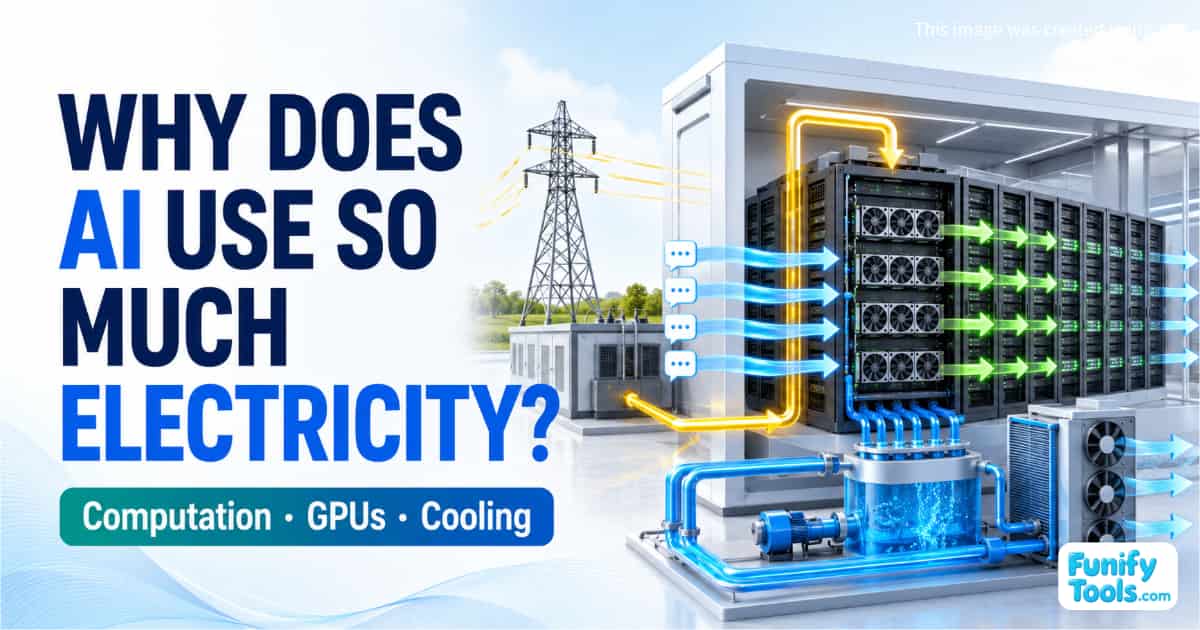
The 10-Second Summary
AI uses a lot of electricity because it performs an enormous number of calculations.
Training requires thousands of GPUs to work continuously for weeks or months, while inference uses additional computing power every time someone asks an AI model a question.
GPUs also generate significant heat, so data centers need powerful cooling systems.
In short:
AI power use = Large-scale computation + Parallel GPU processing + Cooling
That is why electricity is becoming one of the most important forms of infrastructure in the AI era.
Why Does AI Consume So Much Electricity?
The answer is simple:
AI requires an enormous amount of computation.
AI does not merely retrieve stored information. It processes data through billions—or even trillions—of mathematical operations to identify patterns, learn relationships, and generate results.
The larger the model and the more data it processes, the more computing power it generally requires.
AI Training Requires Enormous Computing Power
Training is the process through which an AI model learns patterns from large datasets.
A large training run may involve thousands of GPUs operating simultaneously for weeks or even months. During this process, the GPUs repeatedly perform mathematical operations such as matrix multiplication and addition.
The entire data center effectively operates like one enormous supercomputer.
Electricity consumption increases with factors such as:
- The number of GPUs
- The size of the AI model
- The amount of training data
- The length of the training process
- The efficiency of the hardware and software
Training a major AI model is therefore one of the most energy-intensive stages of AI development.
AI Inference Also Uses Electricity
AI continues to consume electricity after training has been completed.
Inference is the process of using a trained model to answer a question, generate an image, translate text, or perform another task.
Every time someone sends a prompt to an AI chatbot, the model must process the input and calculate which words or tokens should come next. Large models may contain tens or hundreds of billions of parameters, although some architectures activate only part of the model for each request.
A single request may consume only a limited amount of electricity. However, when millions of people use AI services throughout the day, the total demand can become substantial.
Why AI Can Require More Computation Than a Search
A traditional search engine mainly finds and ranks information that has already been indexed.
Generative AI often performs a different kind of work. It processes the user's input through multiple layers of a neural network and generates a new output one token at a time.
The exact comparison depends on the search system, AI model, response length, and hardware. Nevertheless, generating an AI response can require significantly more computation than retrieving a conventional search result.
Long answers, complex reasoning, image generation, and video generation can increase the workload further.
Cooling Requires Additional Electricity
Electricity is not used for computation alone.
GPUs and other AI accelerators generate a large amount of heat while processing data. If that heat is not removed, the hardware can slow down, become unstable, or suffer damage.
Data centers therefore rely on cooling equipment such as:
- Fans
- Pumps
- Chillers
- Air-cooling systems
- Liquid-cooling systems
- Cooling towers
All of this supporting equipment consumes additional power.
The amount used for cooling varies according to the facility's location, climate, server utilization, cooling design, and operating efficiency. A modern data center in a cool region may require less cooling energy than a facility operating in a hot climate.
Why AI Data Centers Need Reliable Power
AI data centers need access to large and stable supplies of electricity.
It is not enough to construct a building and install GPU servers. The operator must also secure enough power to run the computing equipment, cooling systems, storage devices, and networking infrastructure continuously.
This is why AI data centers are often planned around factors such as:
- Available electrical-grid capacity
- Electricity prices
- Access to renewable or low-carbon energy
- Reliability of the local power supply
- Grid-connection schedules
- Cooling and water availability
In some regions, the main obstacle to expanding AI infrastructure is no longer obtaining land or purchasing chips. It is securing enough electricity to operate the equipment.
Final Summary
AI consumes large amounts of electricity because it combines:
- Massive numerical computation
- Thousands of GPUs working in parallel
- Continuous inference for user requests
- Data movement across memory and networks
- Cooling and other supporting systems
The AI industry therefore depends on more than models and processors. It also depends on data centers, electrical grids, power generation, cooling technology, and efficient infrastructure.
In the AI era, electricity is becoming as strategically important as computing chips themselves.
This article is also available in Korean: Read the Korean version