10-second lesson
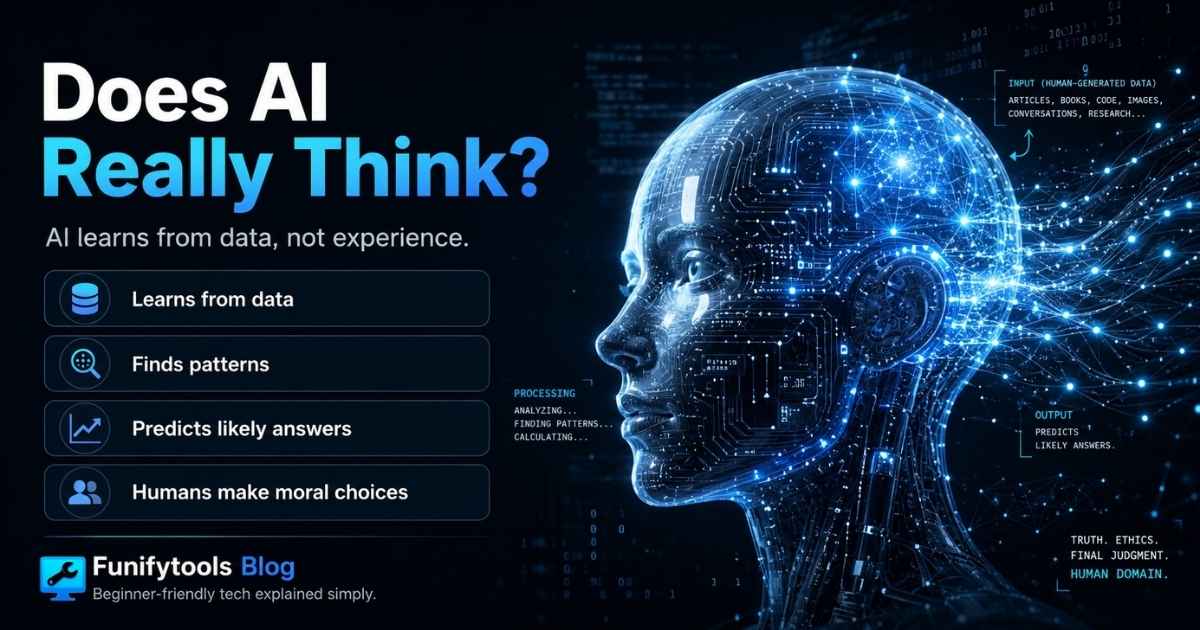
- AI does not think the way humans think; it predicts, compares, and generates based on patterns.
- It does not learn from lived experience, emotions, pain, memory, or personal awareness.
- Modern AI is trained on huge amounts of text, images, code, audio, and other data created by people.
- When AI answers a question, it is not “understanding” like a person; it is generating a response based on learned patterns.
- AI can sound confident even when it is wrong, so human judgment still matters.
- It can help with writing, coding, research, planning, design, and problem solving, but it should not replace human responsibility.
- The real power of AI is pattern recognition at massive scale, not human-style consciousness.
- AI is a tool. Humans still have the final say on truth, ethics, context, and consequences.
Learn More in Detail
Artificial intelligence can feel weirdly human sometimes. It can answer questions, write essays, explain code, summarize long documents, make images, translate languages, and even hold a conversation that feels natural. Sooner or later, almost everyone runs into the same question: does AI actually think?
The honest answer is: not in the human sense. AI can process information, find patterns, and generate responses that look thoughtful. But that does not mean it has a mind, a personal point of view, memories of living in the world, or an inner voice reflecting on what it believes. AI is impressive, but it is not a person hiding inside a server. It is a system trained to recognize patterns and produce useful output.
That distinction matters. If you treat AI like a search engine, you may underestimate how flexible it is. If you treat it like a human brain, you may overestimate what it understands. The useful middle ground is this: AI is a powerful prediction and generation tool. It can help you think, but it does not think the way you do.
What People Usually Mean by “Thinking”
When people say humans think, they usually mean more than just producing words. Human thinking includes memory, emotion, intention, doubt, curiosity, fear, experience, and judgment. A person does more than calculate an answer. A person has a life behind that answer. We remember past mistakes. We connect ideas to things we have seen, touched, lost, wanted, or regretted. We change our minds because something actually matters to us.
AI does not have that kind of inner life. It does not wake up, look around, get bored, feel embarrassed, or worry about whether its answer hurt someone. It does not have childhood memories, personal values, or private goals. It does not experience the world through a body. It does not know what coffee tastes like, what rain feels like, or what it means to miss someone. It can describe those things because it has learned patterns from human language, but description is not the same as experience.
This is where AI can fool us a little. Language is deeply tied to how humans express thought. So when a machine produces fluent language, our brains naturally want to treat it like a thinking speaker. That reaction is understandable. But fluent output is not proof of consciousness. A system can sound thoughtful without having thoughts in the human sense.
How AI Learns From Data
AI learns from data, not from lived experience. During training, an AI system is exposed to massive collections of information. That can include books, articles, websites, code, images, captions, conversations, documentation, and many other types of human-made material. The system looks for patterns in that data: which words tend to appear together, how sentences are structured, how questions are usually answered, how images relate to labels, and how code is commonly written.
Over time, the AI builds a statistical map of patterns. It does not store knowledge exactly the way a person stores memories. It does not sit there thinking, “I remember reading that one article.” Instead, training changes the internal settings of the model so it becomes better at predicting and generating outputs that match patterns in the data.
That is why AI can answer a wide range of questions. It has absorbed patterns from many fields: technology, history, science, business, programming, design, language, and everyday life. But it is also why AI can make mistakes. If the pattern is unclear, outdated, incomplete, biased, or misunderstood, the answer can be wrong while still sounding smooth.
Why AI Sounds So Confident
One of the strangest things about AI is how confident it can sound even when it is wrong. This happens because confidence in language is not the same as confidence in truth. AI is very good at producing sentences that look like the kind of answer a person expects. It can use a clear structure, strong wording, and polished explanations. But that polished style does not automatically mean the content is correct.
Humans do this too, of course. People can be confidently wrong all the time. The difference is that a person may have a reason, belief, memory, or emotional attachment behind that confidence. AI does not need any of that. It can produce a confident-sounding answer because that style matches the pattern of helpful explanations in its training data.
This is why you should be careful with AI answers, especially when the topic involves law, medicine, finance, safety, recent news, technical debugging, academic citations, or anything that can affect real decisions. AI can be a great assistant, but it should not be treated as an unquestionable authority.
Prediction Is Not the Same as Understanding
A common way to explain modern language AI is that it predicts the next word or token. That explanation is useful, but it can also sound too simple. The system is not just guessing random words one at a time like a cheap autocomplete tool. Large AI models build extremely complex patterns from context. They can follow instructions, compare ideas, explain relationships, and adapt tone because their training has captured deep structures in language.
Still, prediction is not the same as human understanding. A person understands a broken phone because they have used phones, dropped things, paid repair bills, felt frustration, and learned from real consequences. AI can explain a broken phone because it has seen many examples of how people talk about phones, batteries, screens, repairs, and troubleshooting.
That does not make AI useless. Actually, it is the reason AI is useful. Pattern recognition at this scale is powerful. It can connect ideas quickly, draft explanations, compare options, and surface possibilities you might not think of right away. But the system is still working through learned patterns, not personal experience.
Can AI Reason?
This is where the conversation gets more interesting. AI can perform tasks that look like reasoning. It can solve math problems, analyze code, compare arguments, explain cause and effect, and break a problem into steps. In practical terms, that can be very useful. If an AI helps you debug a script or organize a business plan, you may not care whether its “reasoning” is human-like as long as the result works.
But there is a difference between producing reasoning-shaped output and having human judgment. AI can follow patterns of reasoning, but it does not care about the result. It does not feel responsible if the conclusion is harmful. It does not have moral discomfort when a solution is technically correct but ethically bad. It does not truly understand stakes unless those stakes are represented in the prompt and data patterns.
So yes, AI can do certain forms of reasoning-like work. It can be extremely good at structured analysis. But that does not mean it has wisdom. Wisdom includes context, restraint, responsibility, and values. Those are still human jobs.
Why AI Can Be Useful Without Being Conscious
A calculator does not understand mathematics the way a mathematician does, but it is still useful. A GPS does not understand travel the way a person does, but it can still guide you across a city. A camera does not understand beauty, but it can capture an image. AI belongs in that same general category, just at a much more flexible and language-rich level.
The fact that AI does not truly think like a human does not make it worthless. It just means we should understand what kind of tool it is. AI is great for drafts, summaries, brainstorming, code suggestions, explanations, language practice, idea organization, and repetitive knowledge work. It can save time and lower the barrier to learning complicated topics.
Where people get into trouble is when they hand over judgment completely. AI can suggest. AI can organize. AI can explain. AI can compare. But people still need to decide what is true, what is fair, what is safe, and what should actually be done.
AI Does Not Know Truth the Way Humans Want It To
AI does not have a built-in truth detector. It can be trained to prefer accurate answers, refuse unsafe requests, cite sources, or say when it is unsure. Those are important improvements. But at the core, AI still generates output based on patterns and instructions. It does not directly experience reality. It does not open its eyes and verify the world.
This is why AI can sometimes mix correct and incorrect information in the same answer. It may explain one part perfectly and then casually invent a detail. It may give a source that sounds real but is not. It may misunderstand a niche topic because the training examples were limited or confusing. It may answer an outdated question as if nothing changed.
The fix is not to avoid AI. The fix is to use it with the right level of trust. For casual learning, AI can be a great starting point. For important decisions, it needs to be checked. For fresh facts, live data, official documents, or expert advice may be necessary. AI is useful, but verification is still part of the job.
The Ethics Problem
The biggest issue is not whether AI can sound smart. The bigger issue is what people do with it. AI can write persuasive text, generate realistic images, automate decisions, analyze personal data, and scale work very quickly. That makes it powerful, but it also creates risk.
If AI is used to help students learn, help doctors review information, help programmers find bugs, or help small businesses create better content, that can be genuinely helpful. But if AI is used to spread misinformation, fake evidence, spam, scams, or biased decisions, the same technology becomes harmful. The tool itself does not carry moral responsibility. The people building it, deploying it, and using it do.
That is why human oversight matters. AI should not be treated as an excuse to avoid responsibility. “The AI said so” is not a real defense when a decision affects people. Humans still need to ask: Is this accurate? Is this fair? Is this safe? Who could be harmed? What context is missing?
What AI Is Good At
AI is very good at working with patterns. It can summarize a long article, clean up messy notes, suggest titles, explain unfamiliar code, compare products, translate rough text, create outlines, and help you get unstuck when you are staring at a blank page. It can also act like a patient tutor, giving examples at different levels of difficulty until something clicks.
For creative work, AI can be a strong starting partner. It can help with naming, structure, tone, alternative angles, and first drafts. For technical work, it can speed up routine tasks, generate boilerplate code, and explain errors. For everyday life, it can help plan, organize, rewrite, and simplify.
The best use of AI is not to replace your brain, but to reduce the boring friction around it. Let it help with the first draft, the outline, the comparison, the cleanup, or the explanation. Then bring your own judgment back in.
What AI Is Bad At
AI can struggle with exact facts, current information, hidden context, personal nuance, and situations where the answer depends on real-world consequences. It can also miss the point when a question is vague. Sometimes it gives the answer that sounds most likely instead of the answer that is actually right.
AI also does not understand your life unless you explain it. It does not automatically know your goals, budget, local laws, family situation, business constraints, or risk tolerance. A human expert may ask follow-up questions because they understand that details matter. AI may rush into a polished answer too quickly if the prompt is missing key information.
That is why good prompting and careful review matter. The better the context you give, the better the output usually gets. And the more carefully you review the answer, the less likely you are to carry forward a mistake.
So, Does AI Really Think?
If by “think” you mean process information, compare patterns, produce explanations, and solve certain problems, then AI can do something that looks a lot like thinking from the outside. In many everyday situations, that is enough to be useful.
But if by “think” you mean conscious awareness, personal experience, emotional understanding, moral responsibility, or human judgment, then no. AI does not think like that. It does not know itself. It does not care. It does not choose a future. It does not understand right and wrong from the inside.
The practical answer is simple: AI is not a mind. It is a tool that can imitate many outputs of a mind. That makes it powerful, useful, and sometimes risky. Use it to move faster, learn better, and explore ideas. But do not hand it the steering wheel for truth, ethics, or responsibility.
The final decision still belongs to people. That is not a weakness of AI. That is the boundary that keeps the tool in the right place.
This article is also available in Korean: Read the Korean version