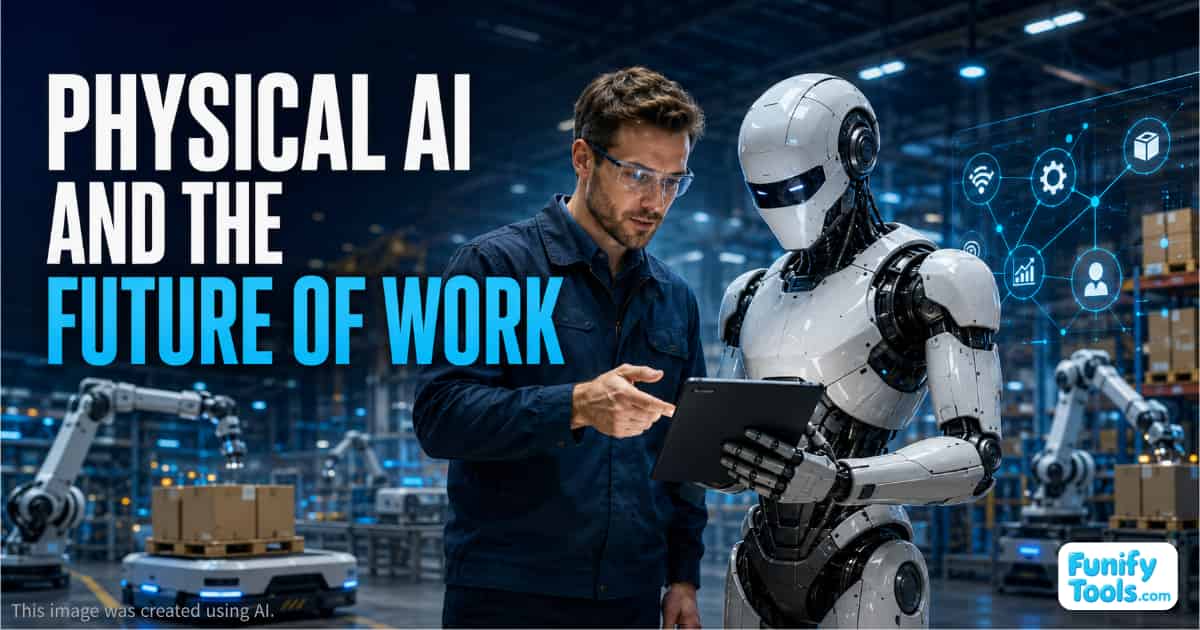
When people talk about AI today, it is becoming increasingly difficult to think only of chatbots that operate on a screen. Attention is shifting beyond AI that can generate text toward systems that can perceive the physical world, make decisions and take action.
This is where the term “physical AI” comes in.
Physical AI Is Redefining the Boundaries of Work
Physical AI refers to artificial intelligence that is integrated with sensors, cameras, control systems, robots and other physical devices. It can perceive its surroundings, interpret situations and perform actions in the real world.
Put simply, it is AI that can see, move and interact with physical objects—not just talk.
The industry often describes this as a continuous system connecting perception, reasoning and action. Unlike conventional generative AI, physical AI must deal with the constraints, unpredictability and safety risks of the real world.
That difference is more significant than it may initially seem.
AI has only recently entered widespread public use, but most people have already come to understand it as a tool for summarizing documents, translating text, writing code and answering questions. Physical AI goes much further.
Imagine a system receiving the instruction, “Pick up the cup.”
A conventional generative AI model can explain what a cup is and describe how someone should pick it up. Physical AI, however, must identify the cup's actual position, determine which way the handle is facing, measure its distance from nearby objects, apply the correct amount of force, avoid collisions and maintain a safe distance from people.
Physical AI is therefore not simply another form of information-processing technology. It must also handle the complexity, uncertainty and responsibility that come with operating in the physical world.
If robots capable of performing these actions become widely available, does that mean human workers will eventually disappear?
Workers Are Unlikely to Disappear, but Work Will Change Dramatically
The short answer is that the entire workforce is highly unlikely to disappear. Existing forms of work, however, could be disrupted on a very large scale.
Many people vaguely feel that AI will eliminate most jobs, but forecasts from major international organizations present a more complex picture.
In its 2025 report, the World Economic Forum estimated that approximately 170 million new jobs could be created worldwide by 2030, while around 92 million could be displaced. This would result in a net increase of roughly 78 million jobs.
At the same time, a significant number of companies said they expected to reduce their workforce in areas where AI can automate existing tasks.
This distinction is important. What lies ahead is more likely to be a large-scale restructuring of employment than the complete end of work.
Jobs Rarely Disappear All at Once
One of the first ideas we need to abandon is the assumption that an entire profession will suddenly disappear overnight.
In reality, some of the tasks within a job are usually automated before the job itself is eliminated—if it is eliminated at all.
In its 2025 update, the International Labour Organization estimated that approximately one in four workers worldwide is employed in an occupation with some degree of exposure to generative AI. However, the organization also explained that most jobs are more likely to be transformed than completely eliminated.
A person's job title may remain the same even as the actual content of the job changes considerably.
In the past, an employee might have written a first draft, checked the information, prepared a report and organized the results manually. In the future, AI may produce the initial draft while the employee focuses on reviewing it, approving decisions, handling exceptions and taking responsibility for the final outcome.
The individual components of a job are likely to change faster than the name of the occupation itself.
Which Tasks Are Most Vulnerable to Automation?
The tasks most likely to decline first are relatively easy to identify. They tend to be repetitive, governed by clear rules, subject to few exceptions and measured using standardized performance criteria.
Examples include:
- Routine data entry
- Standardized document processing
- Scripted customer service
- Repetitive manufacturing tasks
- Predictable warehouse and logistics operations
These areas are already facing strong pressure from automation.
Other forms of work are much more difficult to replace. These include jobs that require direct human interaction, constant awareness of context, judgment under uncertain conditions, management of unexpected events or human accountability when mistakes carry serious costs or safety risks.
Caregiving, management, negotiation, on-site supervision, complex problem-solving, relationship-building and organizational leadership are examples of work that remains difficult to automate fully.
The key distinction is not simply whether a job involves physical or office work. A more useful question is whether the work can be reduced to predictable rules or whether it requires people to continuously handle exceptions in a complex real-world environment.
Physical AI Brings Automation Into the Real World
Physical AI makes the debate even more complicated.
Until recently, discussions about AI automation focused primarily on white-collar work. Physical AI is now raising similar questions about jobs performed in factories, warehouses, roads and other physical environments.
Examples include:
- Robots that pick up and transport goods in warehouses
- Systems that inspect and assemble components in factories
- Autonomous transportation
- Uncrewed mobile equipment
- Service robots
The International Federation of Robotics has reported that industrial robot density in manufacturing continues to rise. The global average has reached 177 robots per 10,000 manufacturing workers. South Korea has the world's highest robot density, with approximately 1,220 robots per 10,000 workers.
Looking at those figures alone, it may seem as though there will soon be no place left for human workers.
A closer look, however, reveals something important. Industrial automation is still heavily concentrated in controlled environments such as factories, where tasks are repetitive and operating conditions can be carefully managed.
The rest of the physical world is not nearly as orderly as a factory.
The Real World Is Much Harder Than a Demonstration Video
A robot that performs well in a factory cannot necessarily replace people at the same speed in a restaurant kitchen, construction site, local shop, hospital, care facility, residential delivery route or sales meeting.
The real world is messy. Exceptions are common, people behave unpredictably, and safety failures can have serious consequences.
No matter how advanced physical AI becomes, processing irregular real-world situations reliably and affordably remains an extremely difficult challenge.
Technology can look nearly flawless in a demonstration video, but actual deployment exposes it to an enormous number of unexpected problems. Ignoring the gap between a controlled demonstration and everyday operation can easily lead to excessive technological optimism.
Physical AI is undoubtedly a powerful trend, but that does not mean all forms of human labor will disappear immediately. For some time, partial automation and human assistance are likely to spread much more widely than complete worker replacement.
Automation May Also Help Solve Labor Shortages
Demographic change is another important factor.
People often view AI and robotics only as technologies that destroy jobs. At the same time, however, many economies are facing a growing shortage of available workers.
According to the OECD Employment Outlook 2025, the average unemployment rate across OECD countries remained low at 4.9% in May 2025, while employment rates continued to stay at relatively high levels.
Meanwhile, population ageing is accelerating. Across the OECD, the number of people aged 65 and over relative to the working-age population rose from 19% in 1980 to 31% in 2023. The ratio could reach 52% by 2060.
This sends an important message.
Companies will not adopt AI and robots only because they want to eliminate jobs. In many cases, they may turn to automation because they cannot find enough people to do the work.
Automation can be used to reduce headcount, but it can also compensate for labor shortages.
The Future Is Not Simply Humans Versus Machines
Looking at the future of work as a simple competition between humans and machines misses the central issue.
The real question is not which side will completely defeat the other. It is which people and organizations will become more productive within a new structure of human-machine collaboration.
The International Monetary Fund has estimated that almost 40% of global employment is exposed to AI. However, the consequences will not be the same for every worker. In some occupations, AI may replace tasks. In others, it may complement workers and improve their productivity.
Advanced economies have a greater proportion of jobs that may be affected by AI, but they may also have more opportunities to use the technology to increase productivity.
AI can therefore function both as a tool that eliminates certain jobs and as an amplifier that makes existing workers more capable.
The most important question is not simply what the technology can do. It is who can use it effectively and who will be forced to adapt to changes imposed by it.
The Greatest Risk May Be the Declining Value of Routine Work
The most realistic conclusion may be that the greatest risk is not an absolute decline in the total amount of work. It is the declining value of people who continue working in conventional, easily automated ways.
In the past, consistently performing repetitive tasks could itself be a valuable professional skill. That advantage is becoming more difficult to maintain.
When AI can draft, summarize, organize and recommend, human work must move to a higher level.
The abilities that become more important include:
- Defining the right problem
- Verifying AI-generated results
- Making ethical and accountable decisions
- Understanding a customer's real circumstances
- Persuading and coordinating people within an organization
- Handling unusual cases that do not fit standard procedures
- Controlling how AI and robotic systems are used
Competitiveness in the future labor market may depend less on how diligently someone can repeat a task and more on how effectively they can use, supervise and control the output produced by AI and robots.
How Should We Prepare for the Age of Physical AI?
What should individuals do to prepare?
First, instead of asking whether your occupation is safe, identify which parts of your work could be automated.
Second, separate the repetitive and easily explained parts of your job from the parts that require distinctly human judgment, relationships or accountability.
Third, simply fearing AI will not prepare anyone for change. People need to use these systems in practice and learn which tasks can be delegated and which decisions must remain under human control.
Fourth, as physical AI becomes more widespread, people with genuine knowledge of real-world workplaces may become even more valuable.
Technology only creates meaningful economic value when it can solve actual problems in the field. Someone who understands coding alone may therefore be less valuable than someone who also understands operational processes, workplace safety, customer behavior and the unexpected situations that occur during real work.
The more technologically advanced the economy becomes, the more important contextual knowledge may be.
Work Is Not Ending—Its Standards Are Changing
In the end, asking whether workers will disappear is only half of the right question.
A more accurate set of questions would be:
Which forms of work will disappear? Which will be redefined? And who will adapt to those changes first?
Physical AI is clearly redrawing the boundaries of labor, but it does not necessarily mean that humans are leaving the workforce. Instead, it is changing the rules by demanding a higher level of judgment, responsibility, collaboration, supervision and system design from people.
Those who are best prepared for the future will not be the ones who only worry about AI taking their jobs. They will be the ones who first understand how their work can evolve alongside AI—and begin adapting before that change is forced upon them.
The age of work is not coming to an end. The standards that define valuable work are changing.
And that transformation has already begun.
Thank you for reading. Have a great weekend!
This article is also available in Korean: Read the Korean version Full Version, Summary