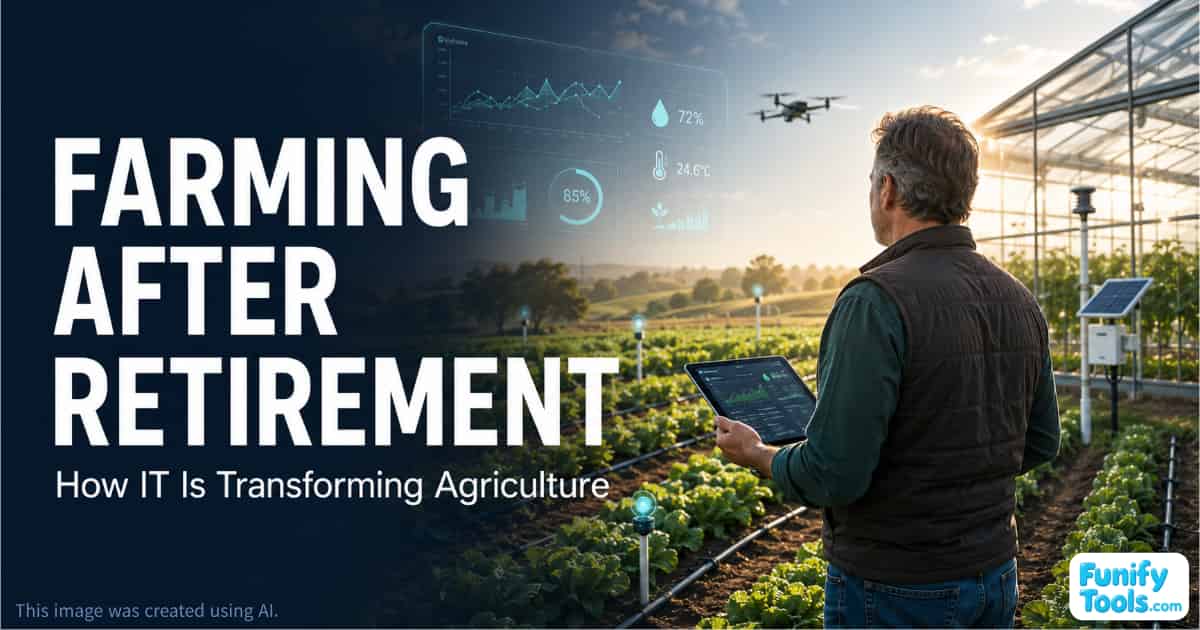
It feels like it has been a while since I last wrote a post. Today, I would like to talk about how information technology is being used in agriculture.
I am still a long way from retirement, but every now and then, I find myself wondering what I might want to do afterward. I could continue living in the city, keep working on a smaller scale, or finally take the time to explore something I have always wanted to try. Among those possibilities, one idea that occasionally comes to mind is moving to the countryside and taking up farming.
When we picture life on a farm, it is easy to imagine a quieter, slower, and more peaceful way of living. In reality, however, farming is far from simple—and modern agriculture is very different from what it used to be.
In the past, farming usually brought to mind images of working the soil, watching the weather, and growing crops through years of experience and intuition. Those things are still fundamental to agriculture. Farming continues to depend on nature, careful attention, and practical knowledge gained in the field.
At the same time, technology is becoming an increasingly important part of the industry. Smart farms, precision agriculture, agricultural drones, AI-powered crop disease detection, farming robots, autonomous machinery, livestock monitoring systems, and food traceability are no longer ideas from the distant future.
For anyone considering farming after retirement, it is worth taking a closer look at how these technologies are already being used.
One of the first concerns prospective farmers face is a lack of experience. Farming is not something that can be learned entirely from books. There are countless situations in which you must observe a crop and make a judgment. Does it need more water? Has it been overwatered? Is the temperature suitable? Are those marks on the leaves the first signs of disease or pests?
These questions can be difficult for a beginner to answer. Agricultural technology can help fill some of those knowledge gaps.
Sensors installed in a greenhouse, barn, or field can measure temperature, humidity, carbon dioxide levels, soil moisture, light, and nutrient solution concentration in real time. Instead of checking every part of the farm manually, a farmer can use a monitoring system that continuously records environmental conditions.
In some cases, the system can also control ventilation, heating, irrigation, and nutrient delivery automatically when conditions change.
One of the best-known examples of this approach is the smart farm.
A smart farm is not simply a farm filled with expensive machinery. It is a farming system that uses data to manage growing conditions and create a more stable environment for crops.
Temperature, humidity, and sunlight are especially important when growing greenhouse crops such as strawberries, tomatoes, and bell peppers. An experienced farmer may be able to assess these conditions intuitively, but someone just starting out may find it difficult to establish reliable standards.
Once sensor readings and crop growth records begin to accumulate, however, farmers can compare when crops were watered, how temperatures changed, and which conditions produced the best yields. Farming no longer depends on intuition alone. Decisions can also be supported by records and data.
Precision agriculture is another important development in agricultural technology.
Rather than treating an entire field as though every part were identical, precision agriculture examines conditions in much smaller areas. Farmers can then apply water, fertilizer, and pesticides only where they are needed and in the appropriate amounts.
Even within the same field, one area may be too dry while another drains poorly. Crops may grow well in one section but struggle in another, and pests or diseases may appear in certain locations before spreading elsewhere.
Drones, satellite imagery, soil sensors, and GPS-guided machinery can help identify and manage these differences.
This approach may also reduce operating costs. Using more fertilizer or pesticide does not necessarily produce better results. Applying only what is needed can lower expenses while reducing the burden on the soil and surrounding environment.
This is especially important for anyone preparing to enter agriculture. Farming has a complicated cost structure, and expenses continue throughout the growing season. Seeds, fertilizer, pesticides, water, electricity, labor, equipment, and maintenance all have to be considered. Small differences in each area can add up to a significant amount.
Using data to reduce unnecessary inputs and understand crop conditions more accurately is therefore likely to become even more important.
Agricultural drones are another widely recognized example of technology in farming.
A drone is more than a device for taking photographs from the air. In agriculture, it can serve as an extra pair of eyes—and sometimes even an extra pair of hands.
Walking through a large rice field or farm to inspect every area takes considerable time. A drone can provide a quick view of the entire property from above. It can help identify uneven crop color, standing water, or sections where plants are not growing well. Drones are also used to spray crops and control pests, reducing the amount of manual labor required.
Moving to the countryside does not necessarily mean that you must become a traditional farmer yourself. Someone who knows how to operate agricultural drones, for example, might provide spraying, surveying, or aerial imaging services to local farms.
Agricultural technology creates opportunities not only in crop production but also in the services that support farming.
Of course, buying a drone is not enough. Operators need proper training, an understanding of safety procedures and applicable regulations, and the ability to maintain the equipment. Still, for someone who is comfortable working with technology and machinery, this could become a promising way to contribute to the agricultural industry.
AI-based crop disease and pest detection is another area worth watching.
When spots appear on leaves, colors begin to change, or stems grow weak, an inexperienced farmer may struggle to determine whether the cause is disease, pests, or a nutrient deficiency.
Some services now allow farmers to photograph a crop with a smartphone and use artificial intelligence to analyze the possibility of disease or pest damage.
AI cannot completely replace an agricultural expert. Results can vary depending on the quality of the photograph, the crop's growth stage, and local environmental conditions. Nevertheless, it can be a useful early-warning tool. It may help a farmer recognize a potential problem sooner and decide when to contact an agricultural extension center or specialist for further assistance.
Agricultural robots and autonomous machinery are also likely to become increasingly important.
Rural communities face serious challenges related to aging populations and labor shortages. Seasonal workers can be difficult to find, particularly during busy planting and harvesting periods, while repetitive farm work can place a heavy physical burden on farmers.
For these reasons, companies and research institutions are developing autonomous tractors, weeding robots, harvesting robots, and transport robots. These machines use technologies such as GPS, cameras, LiDAR, and AI-powered computer vision to follow planned routes, recognize crops, detect obstacles, and perform specific tasks.
However, it would be a mistake to view these technologies too romantically.
The equipment can be expensive, repairs may require specialized assistance, and certain machines may not be suitable for every type of farm. Greenhouses, open fields, rice paddies, and orchards all have very different operating environments.
Before adopting robots or autonomous machinery, farmers must consider whether there is enough room for the equipment to move, whether crop spacing is consistent, whether the ground is stable, and whether the farm has a reliable communications network.
Making good use of agricultural technology is therefore not simply a matter of purchasing equipment. It requires thinking about how the entire farm will be designed and operated.
Technology is also being adopted rapidly in livestock farming.
Sensors can monitor an animal's body temperature, activity level, feed consumption, location, and rumination patterns. This information can help farmers identify signs of illness or breeding cycles earlier.
Automated systems can also manage temperature, humidity, and ventilation inside barns, helping to reduce stress among animals and support more consistent production.
Livestock farming is difficult to step away from, even for a single day. Animals must be fed and cared for continuously, and they can respond quickly to changes in their environment. If warning signs are detected too late, the consequences can be severe.
In this sense, livestock technology is more than a matter of convenience. It is a risk-management tool.
IT also plays an important role in the distribution and sale of agricultural products.
Growing high-quality produce is only one part of running a successful farm. Farmers must also decide how and where to sell it.
Technologies such as QR codes, RFID tags, traceability platforms, and cold-chain monitoring systems can show where a product was grown, when it was harvested, and how it moved through the distribution network.
Consumers want food they can trust, while producers increasingly need ways to demonstrate how their products were grown and handled. A reliable traceability system can help strengthen that trust.
Online sales are another important consideration for anyone interested in farming after retirement.
In the past, many farms depended heavily on wholesale markets and traditional distributors. Today, producers have more options, including direct-to-consumer online sales, subscription boxes, local food platforms, social media, and livestream shopping.
Farm products are ultimately goods that must connect with customers. Clearly explaining who grew them, how they were produced, and how they can be enjoyed can help a small farm stand out.
Skills in blogging, website management, online stores, photography, video production, and customer communication can all become valuable agricultural assets.
This is one of the areas I find especially important.
Growing crops well and selling them well are two different abilities. Even an excellent harvest may not generate a stable income if there is no reliable market for it. On the other hand, a relatively small farm may be able to create new opportunities by communicating its story, quality, and reliability effectively.
Agricultural technology should therefore be understood as more than sensors and automation. It also includes marketing, distribution, and communication with customers.
Weather data and disaster preparedness are equally important.
Agriculture is deeply affected by weather. Heat waves, cold snaps, droughts, heavy rain, typhoons, and frost can dramatically change the outcome of an entire growing season.
Weather APIs, satellite data, regional observation networks, and on-site sensors can provide information tailored to a particular farm. If frost is expected, farmers can prepare protective measures in advance. During a forecast heat wave, they can increase ventilation or cooling in livestock facilities. Before heavy rain arrives, they can inspect drainage systems and take steps to reduce the risk of flooding.
As the effects of climate change become more severe, data-based risk management will become increasingly important in agriculture.
Another essential part of farming is developing the habit of keeping records.
The more carefully a farm is documented, the more opportunities there are to improve it. Recording planting dates, irrigation volumes, fertilizer use, pest outbreaks, harvest quantities, sales prices, working hours, and weather conditions can lead to better decisions the following year.
There is no need to begin with an expensive or complicated platform. A spreadsheet, Google Sheets, or even a simple note-taking app can be enough at first. What matters is moving beyond memory and intuition by creating a record that can be reviewed later.
In that sense, agricultural technology may begin not with expensive machinery but with careful observation and consistent record-keeping.
There is also no need to build an elaborate smart farm or purchase costly equipment from the beginning.
A more practical first step is to choose a crop you are interested in and learn which technologies are commonly used to grow it. Visiting a smart farm training center, attending programs offered by a local agricultural extension service, studying real farms, and reviewing crop-specific cultivation data can all provide valuable experience.
Moving to the countryside to farm is not simply a decision to leave the city. It means entering a new industry and learning an entirely new way of life.
Farmers must understand nature, markets, technology, and day-to-day operations. Anyone seriously considering this path needs to think realistically about the region, the crop, startup costs, sales channels, and the amount of physical labor they can manage.
One thing seems certain: agriculture will not continue exactly as it has in the past.
Farming remains work rooted in soil, weather, and physical effort, but it is also becoming increasingly connected to data and automation. The intuition of experienced farmers is still invaluable, and it is now being supported by sensors, artificial intelligence, drones, robots, and online sales platforms.
These changes may feel overwhelming to someone thinking about starting a farm, but they may also create new opportunities.
People with experience in IT, automation, data management, or online services may find many ways to apply their skills in agriculture. Organizing farm data, documenting production, connecting automated equipment, building online sales pages, and communicating with customers can all strengthen a farm's competitiveness.
Rather than viewing farming after retirement simply as a peaceful country lifestyle, it may be more realistic to see it as a small agricultural business with the potential for digital transformation.
Is retirement still a long way off for you? If so, this may actually be the best time to begin preparing gradually.
There is no need to buy farmland or invest in equipment right away. You can start by learning how agricultural technology is being used, exploring the operation of smart farms and precision agriculture, and studying the production methods and sales structure of crops that interest you.
Even if you ultimately decide not to become a farmer, understanding how agriculture is changing can still be worthwhile.
Agriculture is one of the world's oldest industries, but it continues to evolve—and information technology is at the center of much of that change.
If farming is one of the options you are considering for life after retirement, it is worth looking beyond the traditional image of working the soil. Modern agriculture increasingly connects cultivation with data, automation, distribution, and online sales.
I do not yet know whether I will actually become a farmer someday. Still, learning about agricultural technology already feels like a meaningful way to broaden the possibilities for the future.
Thank you for reading. I hope you have a wonderful day!
This article is also available in Korean: Read the Korean version