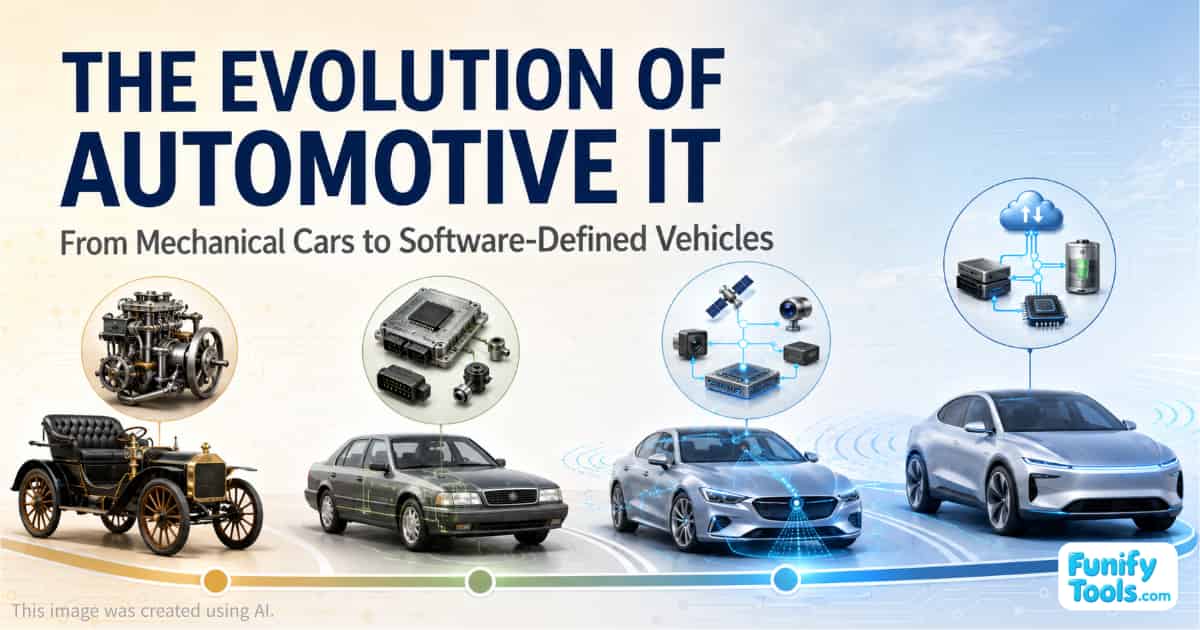
Today, we are going to explore the history of information technology in automobiles.
When people think about cars, they usually picture engines, design, speed, and driving performance. But a closer look at automotive history reveals that cars have been evolving alongside information technology for a surprisingly long time.
The earliest automobiles contained only a few basic electrical components. Electronic control systems followed, and today semiconductors, sensors, software, and communications technology have become central to automotive competitiveness.
This is why modern vehicles are often described as “computers on wheels.”
Let us follow the development of automotive IT and see how it transformed the car from a mechanical machine into a connected, software-driven platform.
Early Automobiles Were Primarily Mechanical
When automobiles first appeared, they contained almost no electronic equipment.
Starting the engine, accelerating, steering, and controlling the vehicle depended almost entirely on mechanical systems. Driving was therefore a much more physical and complicated activity than it is today.
Over time, electrical systems such as ignition components, batteries, and lighting began to appear. The automobile gradually evolved from a purely mechanical machine into one that combined mechanical engineering with electrical technology.
The introduction of the electric starter was particularly important to the widespread adoption of automobiles.
Before electric starters became common, drivers often had to start an engine manually with a hand crank. This required physical effort and could be inconvenient or even dangerous.
The electric starter made automobiles considerably easier to operate. Although starting a car at the press of a button or the turn of a key now seems completely ordinary, it represented a major improvement in usability at the time.
This was not yet the beginning of automotive computing, but it introduced electrical power and control concepts that would later become essential.
Electronic Control Enters the Automobile
Information technology began playing a much larger role in automobiles with the spread of electronic control systems.
Two important examples were electronic fuel injection and the Engine Control Unit, commonly known as the ECU.
In older vehicles, fuel delivery and ignition were largely controlled through mechanical systems. These methods worked, but there were limits to how precisely they could respond to changing conditions.
Sensors and computer control changed that.
Modern engine sensors can measure information such as:
- Engine speed
- Intake airflow
- Coolant temperature
- Throttle position
- Oxygen levels in the exhaust
- Engine load
The ECU processes these signals and calculates the appropriate fuel quantity and ignition timing.
In simple terms, the vehicle began to monitor its own internal condition and adjust its operation accordingly.
This improved fuel economy, reduced emissions, made engines easier to start, and increased overall driving stability. It marked a major transition from purely mechanical operation to data-driven control.
Sensors and In-Vehicle Networks
As electronic control became more widespread, automobiles gained an increasing number of specialized control units.
Electronic systems began managing not only the engine but also:
- Transmission
- Brakes
- Airbags
- Steering
- Climate control
- Lighting
- Doors and windows
- Instrument displays
As the number of systems increased, they needed a reliable way to exchange information.
This made in-vehicle networking essential.
One of the most important technologies was the Controller Area Network, better known as CAN.
CAN allows electronic control units throughout a vehicle to communicate over a shared network. Instead of every component operating independently, multiple systems can exchange data and coordinate their behavior.
For example, the engine, transmission, stability-control system, and instrument cluster may all use some of the same vehicle-speed information.
This networked architecture became one of the foundations of modern automotive electronics.
Vehicle Diagnostics Become Data-Driven
Diagnostic technology also changed the way vehicles were maintained.
In the past, technicians often had to identify faults through direct observation, mechanical inspection, and personal experience. Those skills remain important, but modern vehicles can also detect abnormal conditions and record diagnostic trouble codes.
A technician can connect a diagnostic scanner to the vehicle and retrieve information about the detected fault.
This changed automotive maintenance from a process based mainly on symptoms into one increasingly supported by data.
The diagnostic code does not always identify the failed component directly. It may instead indicate which system detected an abnormal value. Technicians must still interpret that information and determine the underlying cause.
Nevertheless, onboard diagnostics made troubleshooting faster, more consistent, and better suited to increasingly complex vehicles.
Modern Automotive Safety Depends on IT
Automotive safety can no longer be explained through mechanical design alone.
Systems such as ABS, Electronic Stability Control, and airbags depend on sensors, electronic control units, and carefully designed software.
Anti-Lock Braking System
ABS monitors wheel speed and detects when a wheel is about to lock during braking.
The system rapidly adjusts brake pressure so the driver can maintain greater steering control while slowing down.
Electronic Stability Control
ESC monitors factors such as steering input, wheel speed, and vehicle rotation.
If the system determines that the vehicle is beginning to skid or move in a direction different from the driver's intended path, it can apply braking force to individual wheels and reduce engine power.
Airbag Control
Airbags also depend on electronic sensing and control logic.
Impact sensors measure sudden changes in acceleration, while the control unit determines whether the collision meets the conditions for deployment. The system must make this decision in a fraction of a second.
Modern vehicle safety therefore depends not only on making the body stronger. It also depends on how quickly the vehicle can detect a dangerous situation, how accurately it can interpret the data, and how appropriately it can intervene.
At this stage, much of the automobile had already entered the world of embedded systems and control algorithms.
Connected Cars Transform the Driving Experience
During the 2000s, automotive IT began changing not only how vehicles operated but also how drivers interacted with them.
A growing number of features became common, including:
- GPS navigation
- Bluetooth connectivity
- Reversing cameras
- Parking sensors
- Parking assistance
- Infotainment displays
- Head-up displays
- Smartphone integration
Earlier automobiles were primarily designed to transport people from one place to another. Cars of this era increasingly provided information, entertainment, communication, and assistance during the journey.
The connected-car concept changed the industry even further.
Once vehicles could communicate with external networks, owners could remotely check vehicle status, receive live navigation data, request emergency assistance, and access online services.
The car became more than a form of transportation. It became a connected digital device.
From this point onward, automotive competitiveness was no longer determined by engine performance alone. Software interfaces, connectivity, digital services, and user experience also became important.
ADAS and Autonomous Driving
Some of the most important terms in today's automotive industry include autonomous driving and Advanced Driver Assistance Systems, or ADAS.
Many modern vehicles already offer features such as:
- Lane-departure warning
- Lane-keeping assistance
- Forward-collision warning
- Automatic emergency braking
- Adaptive cruise control
- Blind-spot monitoring
- Automated parking
These systems use cameras, radar, ultrasonic sensors, and sometimes LiDAR to observe the surrounding environment.
The vehicle's onboard computers then analyze the sensor data and determine whether to warn the driver or assist with braking, acceleration, or steering.
This requires several processes to happen quickly:
- Sensors collect information about the environment.
- Computers interpret the data.
- Software evaluates possible risks.
- The vehicle chooses an appropriate response.
- Electronic systems control the brakes, steering, or powertrain.
The more advanced the assistance system becomes, the more the vehicle depends on computing performance, sensor accuracy, software reliability, and carefully designed safety logic.
Electric Vehicles Accelerate the Software Transition
The growth of electric vehicles has accelerated the move toward software-centered automobiles.
An electric vehicle requires sophisticated software to manage systems such as:
- Battery temperature
- State of charge
- Battery-cell balancing
- Power delivery
- Motor control
- Charging speed
- Energy consumption
- Regenerative braking
- Thermal management
The Battery Management System, or BMS, continuously monitors the battery pack and helps keep it within safe operating limits.
Software also determines how the vehicle distributes power, recovers energy during braking, protects the battery, and estimates the remaining driving range.
As a result, electric-vehicle performance depends not only on the battery cells and motors themselves, but also on how intelligently the software manages them.
OTA Updates Change the Product Life Cycle
Over-the-air updates, commonly known as OTA updates, represent another major transformation.
Traditional vehicles generally left the factory with a fixed set of capabilities. Improving or changing a system often required a visit to a service center or the physical replacement of components.
OTA technology allows manufacturers to deliver software updates remotely.
Depending on the vehicle and system, an update may:
- Fix software problems
- Improve interface performance
- Update maps
- Adjust energy-management logic
- Enhance driver-assistance functions
- Add supported features
- Strengthen cybersecurity
This means a vehicle can continue to change after it has been sold.
The automobile is no longer necessarily a finished product at the moment it leaves the factory. It is becoming a continuously maintained and updated platform.
What Is a Software-Defined Vehicle?
The term Software-Defined Vehicle, or SDV, describes a vehicle whose functions and user experience are increasingly determined by software.
This does not mean that mechanical engineering has become unimportant. Brakes, suspension, steering components, motors, batteries, and vehicle structures remain essential.
The difference is that more of the vehicle's behavior is now coordinated and improved through software.
A software-defined vehicle may use a more centralized computing architecture instead of relying on many isolated electronic control units. Its features may be managed through common software platforms and updated throughout the vehicle's lifetime.
In this model, software becomes central to:
- Vehicle performance
- Safety functions
- Energy efficiency
- Infotainment
- Connectivity
- Personalization
- Maintenance
- Future feature development
The result is a vehicle that increasingly resembles a digital platform with mechanical mobility.
Cybersecurity Becomes a Safety Requirement
As vehicles become more connected and software-dependent, cybersecurity becomes an essential part of automotive safety.
A connected vehicle may communicate with:
- Smartphones
- Cloud platforms
- Navigation services
- Charging networks
- Service centers
- Other infrastructure
Each connection creates useful functionality, but it can also create potential security risks.
Manufacturers therefore need to protect vehicle networks, authenticate software updates, isolate critical systems, monitor vulnerabilities, and respond to newly discovered threats.
In a modern automobile, cybersecurity is not merely an IT concern. A compromised digital system could affect physical operation, so software protection must be treated as part of vehicle safety.
IT Will Shape the Future of the Automobile
The history of the automobile is not simply a story of engines becoming more powerful.
It is also the history of electrical systems, electronic control, sensors, in-vehicle networks, diagnostics, connectivity, driver assistance, autonomous-driving research, and software-defined vehicles.
The progression can be summarized as follows:
- Mechanical controls
- Basic electrical systems
- Electronic engine management
- Multiple networked control units
- Data-driven diagnostics and safety
- Connected infotainment and services
- Advanced driver assistance
- Electrification and battery software
- OTA updates
- Software-defined vehicle platforms
In the past, an automobile was primarily a machine that moved according to the driver's physical inputs.
A modern vehicle processes large amounts of data in real time, monitors its own systems, observes its surroundings, communicates with external networks, and may intervene when it detects danger.
This is why evaluating a modern vehicle requires more than looking at engine displacement, horsepower, or acceleration.
We must also consider:
- Semiconductor performance
- Sensor quality
- Software architecture
- Data-processing capability
- Network design
- Update support
- User interface
- Cybersecurity
- Long-term software maintenance
The future of the automobile will be driven not only by mechanical engineering, but also by the information technology operating inside it.
The modern vehicle is becoming a digital platform on wheels.
Thank you for reading, and I hope you have a wonderful day!
This article is also available in Korean: Read the Korean version