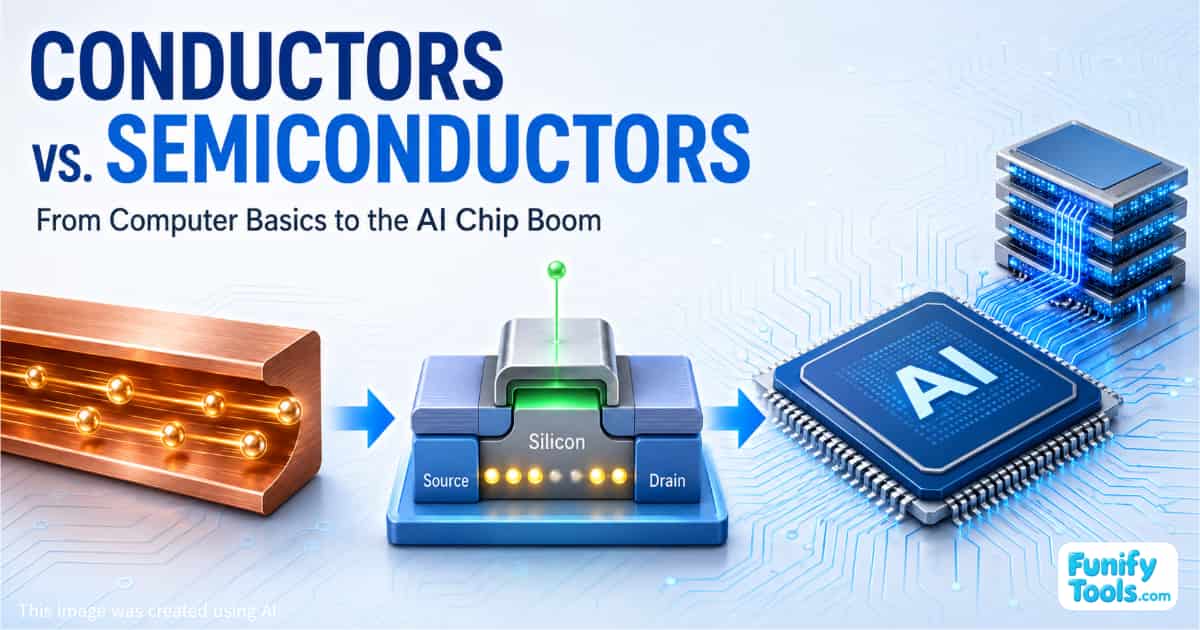
The computers and smartphones we use every day operate using electricity. However, electricity does not flow through every material in the same way. Some materials allow electricity to pass through easily, while others block it almost completely. There are also materials whose electrical conductivity can change depending on specific conditions.
A material that conducts electricity well is called a conductor. A material whose conductivity can be precisely controlled is called a semiconductor.
| Category | Definition | Main function | Common examples |
|---|---|---|---|
| Conductor | A material through which electricity flows easily | Carries electrical current and connects components | Copper, aluminum |
| Insulator | A material through which electricity barely flows | Blocks current for insulation and protection | Rubber, glass, plastic |
| Semiconductor | A material whose conductivity changes under certain conditions | Controls current and enables electronic circuits | Silicon, germanium |
What Is a Conductor?
A conductor acts as a pathway for electricity. Metals such as copper and aluminum are common examples because their electrons can move relatively freely. When voltage is applied, electrons travel through the material with comparatively little resistance.
Conductors are therefore used to make electrical wires, connect electronic components, and deliver power.
A simple way to think about a conductor is to imagine a road for electricity. Just as cars can move efficiently along a wide, well-maintained road, electric current can travel easily through a material with low electrical resistance.
What Is a Semiconductor?
The word “semiconductor” suggests something between a conductor and an insulator. However, its most important characteristic is not simply that it conducts electricity moderately well.
What makes a semiconductor valuable is that its conductivity can be deliberately controlled.
A semiconductor material such as silicon does not conduct electricity particularly well in its pure form. However, manufacturers can add extremely small amounts of other elements through a process called doping. This changes the material's electrical properties and allows it to carry current more effectively.
A semiconductor's behavior can also change in response to an electric field, temperature, or light. Rather than acting like a simple road, a semiconductor can function like a highly precise valve that allows electric current to pass through or stops it when necessary.
This ability to control electrical current is what makes modern electronic devices possible.
Why Computers Need Semiconductors
Computers use semiconductors because they need an enormous number of switches that can turn on and off extremely quickly.
The smallest unit of information in a computer is represented by 0 and 1. These binary states can be expressed using two electrical conditions:
- Current is flowing.
- Current is not flowing.
A transistor made from semiconductor material operates like a tiny switch. One electrical signal controls whether another current can pass through it.
When transistors are combined, they can form circuits that perform logical operations such as AND and OR. These logic circuits can then be combined into larger processing units capable of addition, multiplication, comparison, and many other calculations.
Semiconductors can also be used to create memory by storing and retrieving tiny electrical charges.
In simple terms, semiconductor devices control electricity to make computation and memory possible. Conductors, on the other hand, carry the electrical power and signals needed for those operations.
Modern chips contain extremely dense networks of microscopic metal interconnects. These metal lines perform the role of conductors by carrying signals between transistors and different parts of the chip.
A computer therefore needs both semiconductor switches and conductive wiring. Neither can perform the entire job alone.
Related reading
How Computers Calculate Using Electricity: Understanding Binary Numbers and How Computers Represent Decimal Values with 0s and 1s
Computers represent and process numbers, text, images, and other information by combining two electrical states: on (1) and off (0).
Why AI Is Driving Semiconductor Demand
Why have semiconductors become such an important topic in the age of AI?
Artificial intelligence—particularly deep learning—can perform tasks such as understanding language, recognizing images, and generating new content. Behind these seemingly human-like abilities, however, AI systems repeatedly perform enormous amounts of numerical computation.
Many AI workloads rely heavily on matrix multiplication and multiply-accumulate operations. As models become larger, they contain more parameters, process more training data, and handle more tokens. The amount of computation required can grow dramatically.
To complete more calculations in the same amount of time, a system needs more switches operating at greater speed and with higher energy efficiency.
That is the role of AI accelerators such as:
- GPUs
- TPUs
- NPUs
- Other specialized AI processors
In this context, a semiconductor is no longer merely one component inside a computer. It becomes the computational engine of the AI era.
AI Needs More Than Fast Processors
Fast computation alone is not enough to deliver strong AI performance.
An AI processor must continuously retrieve data from memory and write results back to it. If data cannot move quickly enough, even an extremely powerful processor may spend time waiting instead of calculating.
This is why technologies such as high-bandwidth memory, or HBM, have become increasingly important. Advanced packaging is also essential because it places processors and memory closer together, allowing data to travel over shorter distances at higher speeds.
Large AI models are often trained using many accelerators working together. This requires high-speed interconnects that can transfer data rapidly between processors, memory systems, servers, and data centers.
Within this broader system:
- Semiconductor processors act as the engines.
- Conductors deliver power and carry signals.
- Memory supplies the data required for computation.
- Interconnects allow processors and servers to communicate.
- Packaging places critical components close together.
- Cooling systems remove the heat generated by intensive processing.
As AI systems grow, the computational engines become larger and more powerful—but the pathways around them must also become wider, faster, and more complex.
This is why AI growth affects not only processor manufacturers but also companies involved in memory, packaging, substrates, networking, power delivery, semiconductor equipment, and cooling technology.
Why the AI Chip Boom Affects Semiconductor Stocks
This technological shift is closely connected to stock-market expectations.
Financial markets are highly sensitive to estimates of future demand. As AI services become more widely adopted, companies are likely to invest more heavily in data centers. That can increase demand for AI accelerators, memory chips, networking equipment, power systems, and related infrastructure.
Some of the most important technologies are also difficult to manufacture and expand quickly. Leading-edge semiconductor processes, HBM, and advanced packaging all require specialized equipment, technical expertise, and substantial production capacity.
When demand rises faster than supply, expectations for corporate revenue, pricing power, and profit margins can increase. This is one reason semiconductor stocks often attract attention whenever enthusiasm about AI strengthens.
Semiconductors are increasingly viewed not simply as components used in IT products, but as essential infrastructure that can improve productivity across entire industries.
However, the benefits of AI growth will not be distributed evenly across the semiconductor sector.
Different companies occupy different positions in the industry:
- Some specialize in computational chips such as GPUs and NPUs.
- Some have a competitive advantage in memory products such as HBM.
- Some produce the advanced packaging and substrates that connect processors and memory.
- Others supply the manufacturing equipment required to produce these chips.
A broad increase in AI demand does not guarantee that every semiconductor company will benefit equally. Investors still need to examine each company's technology, market position, production capacity, customers, valuation, and profitability carefully.
Conductors Carry Electricity; Semiconductors Control It
To summarize, conductors provide the pathways through which electrical power and signals travel. Semiconductors act as switches that control those flows and turn them into computation.
A computer is essentially a system containing vast numbers of microscopic switches connected by even smaller conductive pathways.
AI requires these systems to perform more calculations, move more data, and operate at high intensity for longer periods. As a result, demand is growing across processors, memory, interconnects, packaging, power infrastructure, and cooling systems.
Ultimately, the AI semiconductor boom begins with one fundamental requirement:
AI needs more computation and much faster movement of data.
That demand is turning semiconductor technology into one of the most important foundations of the AI economy.
Thank you for reading, and I hope you have a wonderful day!
This article is also available in Korean: Read the Korean version Full Version, Summary