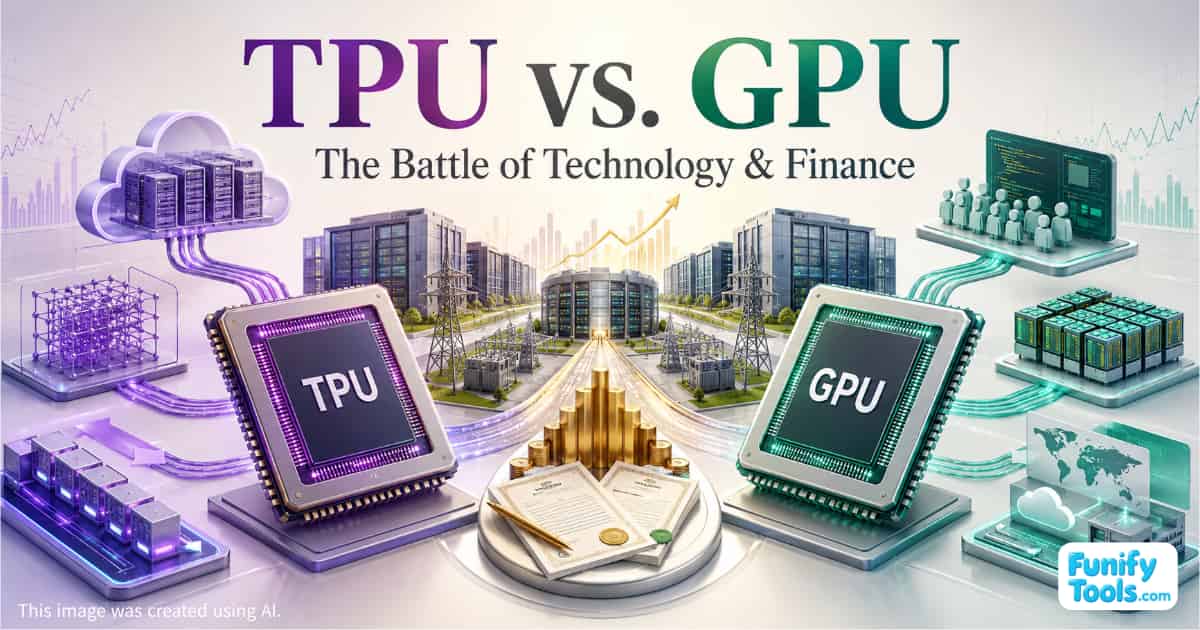
Anyone who follows artificial intelligence is now familiar with the term GPU. More recently, however, Google's TPU has also become a frequent topic of discussion.
At first glance, both are simply chips used for AI computing. Recent reports suggest, however, that the competition is no longer limited to chip performance. It is increasingly becoming a contest over who can finance, build, and control AI infrastructure more effectively.
In other words, the TPU-versus-GPU rivalry is developing into both a technological battle and a financial one.
What Is a GPU?
GPU stands for Graphics Processing Unit.
GPUs were originally designed to process 3D graphics quickly. They contain thousands of smaller computing units capable of performing many calculations in parallel, making them particularly effective at workloads involving matrix multiplication and vector operations.
Because deep learning relies heavily on these types of calculations, GPUs naturally became the standard hardware for training and running AI models.
Nvidia strengthened this position by building a broad software ecosystem around its hardware. CUDA, along with supporting libraries and development tools, made it easier for researchers and companies to use Nvidia GPUs for AI, scientific computing, simulation, and other demanding workloads.
As a result, the GPU became more than a graphics processor. It developed into the default general-purpose accelerator for modern AI.
What Is a TPU?
TPU stands for Tensor Processing Unit.
A TPU is a custom processor designed by Google specifically for machine-learning workloads. It is closer to an application-specific integrated circuit, or ASIC, than to a traditional general-purpose processor.
As its name suggests, the TPU is optimized for tensor operations—the large-scale mathematical calculations used in neural networks. It is deeply integrated with Google's infrastructure and development ecosystem, including Google Cloud, TensorFlow, and JAX.
If a GPU is a flexible accelerator capable of handling graphics, scientific computing, and AI, a TPU is more like a purpose-built engine tuned for large-scale machine learning.
That specialization can provide advantages in performance, throughput, and energy efficiency for supported workloads. The tradeoff is that TPU access and deployment options are more closely connected to Google's infrastructure.
The Technical Differences Between TPUs and GPUs
From a purely technical perspective, the distinction can be summarized relatively simply.
A GPU is a flexible parallel processor that supports many types of workloads. It can be used for gaming, graphics rendering, scientific simulations, video processing, AI training, and inference. GPUs are available through multiple cloud providers and can also be deployed in privately operated data centers.
This versatility is one of the GPU's greatest strengths. Developers can use it with a wide range of frameworks, libraries, and operating environments.
A TPU is designed primarily for large-scale machine-learning training and inference. Its architecture focuses on efficiently processing the matrix and tensor operations common in neural networks.
TPUs can be highly efficient when a model and software stack are well suited to Google's hardware. However, they are less broadly available than GPUs and are more tightly integrated with Google Cloud and Google's development tools.
| Category | GPU | TPU |
|---|---|---|
| Full name | Graphics Processing Unit | Tensor Processing Unit |
| Original purpose | Graphics processing | Machine-learning acceleration |
| Design | General-purpose parallel accelerator | Purpose-built AI accelerator |
| Workloads | Graphics, simulation, AI, video, scientific computing | Primarily AI training and inference |
| Software ecosystem | CUDA and broad framework support | Google Cloud, TensorFlow, JAX and related tools |
| Deployment options | Multiple clouds and on-premises environments | Primarily Google's infrastructure |
| Main advantage | Flexibility and broad compatibility | AI specialization and potential efficiency |
| Main limitation | Cost, power consumption, and availability | More limited deployment flexibility and potential ecosystem dependence |
These differences matter, but they no longer tell the entire story.
The Competition Is Expanding Beyond Chip Performance
For years, discussions about AI accelerators focused on benchmarks: training speed, inference throughput, memory bandwidth, power consumption, and cost per operation.
The competitive landscape is now becoming much broader.
Building AI infrastructure requires more than purchasing processors. Companies also need land, electricity, cooling systems, networking equipment, memory, construction capacity, and long-term access to data-center space.
Most importantly, they need financing.
This means that chip companies and cloud providers are increasingly competing not only through hardware and software, but also through their ability to support enormous infrastructure projects.
The central question is no longer simply:
Which chip is faster?
It is increasingly becoming:
Which company can provide the hardware, software, data-center capacity, power, and financing as one complete package?
Nvidia's Role Is Moving Beyond Selling GPUs
According to recent reports, Nvidia's influence in the AI industry extends beyond manufacturing and selling processors.
The company has reportedly supported customers and infrastructure partners as they secure the resources needed to build large-scale AI data centers. These arrangements can include investments, purchase commitments, partnerships, credit support, and other forms of financial backing.
The logic is straightforward. A customer that obtains financing and data-center capacity can purchase and deploy more GPUs. Nvidia therefore has a strong incentive to help expand the infrastructure in which its hardware will operate.
This creates a self-reinforcing ecosystem:
- Infrastructure developers secure funding.
- New data-center capacity is constructed.
- Nvidia GPUs are installed in those facilities.
- Cloud and AI companies gain access to more computing power.
- Demand for Nvidia's hardware and software ecosystem grows further.
Under this model, Nvidia is not functioning solely as a chip supplier. It is also helping shape the financial and physical infrastructure surrounding its products.
Google Is Building a Similar Infrastructure Strategy
Google appears to be pursuing a comparable strategy around its TPUs.
Producing a powerful AI chip is not enough if there is insufficient electricity, cooling capacity, or rack space available to deploy it. Google therefore needs access to data centers capable of operating TPU-based infrastructure at a very large scale.
Reports involving bitcoin-mining company TeraWulf and cloud infrastructure provider Fluidstack illustrate this direction. Google reportedly agreed to support long-term lease obligations connected to the construction and operation of AI data-center capacity.
These arrangements could give Google access to additional power and infrastructure suitable for deploying its AI technology. Reports also indicate that the structure included warrants that could allow Google to acquire an ownership interest in TeraWulf.
The strategic logic resembles the ecosystem surrounding GPUs. Google can use its balance sheet and credit strength to support infrastructure development, while securing more capacity for TPU-based services.
In this sense, Google is not simply competing with Nvidia by designing another processor. It is attempting to build an entire commercial and financial structure around its AI hardware.
Why the Financial Structure Matters
This development is important because AI infrastructure is extremely capital-intensive.
A new AI data center may require years of construction, large electricity contracts, expensive cooling systems, advanced networking equipment, and long-term commitments from tenants.
Smaller infrastructure providers may not have enough credit strength to finance these projects independently. A guarantee or long-term commitment from a large technology company can make lenders and investors more willing to provide funding.
The technology company gains access to infrastructure, while the data-center developer gains financing and a major customer.
However, this arrangement also transfers risk.
If demand for AI computing fails to grow as expected, the data center may not generate enough revenue to justify its cost. Long-term leases and guarantees can then become financial liabilities for the companies that supported the project.
The competition is therefore becoming a test of both technological judgment and capital allocation.
The Growth of AI-Related Debt
The rapid expansion of AI infrastructure is also affecting corporate debt markets.
Reports indicate that major hyperscalers—including Google, Meta, and Amazon—have issued large amounts of corporate debt to support investment in data centers, chips, networks, and other AI infrastructure.
For technology companies, borrowing can be a rational strategy when expected returns from AI investment exceed financing costs. It allows them to expand quickly without relying entirely on existing cash.
For bond investors, however, the scale and speed of the investment raise several questions:
- Will AI services generate enough revenue to justify the spending?
- How quickly will new chips become obsolete?
- Will electricity and construction costs continue to rise?
- Could excessive data-center capacity reduce future returns?
- Will credit spreads widen if investors become more cautious?
- How much exposure do technology companies have through guarantees and long-term leases?
These questions show why the TPU-versus-GPU contest is increasingly connected to finance.
The Competitive Unit Is Becoming the Entire Package
In the next phase of the AI market, individual chip performance may become only one part of the purchasing decision.
The complete package could include:
- Accelerator performance
- Memory capacity and bandwidth
- Power efficiency
- Software libraries and developer tools
- Networking systems
- Cloud availability
- Data-center locations
- Electricity supply
- Financing and lease structures
- Long-term supply commitments
- Technical support
- Migration costs
Google can offer TPUs as part of a deeply integrated Google Cloud environment. This may provide strong performance and operational efficiency for customers whose workloads fit the platform.
Nvidia's strength is different. Its GPUs are available through multiple cloud providers, server manufacturers, and on-premises configurations. CUDA also gives Nvidia a large and mature software ecosystem.
The competition is therefore not simply specialized hardware versus general-purpose hardware. It is an integrated cloud platform competing with a broadly distributed accelerator ecosystem.
The Risk of Excessive AI Infrastructure Investment
The current investment cycle assumes that demand for AI computing will continue to grow rapidly.
That assumption may prove correct. AI models are becoming larger, inference demand is increasing, and companies are integrating AI into more products and business processes.
Nevertheless, overinvestment remains a genuine risk.
Data centers are built for long operating periods, while AI chips advance much more quickly. A facility may still be relatively new when the processors inside it are already considered inefficient compared with the next generation.
If interest rates rise, financing becomes more expensive. If AI revenue grows more slowly than expected, companies may struggle to earn adequate returns from their infrastructure.
Possible risks include:
- Underused data-center capacity
- Falling rental rates for computing infrastructure
- Accelerated depreciation of older AI chips
- Expensive power agreements
- Losses on long-term lease commitments
- Reduced demand for a particular accelerator architecture
- Pressure on cloud providers to lower prices
In that environment, financial strength could become as important as technical leadership.
More Competition Could Benefit Customers
For developers and businesses, stronger competition between TPUs and GPUs could be good news.
Nvidia's dominant position has given the company significant influence over pricing, supply, and the direction of the AI software ecosystem. A credible alternative could give customers more negotiating power and reduce dependence on a single supplier.
Reports that companies such as Meta have considered using Google TPUs are important even if a complete transition never happens. The possibility of moving workloads to another platform can strengthen a customer's negotiating position.
Competition may encourage:
- Lower prices
- Improved availability
- Better energy efficiency
- Faster hardware development
- Stronger software support
- More flexible cloud offerings
- Greater interoperability between platforms
However, switching from one accelerator ecosystem to another is rarely simple. Models, libraries, deployment pipelines, monitoring tools, and employee skills may all need to be adapted.
Platform Lock-In Remains a Major Concern
The growth of alternative AI chips does not automatically eliminate platform dependence. It may simply create different forms of lock-in.
A company that adopts Google's full TPU package may become deeply dependent on Google Cloud, Google's development tools, and TPU-specific infrastructure.
A company that builds primarily around Nvidia may become dependent on CUDA, Nvidia networking products, optimized libraries, and cloud configurations designed around Nvidia hardware.
This means that decision-makers should evaluate more than raw performance.
A useful set of questions includes:
- Can this workload run on another platform?
- How difficult would migration be?
- Are the software tools based on open standards?
- Can the system be deployed across multiple cloud providers?
- How much specialized employee training is required?
- What will the total cost look like over five years?
- How much negotiating power will the company retain?
- Could the hardware be repurposed if the original workload changes?
TFLOPS and benchmark results remain important, but they do not measure long-term flexibility.
TPU vs. GPU: Which One Is Better?
There is no universal answer.
A GPU may be the better option when a company needs broad framework compatibility, flexible deployment, mature development tools, and the ability to use multiple cloud or on-premises environments.
A TPU may be attractive when workloads are well suited to Google's architecture and the organization already relies heavily on Google Cloud, TensorFlow, JAX, or related services.
The final decision should consider:
- Workload performance
- Model compatibility
- Training and inference requirements
- Energy efficiency
- Cloud pricing
- Developer experience
- Availability
- Migration costs
- Vendor concentration
- Long-term platform strategy
A slightly faster chip may not be the better choice if it creates much higher operational or migration costs later.
Final Thoughts
The competition between TPUs and GPUs has moved far beyond benchmark charts.
It now involves chips, software, cloud platforms, data-center capacity, electricity, financing, leases, and corporate credit. The companies best positioned to lead the AI infrastructure market may be those capable of designing all of these elements as one coordinated system.
Nvidia's advantage comes from its widely adopted GPU and CUDA ecosystem. Google's opportunity comes from combining purpose-built TPUs with its cloud platform, technical expertise, and financial strength.
The result is both a technology contest and a capital-allocation contest.
As companies commit billions of dollars to AI infrastructure, customers and investors will ultimately share both the potential rewards and the financial risks. For developers and business leaders, the most important question is no longer simply which chip is faster today.
It is also which platform will provide the best combination of performance, cost, flexibility, and strategic freedom over the years ahead.
Thank you for reading, and have a wonderful day!
This article is also available in Korean: Read the Korean version