Just for context, I do not invest in stocks.
About five or six years ago, however, I remember debating whether to buy a new graphics card because prices had risen so dramatically. If I remember correctly, it was during the period when Nvidia's 30-series cards were extremely difficult to find.
What struck me at the time was how heavily the graphics card market revolved around Nvidia. Compatibility, software support, and the broader ecosystem made the company's position feel almost impossible to challenge.
I once happened to be having coffee with a few experienced investors and casually suggested that the share price of a company with something close to a monopoly might rise significantly. They all warned me against buying it, saying the stock had already climbed too far.
I forgot about that conversation and moved on, but today's news brought the memory right back. If only I had known. 😢
Nvidia Delivers Another Strong Quarter
On November 20, Nvidia reported quarterly results that exceeded market expectations.
Sales of data center chips used for artificial intelligence were particularly strong, while the company's revenue forecast for the following quarter also came in above analysts' consensus estimates.
Global technology stocks had been under pressure in recent weeks. Investors were becoming increasingly concerned that spending on AI infrastructure might be overheating, while the high valuations of AI-related companies created an additional source of anxiety.
Nvidia's results appear to have eased those concerns, at least for the moment.
The report provided further evidence that the expansion of data centers by major technology companies is translating into real orders. Nvidia's shares rose in after-hours trading following the announcement, and investor sentiment recovered quickly.
The Rally Quickly Spread Across Asia
The positive response was immediately reflected in Asian markets.
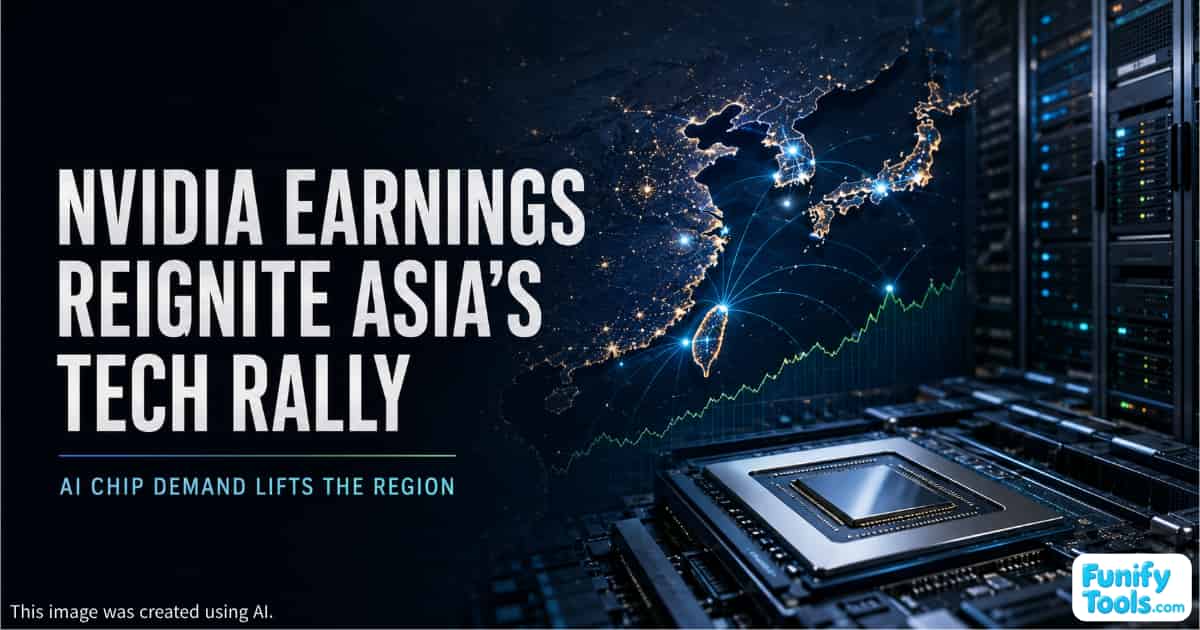
Taiwan's TSMC, a critical part of Nvidia's supply chain, rose sharply. South Korea's SK Hynix and Samsung Electronics also gained at the same time.
Stock indexes in Taiwan and South Korea, both of which have substantial exposure to technology and semiconductor companies, climbed by approximately 2% to 3%. Japan's Nikkei index also rose by nearly 3%, with AI-related stocks leading the advance.
In other words, the quarterly performance of one American company was powerful enough to lift technology stocks across much of Asia.
Nvidia Remains the Market's AI Benchmark
The reaction once again confirmed that investors continue to view Nvidia as one of the most important benchmarks for the AI industry.
As more AI services are introduced, companies need additional GPUs and greater data center capacity to operate them. Nvidia remains at the center of that ecosystem, and its latest results offered further evidence that demand is still strong.
Of course, it remains to be seen whether the rally can continue, whether concerns about excessive valuations will disappear, or whether the market will reverse course again.
One thing, however, seems fairly clear: when a company demonstrates a technological advantage approaching market dominance, capital tends to flow back toward it very quickly.
What Nvidia's Results Mean for the Wider AI Market
Nvidia's earnings gave the market another signal that demand for AI infrastructure is still expanding.
Technology stocks that had recently lost momentum because of overheating concerns began moving higher again, and the rally quickly spread to Asian markets.
As long as competition over AI infrastructure continues, Nvidia and the companies within its supply chain are likely to remain near the center of market attention.
At the same time, investors also need to consider what might happen after a period of spectacular growth. Strong performance does not remove the possibility of a later decline, especially when expectations and valuations are already high.
Of course, I am not an investment professional, so I cannot pretend to know where the stock price goes from here.
Still, I cannot help thinking that the instinct I had several years ago—when I was shocked by the price of a single graphics card—was not entirely wrong.
Today's news offered another clear example of how the direction of technology can eventually influence the value the market assigns to a company.
Thank you for reading, and I hope you have a wonderful day!
This article is also available in Korean: Read the Korean version