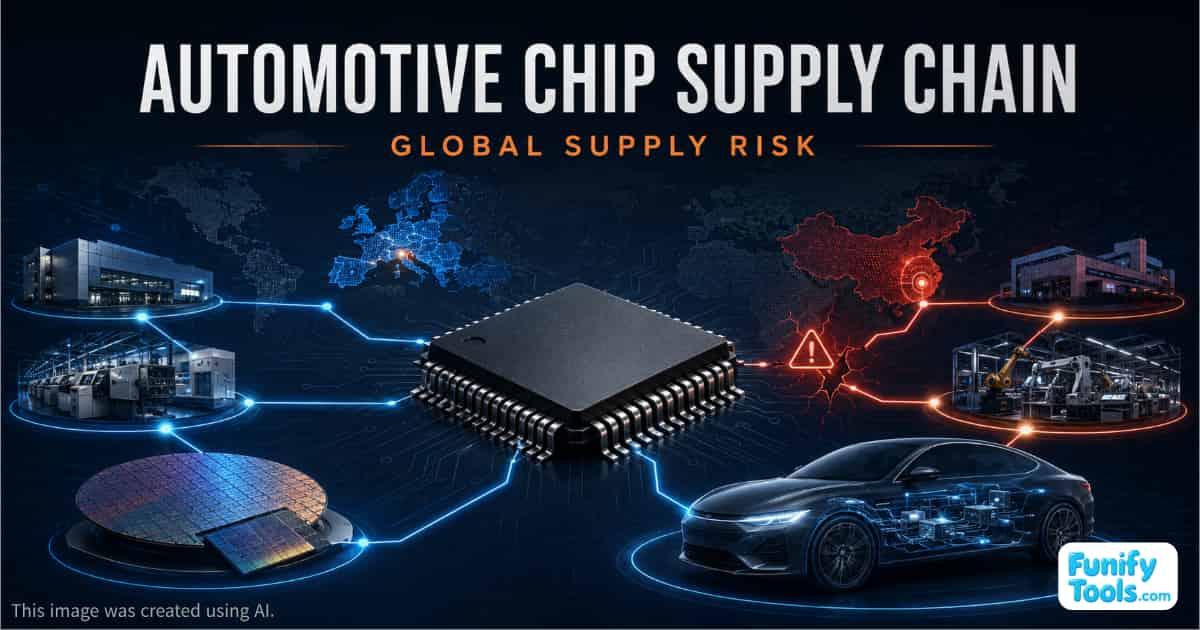
Yesterday, one of the major semiconductor stories involved a dispute between the Chinese government and Nexperia, an automotive semiconductor manufacturer. Nexperia may not be a familiar name to many people, but the situation brings back memories of the automotive chip shortages that disrupted global vehicle production several years ago.
Today, I'd like to take a closer look at what has happened, why Nexperia matters, and whether this dispute could develop into a broader supply chain problem.
How the Dispute Developed
The situation has unfolded roughly as follows:
In 2025, the Dutch government took measures that effectively restricted Chinese parent company Wingtech's control over Nexperia.▼China subsequently imposed export controls on Nexperia chips manufactured in the country.▼By October 2025, concerns about possible supply disruptions had spread throughout the automotive industry, bringing the risk of another global automotive semiconductor shortage into focus.▼Diplomatic negotiations helped ease the immediate pressure, but the underlying dispute remained unresolved.▼In early 2026, Nexperia's Chinese subsidiary announced that it would effectively operate independently, widening the divide between the company's Dutch headquarters and its Chinese operations.▼The Dutch headquarters opposed restoring Wingtech's control, while the Chinese subsidiary called for that control to be reinstated.▼The Chinese packaging operation then claimed that the Dutch headquarters had disabled the office accounts of employees in China.▼The Dutch headquarters was also reported to have stopped supplying wafers to the company's plant in Guangdong.▼With chip design, wafer supply, packaging operations and corporate control divided between different entities, the risk of disruption across the supply chain increased.▼On March 7, 2026, China's Ministry of Commerce issued an official warning that the dispute could once again threaten the stability of the global semiconductor supply chain.
At first glance, this may appear to be a corporate dispute involving China and the Netherlands. In reality, however, it could have much wider implications for the automotive semiconductor supply chain. That is why China's Ministry of Commerce has publicly raised the possibility of renewed disruption to global chip supplies.
Why Nexperia Matters
The key question is what kind of customers and markets Nexperia serves.
When people hear the word “semiconductor,” they often think of high-performance AI processors made by companies such as Nvidia. In the automotive industry, however, less glamorous components can be just as important. Power semiconductors, protection devices and MOSFETs are used extensively throughout modern vehicles.
Nexperia offers automotive-grade ESD protection devices and MOSFET product lines. These components may not attract much public attention, but they play essential roles in protecting in-vehicle networks, controlling electrical power and supporting a wide range of automotive electronic circuits.
Put simply, these are not necessarily the most visible chips inside a car, but they are part of the foundation that allows the vehicle's electronic systems to operate safely and reliably.
Why This Is Not Just a China-Specific Risk
It would be misleading to view this purely as a risk limited to China.
Although the immediate operational problems emerged in China, the broader situation involves a dispute between Nexperia's Dutch headquarters and its Chinese subsidiary. It also includes restricted access to internal systems, interruptions to production processes and reports of wafer supplies being suspended.
When these problems overlap, a regional dispute may not remain confined to that region. It can affect the procurement schedules of automotive suppliers and vehicle manufacturers around the world.
The automotive industry is especially vulnerable because a single missing component can disrupt an entire production schedule. In that sense, the dispute may have started in China, but its potential consequences are global if it remains unresolved.
A Supply Crisis Has Not Yet Been Confirmed
It is still too early to conclude that the global automotive industry is facing another major semiconductor shortage.
This distinction is important. According to media reports, most operations in China have recently resumed. The current situation is therefore better described as a renewed warning about supply chain instability than as a large-scale supply shock that has already occurred.
News reports can sometimes make a potential risk appear as though it is already a full-blown crisis. To assess the situation properly, we need to distinguish between what has actually happened and what could happen in the future.
For now, it makes more sense to monitor developments carefully than to assume that another global chip shortage is inevitable.
Could Hyundai and Kia Be Affected?
What does this mean for South Korean automakers?
I looked for publicly available information connecting Hyundai Motor or Kia directly to Nexperia components, but I could not find clear confirmation that either company uses Nexperia chips in specific vehicles.
That does not necessarily mean they are completely unaffected.
Automotive semiconductors are not always purchased directly by vehicle manufacturers. In many cases, they enter the supply chain through multiple tiers of component suppliers. A company such as Nexperia, which supplies widely used automotive and power semiconductor components, could be connected to a vehicle manufacturer's supply chain even when individual models or supply agreements are not publicly disclosed.
It would therefore be premature to claim that Korean automakers are already being affected. At the same time, it would also be difficult to say with certainty that they are entirely insulated from the dispute.
Why Replacing Automotive Chips Is Not Easy
Nexperia is not the only company supplying automotive power semiconductors and protection devices. There are several alternative manufacturers in the market.
However, the existence of competing products does not mean that automakers can immediately replace an approved component.
Automotive parts are subject to strict requirements involving performance, reliability, safety and certification. Replacing a semiconductor may require additional testing and validation, and making changes to a vehicle that is already in mass production can involve significant time and expense.
In other words, having alternative suppliers available and being able to switch components immediately are two very different things. This is why the market is treating the Nexperia dispute as a potential supply chain risk rather than merely an internal corporate disagreement.
What We Should Watch Next
The Nexperia dispute should not be dismissed as a problem limited to one company or one country. It has the potential to renew concerns about the stability of the automotive semiconductor supply chain and should be watched closely for signs of broader disruption.
There is currently no confirmed direct impact on South Korean automakers, but it would also be unwise to assume that they are completely unaffected. The most reasonable response is neither excessive alarm nor premature reassurance, but careful monitoring.
The key question is whether the dispute begins to cause meaningful production and delivery problems or whether negotiations and the normalization of operations prevent it from escalating further.
I will continue following the situation to see whether it develops into a genuine supply disruption or gradually settles through negotiations.
Thank you for reading, and have a wonderful weekend!
This article is also available in Korean: Read the Korean version