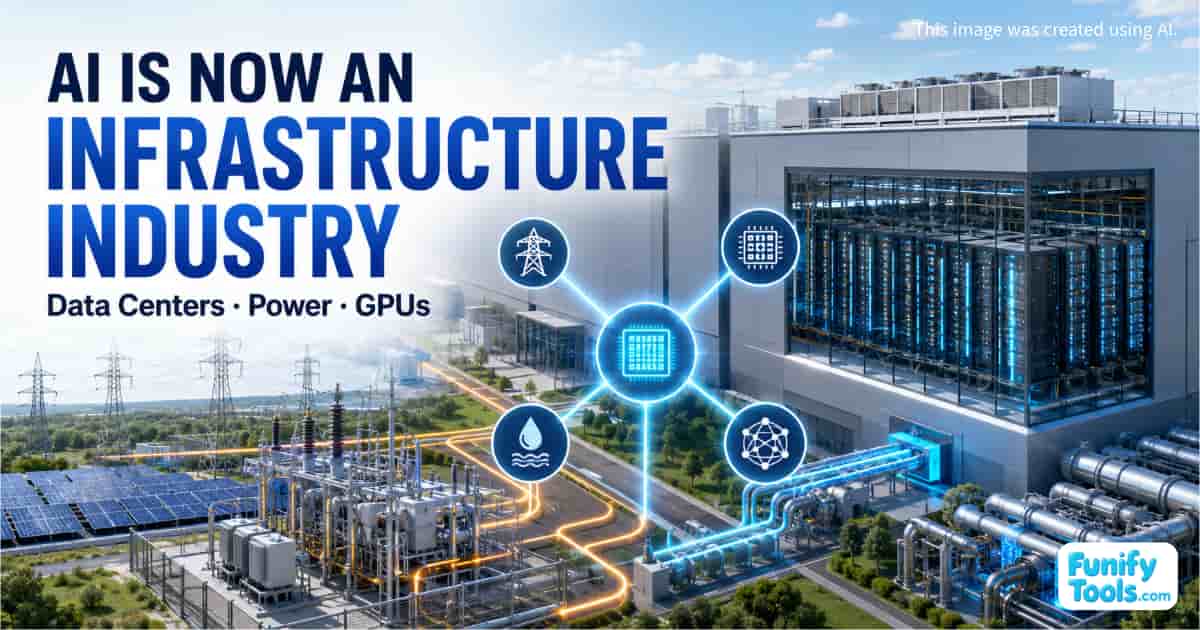
Most conversations about artificial intelligence still focus on model performance and competition between AI services. In practice, however, the most important bottleneck is increasingly the computing infrastructure required to keep those models running.
Recent international reports revealed that Radiant, a newly established AI infrastructure company backed by global alternative asset manager Brookfield, merged with British cloud computing startup Ori Industries. Following the deal, the combined company was valued at approximately $1.3 billion.
At first glance, this may look like another startup merger. But the deal offers important clues about where money is flowing in the AI economy—and which companies may eventually gain the greatest influence.
Providing the Factory That Runs AI
Radiant's strategy is straightforward: provide access to AI chips on demand.
In other words, it is not primarily trying to build the best AI model. It is positioning itself as the provider of the fuel, machinery, and factory space required to run those models.
The structure of the merger is also interesting. Ori's existing investors reportedly rolled their equity into the new company, while Brookfield contributed additional capital to help the business scale. Ori's founder is also expected to take on a central role at Radiant following the merger.
This is a classic combination of complementary capabilities:
- The startup contributes technology and operational expertise.
- The asset manager provides capital and infrastructure-development capabilities.
- The combined company attempts to scale AI computing as a long-term infrastructure business.
The deal signals that AI is no longer confined to the language of software companies. It is increasingly being reorganized around the economics of traditional infrastructure.
AI Computing Is Still a Supply-Constrained Market
The central issue is that AI computing remains a supply-constrained market.
When demand rises rapidly, several resources must become available at the same time:
- GPUs and other AI accelerators
- Data-center capacity
- Electricity
- Cooling infrastructure
- High-speed networking
- Suitable land and facilities
- Skilled operators
Having a powerful AI model is not enough. A company must also possess the physical capacity to run it reliably and at scale.
This creates room for providers beyond the largest hyperscale cloud companies. Specialized infrastructure operators can bundle the computing resources needed by particular groups of customers and deliver them under more tailored commercial arrangements.
Governments and large enterprises often have demanding requirements involving:
- Security
- Data location
- Regulatory compliance
- Contract stability
- Predictable costs
- Dedicated capacity
- Long-term availability
These requirements may be better served by a provider that combines infrastructure and operational software rather than offering only conventional, standardized cloud rental services.
Companies such as Radiant are targeting this gap.
AI Infrastructure Is Becoming a Power Business
Another unavoidable reality is that electricity is becoming one of the decisive factors in the AI race.
Building a data center is not enough. The operator must be able to secure the required power at the right time, in the right location, and under commercially sustainable terms.
The economics of AI infrastructure are increasingly shaped by factors such as:
- Grid connection delays
- Permitting
- Regional regulations
- Electricity prices
- Peak-demand management
- Power availability
- Reliability requirements
A completed data-center building has limited value if it cannot obtain enough electricity to operate its servers.
This is why interest is growing in solutions that generate or secure power close to where it will be consumed, rather than depending entirely on the existing electrical grid.
When computing and power capacity are designed as one integrated system, customers face less uncertainty about whether their workloads can actually run. Infrastructure providers, meanwhile, may find it easier to secure long-term contracts and maintain higher utilization rates.
AI has now moved beyond abstract discussions of algorithms. It has become deeply connected to practical questions about electricity, land, permits, construction, and industrial operations.
Control of GPUs Is Becoming a Strategic Advantage
Developments in the chip ecosystem are equally important.
AI chip companies are no longer concerned only with selling processors. They also have an interest in determining who can deploy those processors at scale and keep them operating continuously.
This is increasingly being shaped through financing, partnerships, capacity agreements, and broader infrastructure relationships.
In a supply-constrained market, power does not come only from the number of chips sold. It also comes from deciding who receives access to limited supply first.
If this structure becomes firmly established, infrastructure operators could benefit from a powerful cycle:
- Access to chips and power makes it easier to attract customers.
- A strong customer base makes it easier to secure more chips and energy.
- Greater infrastructure capacity attracts even more workloads.
- Higher utilization supports further expansion.
The companies that control infrastructure may find it easier to win customers, while those with large and reliable customer demand may find it easier to obtain GPUs and electricity.
As a result, the key performance indicators of the AI industry are expanding beyond model quality. Increasingly important measures include:
- Speed of securing power
- Data-center construction lead times
- Ability to procure chips
- Infrastructure utilization
- Energy efficiency
- Cooling efficiency
- Network capacity
- Operating reliability
This is why AI is gradually becoming less of a pure technology competition and more of a battle over supply chains and infrastructure operations.
Governments Want Sovereign AI Capacity
National policy is another important part of this shift.
An increasing number of countries, including the United Kingdom, are treating domestic computing capacity as a strategic priority and considering the use of public funding to expand it.
As governments place more importance on national AI capabilities, requirements involving sovereignty, regulatory compliance, and data residency are likely to become stricter.
Governments and regulated industries may want to ensure that sensitive data:
- Remains within national borders
- Is processed in approved facilities
- Complies with local regulations
- Is not entirely dependent on foreign infrastructure
- Remains accessible during geopolitical or supply-chain disruptions
These requirements create areas that private hyperscale cloud providers may not always be able—or willing—to address on their own.
That leaves space for new infrastructure suppliers capable of combining local computing capacity, regulatory compliance, dedicated hardware, energy access, and long-term operational support.
AI Is Turning Into a Capital-Intensive, Long-Term Business
Viewing the Radiant and Ori deal only as a merger valued at $1.3 billion would miss the larger significance.
The more important message is that AI is beginning to resemble a traditional infrastructure industry: capital-intensive, operationally complex, and built around long-term assets and contracts.
In the software era, a company could often scale rapidly without owning much physical infrastructure. AI changes that equation.
Large-scale AI requires expensive processors, specialized data centers, substantial electrical capacity, advanced cooling, fast networks, and continuous maintenance. These systems take time to plan, permit, build, connect, and operate.
The competitive question is therefore no longer simply:
“What can we build with AI?”
It is expanding into a much more practical set of questions:
“Where will it run, under what conditions, at what cost, and how reliably?”
For companies developing AI products, access to stable infrastructure may become as important as the quality of the original idea.
The Physical Foundation May Decide the AI Race
The AI economy is often presented as a competition between algorithms, models, and applications. But every AI service ultimately depends on a physical foundation.
Models require processors. Processors require data centers. Data centers require electricity, cooling, networking, land, and regulatory approval.
The winners of the AI era may therefore include not only the companies that build the best models, but also those that can secure and operate the infrastructure needed to keep them running.
In the end, competitiveness in AI is being redefined. It is no longer based solely on ideas or software capabilities. It increasingly depends on a company's combined ability to obtain chips, secure power, build infrastructure, manage supply chains, and operate everything reliably over the long term.
I hope this perspective helps you make better sense of the rapidly changing and often confusing AI landscape.
Thank you for reading, and I hope you have a wonderful day!
This article is also available in Korean: Read the Korean version