Hello, everyone.
In a previous article, I covered Meta's announcement that it would build a massive new data center in Texas. This time, Google has unveiled an investment on an even larger scale.
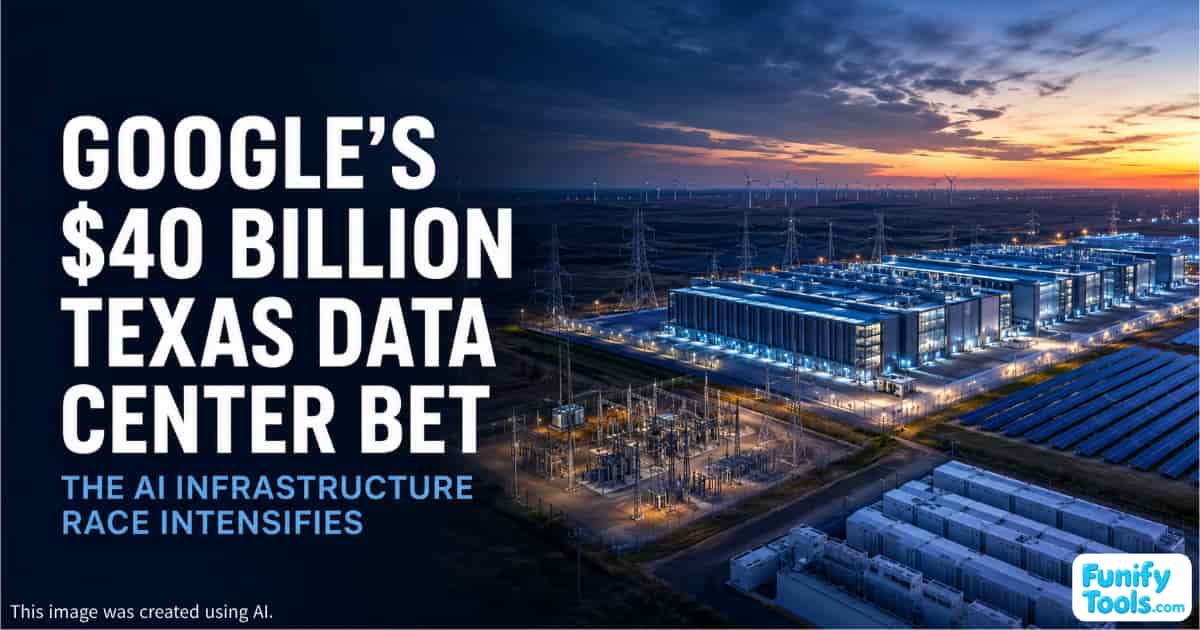
According to reports from Reuters and Bloomberg, Google plans to invest a total of $40 billion in Texas through 2027. The investment will fund the construction of three new data centers as well as the expansion of its existing facilities in the state.
One of the new data centers will be built in Armstrong County in the Texas Panhandle, while two others are planned for Haskell County near Abilene. One of the facilities will reportedly be developed alongside solar power and battery storage infrastructure to help reduce the strain on the local electricity grid.
The investment also includes additional spending on Google's existing Midlothian data center campus and its Dallas cloud region. Once these projects are included, Texas will become the state receiving Google's largest investment in the United States.
Why Google Is Investing So Heavily in Data Centers
The most immediate reason for this investment is straightforward: AI services and cloud computing require an enormous and rapidly growing amount of processing capacity.
Microsoft, OpenAI, Amazon, Meta, and Anthropic have all announced investments in AI-focused data centers across the United States. The competition is increasingly becoming a race to determine which company can build enough infrastructure—and bring it online quickly enough—to support the next generation of AI services.
The companies that secure computing capacity, electricity, land, and network access first may gain a major advantage. As AI models grow larger and their use becomes more widespread, infrastructure is no longer just a supporting asset. It is becoming a central part of the competition itself.
Why Texas?
So why are so many technology companies choosing Texas?
First, electricity prices are relatively competitive, and large areas of land are easier to secure than in many other parts of the country. Hyperscale data centers require extraordinary amounts of electricity, land, cooling equipment, and supporting infrastructure. Regions with abundant land and lower energy costs therefore have a natural advantage.
Second, the Texas state government has generally welcomed large infrastructure projects and maintained a business-friendly approach to permits and development. This has helped attract an increasing number of data centers operated by major technology companies.
As a result, Texas is gradually becoming one of the most important AI infrastructure hubs in the United States.
More Than Just New Buildings
Google has emphasized that its investment will involve more than simply constructing data center buildings.
The company says the projects will create thousands of jobs and support training programs for university students and electrical apprentices. Google also plans to establish funds supporting local energy-efficiency projects.
In addition, it says it will help bring new renewable energy resources onto the Texas power grid and cover the costs associated with operating its data centers rather than shifting those expenses to local communities.
These commitments are particularly important because large data centers can place significant pressure on regional power supplies. As companies build more AI infrastructure, they will face growing expectations to explain where their electricity will come from, how they will manage peak demand, and whether local residents will bear any additional costs.
Is AI Infrastructure Investment Moving Too Fast?
The rapid acceleration of data center construction has also raised concerns among some investors.
The central question is whether spending on AI infrastructure is moving too far ahead of the revenue and demand it is expected to generate. If demand does not grow as quickly as companies anticipate, today's aggressive investments could eventually be criticized as overbuilding. That, in turn, could revive concerns about an AI infrastructure bubble.
Data centers are expensive, long-term assets. They require years of planning, large power commitments, specialized chips, cooling systems, network connections, and continuous maintenance. A company cannot easily reverse those investments if market conditions change.
Even so, Meta and Google are both accelerating their plans for enormous infrastructure projects. Their decisions suggest that the largest technology companies believe the risk of building too little capacity may be greater than the risk of building too much.
The competition over AI infrastructure is therefore becoming more intense—and much more interesting to watch.
One point already seems clear: Texas is likely to become one of the central battlegrounds in America's AI data center race.
Thank you for reading, and I hope you have a wonderful day!
This article is also available in Korean: Read the Korean version