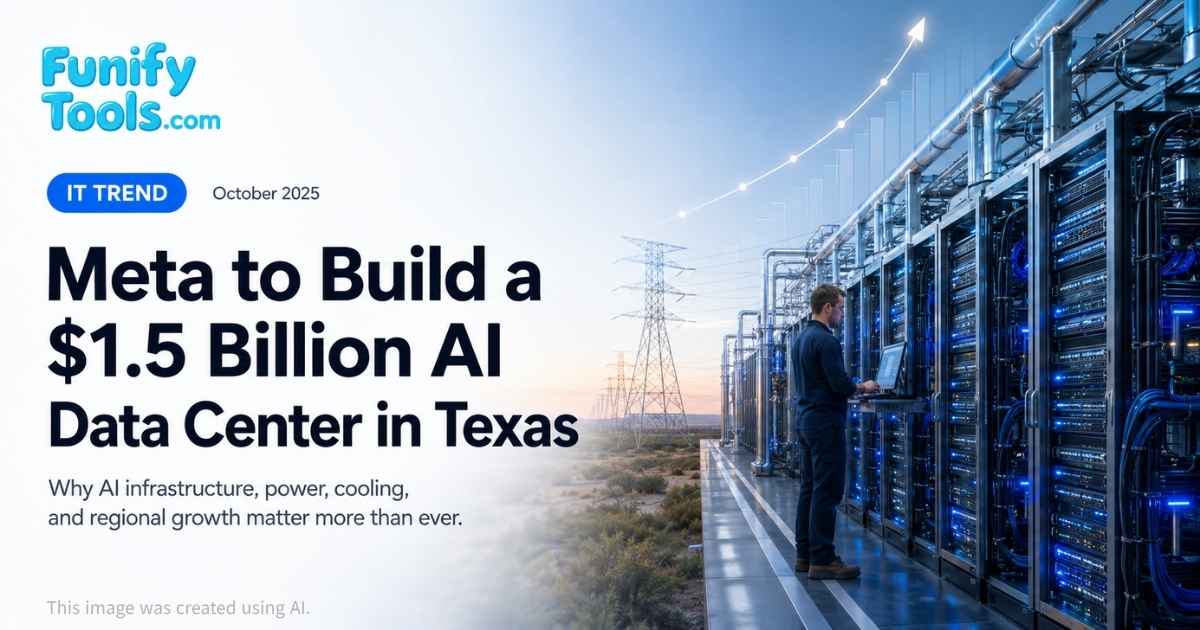
Meta has announced another massive infrastructure investment. This time, the company plans to build a dedicated AI data center in El Paso, Texas, with a reported price tag of $1.5 billion.
The target completion year is 2028, and the site is expected to scale up to as much as 1 gigawatt of power capacity. That number is enormous. It is the kind of figure that makes it clear this is not just a normal server building, but a major piece of AI-era infrastructure.
At first glance, this may sound like another corporate expansion story. A big tech company builds a big facility, hires workers, and adds more computing power. But if we look a little closer, this project shows what the global AI race is really becoming.
AI is not only about clever software or impressive chatbots. Behind every answer, image, recommendation, translation, and generated video, there is a physical system running somewhere: chips, servers, electricity, cooling, fiber networks, and people who keep the whole thing operating.
So what exactly is a data center, and why are companies spending so much money on them now?
A Data Center, the Factory of the Digital Age
A data center is, simply put, one of the hearts of the internet. Every time we upload photos to social media, save files to the cloud, stream a video, search for information, or ask an AI assistant a question, the request is processed somewhere. In many cases, that somewhere is a data center.
Inside these facilities, thousands of servers run around the clock. They store information, process requests, move data across networks, and send results back to users in real time. To us, it may feel like a page loads instantly or an AI answers immediately, but behind that moment is a huge amount of invisible work.
That is why a data center is not just a building full of computers. It is a carefully engineered environment where electricity, cooling, networking equipment, security systems, storage hardware, and software operations all work together. If one part fails, the service people rely on may slow down or stop.
Traditional data centers mainly supported websites, apps, cloud storage, and everyday online services. AI-focused data centers are different because AI workloads demand far more computing power, denser hardware, faster connections between machines, and more advanced cooling systems.
Why AI Needs So Much Infrastructure
Training AI models consumes huge amounts of GPU resources. GPUs are good at handling many calculations at the same time, which makes them essential for modern AI. But those chips also consume a lot of power and generate a lot of heat.
Even after an AI model is trained, the work does not stop. Every user prompt, image request, translation, summary, or recommendation requires inference: the process of running the model to produce an answer. When millions of people use AI services every day, inference itself becomes a massive infrastructure challenge.
This is why Meta's El Paso facility is being designed specifically for AI workloads. The servers, network connections, power systems, and cooling equipment all need to support high-density computing for long periods of time.
In a normal office, cooling means keeping people comfortable. In an AI data center, cooling means keeping expensive machines alive. If the heat is not managed properly, performance drops, hardware wears out faster, and reliability becomes a problem.
The site is expected to use closed-loop liquid cooling technology. This method circulates liquid through a controlled system to move heat away from equipment more efficiently than traditional air cooling. For AI-scale computing, this kind of cooling is becoming increasingly important.
Meta has also said it plans to restore more than twice the amount of water the facility consumes back to the local watershed. In other words, the company is presenting the project not only as a computing investment, but also as a sustainability challenge that needs to be managed carefully.
Why Texas, and Why El Paso?
There are several reasons Texas can make sense for a project like this. Large AI data centers need stable electricity, land, network connectivity, construction capacity, local cooperation, and long-term planning. A location is not chosen only because land is available. It has to support the facility for years.
El Paso offers power infrastructure, access to skilled workers, and state-level tax advantages. For an AI data center, stable electricity is not optional. It is one of the core requirements. Without reliable power, a project of this scale cannot operate properly.
Large developments also depend on cooperation from local communities, utility providers, construction partners, and regional institutions. The CEO of Borderplex Alliance, a local economic development organization, described Meta as "the fastest gazelle," suggesting that once one major company moves first, others may be more likely to follow.
That comparison matters. Big technology investments often create momentum. When one hyperscale company builds in a region, other companies may start looking at the same area for fiber routes, energy access, workforce development, and supporting industries.
More Than One Building
A data center is never just one building. When a hyperscale project arrives, it usually brings a much wider infrastructure story with it.
Power transmission lines may need to expand. Renewable energy projects may become more attractive. Fiber-optic networks may improve. Water management systems, backup power, roads, and construction supply chains may all become part of the conversation.
That means a single data center can reshape the industrial and energy structure of an entire city or region. It can create jobs during construction, require specialized workers after launch, and attract companies that want to be close to reliable digital infrastructure.
Meta has already invested more than $10 billion in Texas and currently employs over 2,500 people in the state. The El Paso project alone is expected to create up to 1,800 construction jobs during the building phase.
So this is not only an IT story. It is also a story about local economies, jobs, energy planning, water policy, industrial development, and the way AI changes physical infrastructure.
The Real AI Competition Is About Infrastructure
When people talk about the AI race, they often focus on the models: which one answers better, which one writes better code, which one generates better images, or which company releases the most impressive demo. Those things matter, but they are only the visible layer.
Underneath that layer is infrastructure. AI companies need enough GPUs. They need data centers that can house them. They need power contracts, cooling systems, fast internal networks, storage capacity, and teams that can operate everything reliably.
According to major industry reports cited in the original discussion, hyperscalers such as Amazon, Google, Microsoft, and Meta are expected to invest hundreds of billions of dollars in AI infrastructure. That tells us something important: the AI race is no longer just a software race.
It is increasingly a race to compute. The companies that can build faster, cool better, buy enough chips, secure enough electricity, and operate at lower cost may gain a long-term advantage.
AI may be the brain, but data centers are the body that keeps that brain alive.
The Energy Question
There is also a difficult question that cannot be ignored: energy. AI data centers need enormous amounts of electricity. As AI services become more common, the demand for power can grow quickly.
This creates both opportunity and pressure. On one side, data centers can encourage investment in energy infrastructure, renewable power, grid upgrades, and more efficient cooling. On the other side, they can also create concerns about local power demand, water use, land use, and environmental impact.
That is why the conversation around AI infrastructure is not simply "more data centers are good" or "more data centers are bad." The important question is how they are designed, powered, cooled, regulated, and connected to local communities.
If AI is going to become part of everyday life, then the infrastructure behind AI has to be sustainable enough to support that future.
Why This Matters Beyond the United States
South Korea is not outside this trend. Data centers are already being developed in areas such as Pangyo and Yongin, and similar questions are becoming more important here as well.
Can the power grid handle rising demand? How will cooling water be supplied? How should ESG expectations apply to these projects? How should local communities be involved? What balance should be struck between industrial growth and environmental responsibility?
These questions are no longer side issues. They are becoming part of the core conversation around national competitiveness. If a country wants to lead in AI, it cannot think only about software talent and algorithms. It also needs chips, servers, power systems, cooling technologies, land-use planning, and long-term infrastructure strategy.
If we only think of AI as an app on a screen, we miss half the picture. The future of AI is being built in places most users will never visit.
The Invisible Heart of Modern Life
Data centers are mostly invisible to ordinary people, but they sit behind almost every digital service we use every day. They are the connection point, the engine room, and in many ways the heartbeat of the internet and modern AI.
Meta's Texas project is an attempt to make that heart bigger, more efficient, and more ready for the AI era. Whether the project becomes a model for future AI infrastructure will depend not only on how much money is spent, but also on how well it handles power, cooling, water, local jobs, and long-term environmental responsibility.
In the AI era, the winners may ultimately be decided not just by who has the best ideas, but by who can compute better, scale faster, operate more efficiently, and sustain that advantage for the longest time.
Thank you for reading, and I hope you always stay happy.
FAQ 1. What is a data center, and why does it matter?
A data center is a facility filled with servers, storage systems, networking equipment, power systems, and cooling infrastructure. It matters because nearly everything we do online, from social media and cloud storage to AI services, depends on data centers running reliably in the background.
FAQ 2. Why does Meta need a separate AI data center?
AI workloads require far more computing power than traditional web services. Training and running large AI models demands GPUs, fast networking, dense server racks, and advanced cooling. A dedicated AI data center is designed around those high-intensity requirements.
FAQ 3. Why was El Paso, Texas chosen for this project?
El Paso offers advantages such as power infrastructure, access to workers, land, and regional support. Large AI facilities need stable electricity and long-term local cooperation, so locations with strong infrastructure and supportive communities are especially attractive.
This article is also available in Korean: Read the Korean version