When most people think of Nvidia, GPUs still come to mind first. GPUs have become the essential chips behind AI training and inference, and since the rise of generative AI, they have been at the center of global data center investment.
However, recent comments by Nvidia CEO Jensen Huang suggest that the company's next phase of growth will extend well beyond selling more GPUs. Nvidia is making it increasingly clear that it wants to evolve from an AI chipmaker into a platform company capable of designing and supplying the entire AI data center.
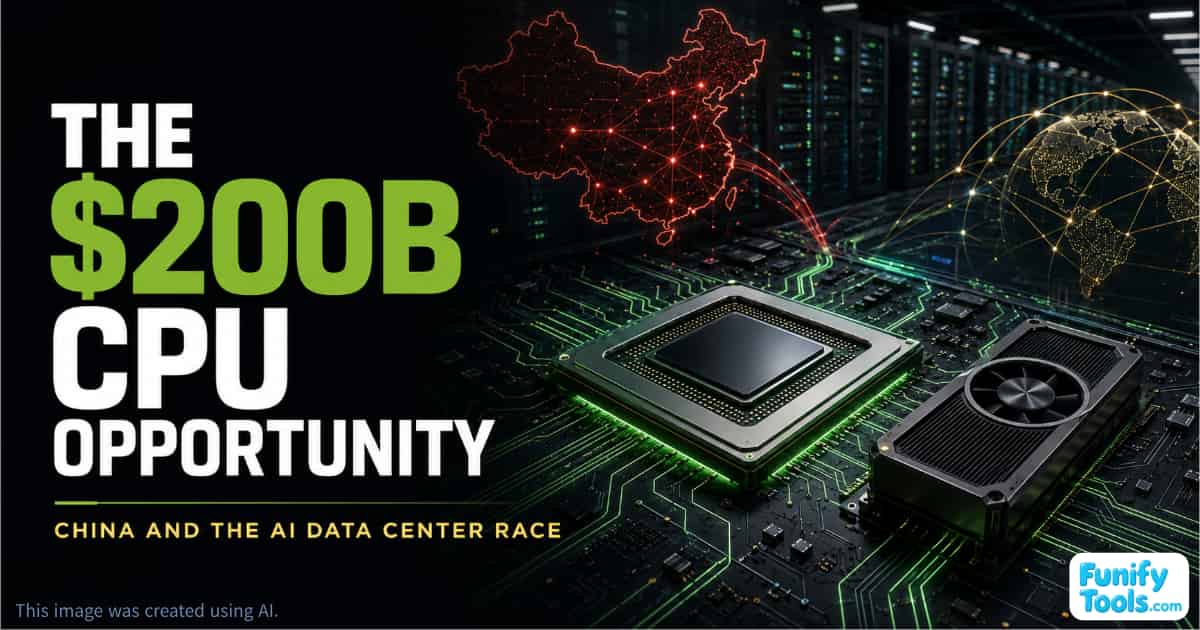
According to a recent report, Huang was asked whether China was included in the $200 billion CPU market that Nvidia believes it could address. His response indicated that it was.
This is about more than Nvidia simply wanting to sell products in China. Despite the continuing technology conflict between the United States and China—and the uncertainty surrounding export controls on advanced AI chips—Nvidia has not removed China from its long-term growth strategy. In other words, the company recognizes the regulatory risks but still views China as one of the most important markets for future AI infrastructure demand.
Why Nvidia Is Talking About CPUs
The important point is that Nvidia is now talking about CPUs, not just GPUs.
A CPU, or central processing unit, handles the general computing and control functions of a server or computer. While GPUs excel at massively parallel processing, CPUs manage the overall flow of the system, distribute workloads, and coordinate the various components required to keep everything running smoothly.
During the early phase of the AI boom, the main priority was training increasingly large models as quickly as possible. That naturally placed GPU performance in the spotlight. As the AI industry moves into its next phase, however, workload coordination and system-level integration inside data centers will become increasingly important.
The AI market is already expanding beyond simple chatbots toward agentic AI systems that can reason through multiple steps and carry out tasks with a degree of autonomy. Instead of merely responding to questions, these systems can analyze data, use software tools, and execute a sequence of actions.
Supporting this type of AI requires more than raw GPU performance. CPUs, networking, memory, storage, and software must all operate as one tightly integrated system.
That is why Nvidia's interest in the CPU market matters. The company is not merely trying to add another chip to its product lineup. It is attempting to gain greater control over the entire architecture of the AI data center.
What the $200 Billion Figure Actually Means
The $200 billion CPU market mentioned by Huang should not be mistaken for revenue that Nvidia is about to generate. It is better understood as the size of the market the company believes it could address over the long term.
Until now, Nvidia's growth story has largely revolved around AI GPUs. Major cloud providers, internet companies, research institutions, and enterprise data centers have purchased enormous numbers of GPUs to train AI models and run AI services. That demand has driven Nvidia's rapid revenue growth.
Eventually, however, there may come a point when GPU sales alone are no longer enough to sustain the same growth narrative. Once customers have built large GPU clusters, their priority may shift from simply buying more GPUs to making their existing AI infrastructure more efficient.
This is where CPUs, networking products, and rack-scale systems could become Nvidia's next major growth engines.
An AI server cannot operate on GPUs alone. Even the fastest GPU will underperform if data cannot be delivered quickly enough, communication between servers becomes a bottleneck, or the CPU fails to distribute workloads efficiently.
Ultimately, the performance of an AI data center is determined not by a single chip, but by how well the entire system works together.
Nvidia's emphasis on next-generation platforms combining its Vera CPU with Rubin GPUs reflects this shift. The company is moving away from selling individual chips and toward supplying integrated infrastructure at the scale of an entire data center.
Why China Matters So Much
The inclusion of China makes this strategy considerably more sensitive.
China represents one of the world's largest potential markets for AI infrastructure. Its major internet companies, cloud providers, AI startups, and government-backed digital infrastructure projects make it difficult to discuss the global AI market without including the country.
At the same time, China is working to strengthen its domestic semiconductor ecosystem. It has accelerated efforts to develop homegrown AI chips in response to U.S. export restrictions.
Even so, fully replacing Nvidia's combination of hardware performance, software ecosystem, developer support, and data center integration capabilities will not be easy in the near term.
For Nvidia, China is simply too important to abandon. Restrictions on sales to China could affect not only short-term revenue but also the company's long-term influence over the AI development ecosystem.
Nvidia's products remain attractive to Chinese customers as well. The central problem is not a lack of demand, but whether sales are politically permitted.
The U.S. government must authorize exports, Chinese authorities must approve or tolerate purchases, and customers must complete transactions without violating either country's regulations. Nvidia's China business is therefore not merely a matter of sales and marketing. It exists within a complicated structure involving the U.S. government, the Chinese government, customers, and the global semiconductor supply chain.
The H200 Situation Shows How Complicated Chip Sales Can Be
The reported situation surrounding Nvidia's H200 chip illustrates this complexity.
According to reports, Nvidia received U.S. government licenses allowing it to sell H200 chips to China. Actual shipments, however, had not yet begun because approval from Chinese authorities was still unresolved.
This is an important distinction for investors. In the semiconductor industry, obtaining permission to sell a product is not the same as generating revenue from that product.
Even if the U.S. government authorizes a sale, Chinese authorities may choose not to approve it. Chinese companies may want to purchase the chips but delay signing contracts because of the political environment.
Nvidia's revenue from China is therefore influenced not only by technological demand, but also by regulation and government policy.
Huang nevertheless has clear reasons to continue emphasizing the importance of China. It is a vast market that is unlikely to stop investing in AI infrastructure.
AI has become closely tied to national competitiveness, and China is likely to continue developing domestic AI models and building new data centers. Including China in Nvidia's long-term market outlook is therefore not simply wishful thinking. It reflects the reality of substantial underlying demand.
Whether that demand can be converted into actual revenue is a separate question. Understanding the difference between market demand and obtainable revenue is one of the most important points in interpreting this news.
Taiwan's Supply Chain Is Another Critical Part of the Story
The report's discussion of Taiwan's supply chain is also significant.
Nvidia designs its chips and platforms, but manufacturing depends heavily on TSMC and the broader Taiwanese semiconductor ecosystem. From there, the products move through server manufacturers, packaging companies, power-system suppliers, and cooling solution providers before they can finally be deployed in data centers.
The AI semiconductor race is no longer a competition involving chip designers alone. Designing faster chips remains important, but the ability to manufacture and deliver complete AI systems at scale is becoming just as critical.
The expansion of Nvidia's next-generation platforms will therefore have a major impact across Taiwan's semiconductor and server supply chain.
What This Means for Investors
From an investment perspective, this news highlights both Nvidia's growth potential and its risks.
On the positive side, Nvidia is expanding from a GPU-focused company into a provider of complete AI data center platforms. If it can combine CPUs, GPUs, networking, server systems, and its software ecosystem into one integrated offering, the size of its addressable market could increase substantially.
As AI data centers become more complex, customers may prefer proven, integrated platforms rather than assembling individual components from multiple vendors. If this happens, Nvidia's pricing power, negotiating position, and influence over the wider AI ecosystem could become even stronger.
The risks, however, are equally clear.
China is an enormous market, but it is highly sensitive to political developments. If the United States tightens export controls, Nvidia's ability to sell products in China could once again be restricted.
China could also delay or reduce purchases of Nvidia products to protect and promote its domestic semiconductor industry. If concerns over indirect exports or regulatory violations intensify, U.S. oversight could become even stricter.
For that reason, the $200 billion opportunity—including China—should be viewed as a long-term addressable market, not as guaranteed future revenue.
Nvidia Wants to Control More Than the GPU
The real significance of this news is that Nvidia has not given up on China—and that it intends to become much more than a GPU company.
As AI moves beyond model training and toward agentic systems capable of carrying out real business tasks, data centers will become more complicated and require much tighter integration. Companies that can combine CPUs, GPUs, networking, server architecture, software, and supply chain management will be in the strongest position to capture that market.
Nvidia's opportunity remains enormous, but turning that opportunity into actual financial results will require more than advanced technology.
U.S.–China regulations, purchasing decisions by Chinese companies, Taiwan's manufacturing capacity, and the broader data center investment cycle will all need to align.
The latest reports suggest that Nvidia's growth story is far from over. At the same time, they show that the company's future is becoming increasingly intertwined with geopolitics and the global technology supply chain.
For investors, the key question is not simply whether Nvidia can enter the CPU market. It is how broadly—and for how long—the company can remain at the center of the global AI data center industry.
That's all for today.
Thank you for reading, and I hope you have a wonderful day!
This article is also available in Korean: Read the Korean version