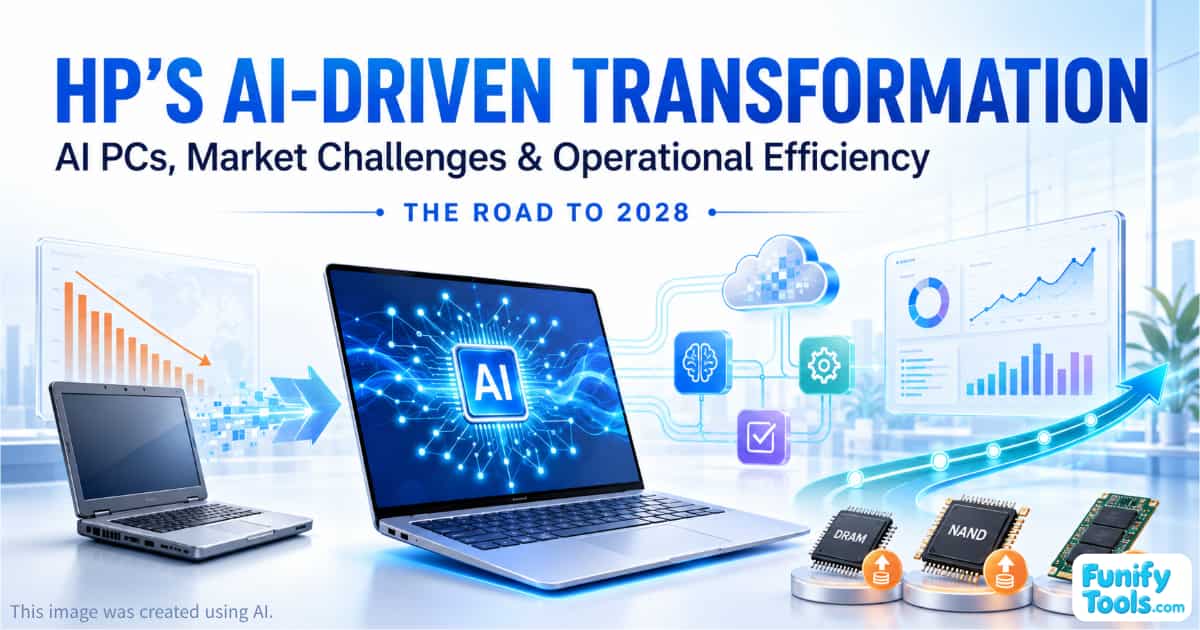
HP is reorganizing its global operations as it prepares for a business environment increasingly shaped by artificial intelligence. Although workforce restructuring is part of the plan, the broader story is about how the company intends to operate, invest, and compete over the next several years.
The decision comes as the traditional PC industry continues to adjust following the exceptional demand seen during the pandemic. Many consumers are keeping their devices for longer, while businesses are taking a more cautious approach to hardware replacement. These longer upgrade cycles can make revenue growth less predictable for companies that remain highly dependent on PC and printer sales.
HP is responding by reviewing its operating costs while directing more resources toward AI-enabled products, services, and internal capabilities. Rather than viewing the restructuring as a single cost-cutting measure, it is more accurate to understand it as part of a broader effort to modernize the company's business model.
From Traditional PCs to AI-Enabled Devices
One of HP's main priorities is the growing market for AI PCs. These devices include processors and other components designed to run certain AI tasks locally instead of relying entirely on cloud-based services.
HP has said that AI-enabled models accounted for more than 30 percent of its PC shipments in a recent quarter. This does not mean that conventional PCs will disappear immediately, but it does show where the company expects future product development and investment to be concentrated.
The transition may also affect the way HP organizes its internal teams. As AI becomes more important across product development, customer support, sales, and operational processes, the company will need different combinations of technical skills and resources.
Some existing functions may become more efficient through automation, while new roles may emerge in areas such as AI software, device optimization, data management, security, and AI-related customer services.
Operational Efficiency Is Another Major Goal
HP expects its restructuring program to produce approximately $1 billion in annualized gross savings by the end of fiscal 2028. The company plans to improve efficiency across several areas, including product development, internal operations, and customer support.
These savings are not necessarily the result of one specific change. They may come from simplifying workflows, reducing duplicated responsibilities, using automation, improving supply-chain management, and reorganizing teams around the company's future priorities.
AI is expected to contribute to some of these efficiency improvements. Tasks involving routine documentation, monitoring, customer inquiries, internal reporting, and data processing can increasingly be supported by automated systems.
However, it would be misleading to describe HP's restructuring solely as a case of AI replacing employees. The company is also responding to changing consumer demand, cost pressures, evolving product strategies, and the need to invest in new areas.
Rising Memory Costs Are Creating Additional Pressure
HP's transformation is taking place at a time when the cost of important PC components is becoming another concern.
Growing investment in AI infrastructure and data centers has increased demand for memory products such as DRAM and NAND. As manufacturers prioritize high-performance memory and other components used in AI systems, the broader technology supply chain can experience tighter availability and higher prices.
HP has indicated that rising memory costs could place greater pressure on its business, particularly during the second half of fiscal 2026. Higher component prices can reduce profit margins unless manufacturers offset them through pricing changes, alternative suppliers, product adjustments, or lower operating expenses.
This creates a difficult balance. HP must continue investing in competitive products while controlling costs in a market where customers remain sensitive to price.
The company's fiscal 2026 earnings guidance reflected some of these uncertainties. It pointed to a challenging combination of component costs, market conditions, and continued investment in new technology.
Why HP Is Restructuring Its Business
HP's current strategy can be understood through three closely connected factors.
The first is the changing PC market. Demand has not disappeared, but purchasing patterns have become less predictable as customers extend the life of their existing devices and evaluate whether new AI features provide enough value to justify an upgrade.
The second is the company's long-term AI strategy. HP wants to strengthen its position in AI-enabled computing and incorporate AI into more products, services, and internal processes.
The third is operational efficiency. Automation and simplified workflows may allow some functions to be performed with fewer resources, while the company redirects investment toward areas considered more important for future growth.
Together, these factors are encouraging HP to reconsider how its organization should be structured. The objective appears to be creating a more efficient company while preserving enough investment capacity to compete in the developing AI PC market.
AI Is Changing More Than Individual Jobs
Discussions about AI and employment often focus on whether a particular technology will replace a particular job. In practice, the effect on large organizations is usually more complicated.
AI can change how departments are organized, how projects are managed, and which skills a company values. It can also influence decisions about product design, customer service, supply chains, and investment priorities.
For a company such as HP, the transition is therefore not simply about automating isolated tasks. It involves reconsidering the relationship between hardware, software, services, and internal operations.
This type of reorganization is also appearing across the broader technology industry. Hardware manufacturers and software companies are reviewing their cost structures while increasing investment in AI capabilities. Each company's circumstances are different, but the common goal is to prepare for a market in which AI becomes part of both the product and the way the business operates.
What the Transition Could Mean for HP
HP's strategy offers potential opportunities, but it also carries risks.
AI-enabled PCs could encourage customers to upgrade their devices and give manufacturers new ways to differentiate their products. Local AI processing may become particularly valuable for privacy, security, productivity, and performance-sensitive applications.
At the same time, customers may not immediately see enough practical value in AI features to replace otherwise functional computers. HP must therefore demonstrate that AI PCs provide meaningful everyday benefits rather than simply adding another technical label to existing products.
The company must also manage its restructuring carefully. Reducing costs can improve efficiency, but excessive or poorly planned changes may result in the loss of important expertise, disruption to customer support, or slower product development.
The success of HP's strategy will depend on whether it can modernize its operations without weakening the capabilities that continue to support its core business.
Final Thoughts
HP's restructuring should be viewed as part of a wider business transformation rather than as a single response to one problem.
The company is dealing with longer PC replacement cycles, rising component costs, uncertain market demand, and the need to invest in AI-enabled products. At the same time, it is exploring how AI and automation can improve its internal productivity.
These pressures have led HP to rethink how its resources should be distributed through fiscal 2028. Some established operations are being streamlined, while investment is shifting toward products and capabilities that the company believes will be more important in the future.
Whether this strategy succeeds will depend on more than cost savings. HP will also need to develop useful AI features, maintain product quality, manage supply-chain pressures, and convince customers that the next generation of PCs offers meaningful value.
HP's transformation is therefore a useful example of how an established technology company is adapting to a market in which AI is changing not only products, but also the way companies organize themselves and plan for growth.
Thank you for reading, and have a wonderful day!
This article is also available in Korean: Read the Korean version