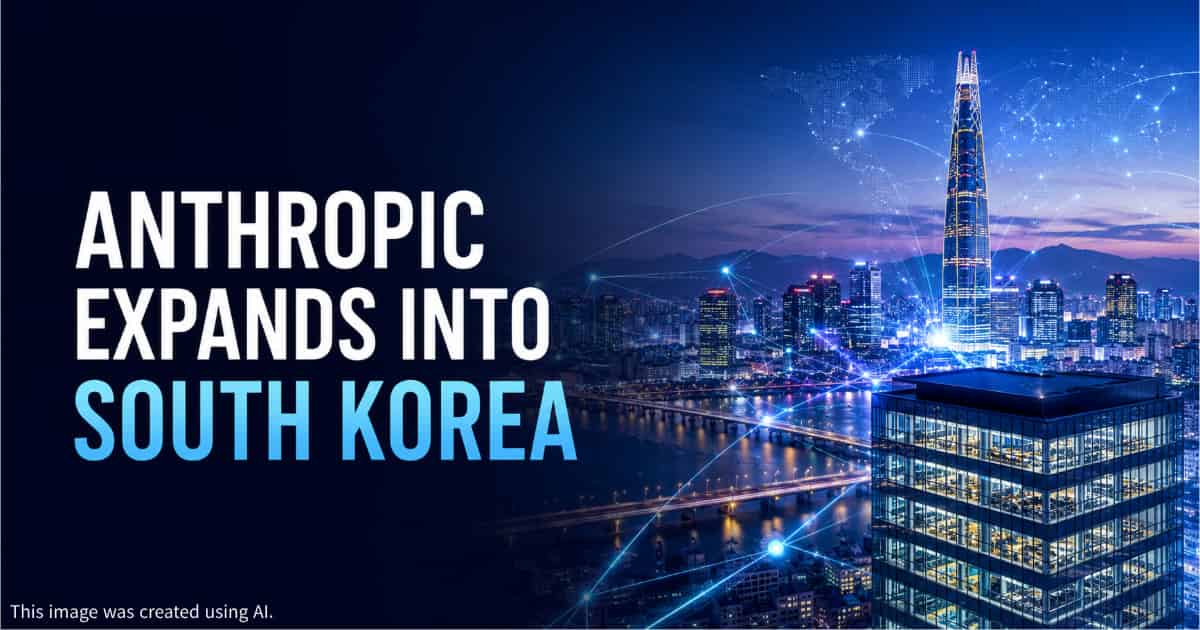
What Could It Mean for Korea's AI Market?
Anthropic, a US-based artificial intelligence startup, has recently announced plans to establish an office in South Korea. At first glance, this may seem like just another overseas expansion by a technology company. In reality, however, it is a significant development that highlights Korea's growing importance in the global AI industry.
Anthropic is best known as the developer of Claude, one of ChatGPT's leading competitors. The company has already experienced rapid growth in the United States and Europe, and its decision to open a Seoul office appears to be part of a broader strategy driven by the sharp rise in AI adoption across Asia.
According to Anthropic's chief operating officer, South Korea, Japan, and India are already among the company's five largest markets by user base. In Korea alone, Claude's weekly active user count reportedly increased more than sixfold over a four-month period.
Korea's advanced digital infrastructure and willingness to embrace new technologies likely played a major role in this growth. High-speed internet access, widespread smartphone use, and strong demand for digital transformation among businesses have created an ideal environment for experimenting with and adopting AI services. For this reason, Korea is increasingly seen as more than just a consumer market. It also has the potential to serve as a testing ground for products and business strategies aimed at the wider Asian market.
Anthropic's relationship with Korea is not entirely new. SK Telecom previously invested approximately $100 million in the company and formed a strategic partnership with it. That relationship likely helped Anthropic establish trust and strengthen its presence in the Korean market, while also contributing to its decision to open a local office.
The company plans to use Korea as one of its key bases for expanding its business across Asia. It is also preparing to establish offices in Tokyo and Bengaluru, India, signaling a broader commitment to the region.
What Could Anthropic's Expansion Mean for Korea?
Anthropic's arrival could bring several meaningful changes to Korea's AI ecosystem.
One of the most immediate possibilities is improved localization. As the company strengthens its presence in Korea, it may devote more resources to improving Claude's Korean-language capabilities and adapting its services to local cultural and business needs. Most leading AI models were originally developed with English-speaking users in mind, so better Korean-language support could make advanced AI tools more practical and accessible to a wider audience.
The expansion could also create new employment opportunities. If global AI companies begin hiring local developers, researchers, sales specialists, and policy experts, Korean professionals may gain more opportunities to participate directly in major international AI projects.
Businesses could benefit as well. Until now, Korean companies adopting overseas AI products have often had to work with support teams located in other countries. A local Anthropic office could provide faster communication, closer technical support, and a better understanding of Korea-specific requirements.
Industries such as finance, manufacturing, education, and media may increasingly use Anthropic's AI models to automate repetitive work, analyze information, improve customer support, and develop new products. Korean startups could also benefit through partnerships, integrations, and joint product development with a major global AI company.
More Competition for Korean AI Companies
However, Anthropic's expansion will not necessarily be positive for everyone.
As more global AI companies enter Korea, competition will become increasingly intense. Domestic technology companies may face greater pressure to improve their models, pricing, developer tools, and customer support. Korean AI businesses will need to distinguish themselves through stronger Korean-language performance, industry-specific expertise, local data capabilities, or closer relationships with domestic customers.
There are also broader social and regulatory issues to consider. The growing use of generative AI continues to raise concerns about privacy, data security, algorithmic bias, copyright, and responsible deployment.
South Korea has relatively strict privacy regulations, so overseas AI companies may face challenges when adapting their products and business practices to local requirements. Opening an office in Seoul does not automatically mean that user data will be stored in Korea or that every service will immediately receive localized support. Those details will depend on Anthropic's infrastructure, policies, and future business decisions.
Korea's Role in the Global AI Industry Is Growing
Anthropic's decision to establish a Seoul office is another sign that South Korea is becoming an important market in the global AI industry. Korea combines advanced infrastructure, a highly connected population, strong corporate demand, and users who are generally quick to experiment with new technologies.
The next question is how deeply Anthropic will localize its services and what kinds of products, partnerships, and support it will offer Korean users and businesses.
Competition in the AI era is not determined by technical performance alone. Success also depends on how well a company understands local languages, regulations, industries, and user expectations. Anthropic's expansion suggests that Korea is no longer being viewed simply as a market for consuming AI technology. It is increasingly becoming a place that may help shape how that technology develops and is used across Asia.
Thank you for reading, and I hope you have a wonderful day!
This article is also available in Korean: Read the Korean version