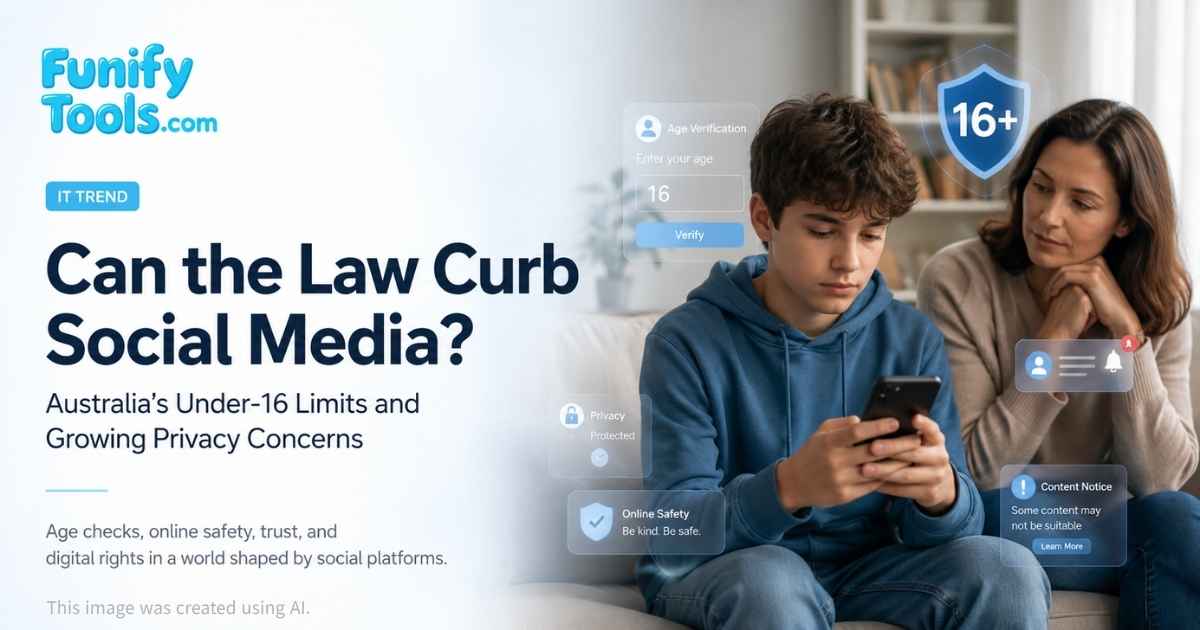
Australia is moving forward with a law that would restrict social media use for children under 16, with the rule expected to begin on December 10, 2025. Recently, Google said the law would be extremely difficult to enforce.
The purpose of the law is easy to understand. It aims to protect young teens from harmful content, addictive platform design, online pressure, and the kind of endless scrolling that can quietly consume attention. But Google's concern is also realistic: even if the intention is good, turning that intention into a working system is not simple.
Under the proposal, teens would need to verify their age to use social media, and platforms would be responsible for identifying whether users are old enough. Some possible methods include age estimation with AI, identity checks, or analyzing behavioral patterns to decide whether a user might be a minor.
That is where the issue becomes complicated. If platforms ask for stronger age verification, users may have to provide more personal information. If platforms use AI estimation, mistakes can happen. If platforms rely on behavior analysis, privacy concerns grow. And even if every major platform follows the rule, determined users may still find workarounds.
The Intention Is Protection
I do not think anyone can dismiss the concern behind this law. Children and teenagers are growing up in an environment where attention is constantly being pulled by notifications, recommendations, short videos, comments, likes, and algorithmic feeds.
When a notification buzzes, the hand reaches for the phone almost automatically. When one short video ends, the next one starts before the brain has time to choose. Even adults who understand the problem often struggle to stop. If that is true for adults, it is hard to expect children to manage it perfectly on their own.
Social media can also expose young users to comparison, bullying, harmful trends, unrealistic beauty standards, misinformation, and content that arrives faster than parents or teachers can explain it. In that sense, the desire to create a protective boundary is understandable.
So the question is not whether children need protection. They do. The harder question is whether a broad legal restriction is the best way to provide it.
Why Enforcement Is So Difficult
Google's argument is that age restriction sounds clear in law, but becomes messy in technology. A platform can ask a user to enter a birthday, but that is easy to fake. It can request ID, but that raises privacy and security concerns. It can use AI, but AI can misjudge people.
There is also a practical problem. Social media is not limited to a few famous apps anymore. Messaging apps, video platforms, game communities, live-streaming services, forums, learning platforms, and even comment sections can all function like social spaces. Drawing a clean line around "social media" is harder than it sounds.
Another challenge is responsibility. Should the platform be responsible? Should the app store be responsible? Should parents be responsible? Should schools teach digital habits? Should governments define the rules? In reality, all of them probably have a role, but assigning that responsibility in a legal system is difficult.
That is why this debate is not just about one Australian law. It is about how society should manage childhood in a digital environment that changes faster than traditional rules can keep up.
The Privacy Trade-Off
Age verification can protect children, but it can also create a new kind of risk. To prove that a user is old enough, a service may need to collect information that users would normally prefer not to share.
For example, if a platform asks for identity documents, users may worry about data leaks. If it uses face-based age estimation, users may worry about biometric data. If it studies behavior patterns, users may worry that platforms are watching them even more closely than before.
This creates an uncomfortable trade-off: to make the internet safer for children, we may build systems that collect more information about everyone. That does not automatically mean the law is wrong, but it does mean the design has to be handled very carefully.
A protective rule should not quietly become a tool for excessive surveillance. If age checks are required, the public also needs clear answers about what data is collected, who stores it, how long it is kept, and how it is deleted.
Can Blocking Access Really Teach Self-Control?
This is the part where I have mixed feelings. Blocking access can reduce exposure, especially for younger children. Sometimes a clear boundary is helpful. But if the goal is to raise people who can live well in a digital world, blocking alone cannot be the whole answer.
Children eventually grow older. If they never learn how social media works, how algorithms pull attention, how online comparison affects emotions, and how to recognize harmful content, then the problem may simply be delayed rather than solved.
It is similar to teaching road safety. We do not protect children only by saying, "Never go outside." We also teach them how to cross the street, how to notice danger, and how to move safely in public spaces. The internet may need the same kind of education.
That does not mean children should be left alone online. It means protection and education have to move together. A locked door can help, but eventually someone has to teach the child what is outside the door.
The Role of Adults
I am never completely certain where the boundary of an adult's role should be. Limiting time, blocking apps, and tightening controls can be a form of protection. But if every rule is imposed without conversation, it can also weaken trust.
Some children respond well to guidance. Others feel watched, controlled, or misunderstood. When that happens, they may hide their online activity rather than talk about it. That is dangerous, because the child who hides everything is also the child who may not ask for help when something goes wrong.
In the end, what matters may not be only technical blocks, but the sense of trust that grows within the relationship between adults and children. If a child believes an adult will listen without immediately scolding, that child is more likely to talk about uncomfortable online experiences.
That kind of trust cannot be installed like an app. It has to be built slowly, through ordinary conversations, shared rules, and adults who are willing to admit that they also struggle with their phones.
Social Media Is Not Just a Toy
Kids today are born into a digital environment. For them, social media is not just entertainment. It is a place where friendships happen, trends spread, news appears, hobbies develop, and identity is tested.
Of course, that does not mean every part of it is healthy. But if adults describe social media only as a harmful toy, many young people will feel that adults do not understand their world. That gap makes guidance harder.
Perhaps the better approach is to say: social media is powerful, and because it is powerful, we need to learn how to use it with care. It can connect people, but it can also exhaust them. It can teach, but it can also distort. It can open a window to the world, but not every view through that window is good for a child.
Rather than slamming the window shut forever, maybe our role as adults is to stand beside them and help them learn what to look at, what to ignore, when to step back, and when to close it themselves.
What a Better Balance Might Look Like
A law may be part of the answer, but it should not be the only answer. A healthier approach might combine several layers: clear platform responsibility, privacy-respecting age checks, better parental tools, digital literacy education, and honest family conversations.
Platforms should design services with young users in mind instead of relying only on engagement. Schools should teach students how algorithms work and how online content affects emotion. Parents should set boundaries, but also explain the reasons behind them. Governments should create rules, but those rules should be realistic, transparent, and careful with privacy.
Most importantly, adults should model the behavior they want children to learn. It is difficult to tell a child to put down the phone while we are scrolling during dinner. It is difficult to teach restraint if we never practice it ourselves.
Before we ask children to control their screens, maybe we should first ask what kind of digital habits they see from us every day.
Final Thoughts
I do not have a perfect answer. I understand why Australia wants stronger protection for children, and I also understand why Google says the law will be hard to enforce. Both sides are pointing to real problems.
But one thing feels clear to me: technology alone cannot solve this, and law alone cannot solve it either. The solution has to include trust, education, design responsibility, and adults who are willing to change their own habits.
Let us put our phones down first, at least sometimes, and fill that space with conversation and empathy. That might be the education today's generation needs most.
Thank you for reading. Wishing you happiness, always!
This article is also available in Korean: Read the Korean version