I previously wrote about Australia's restrictions on social media use for children under 16. Now, a similar movement appears to be gaining momentum in Europe.
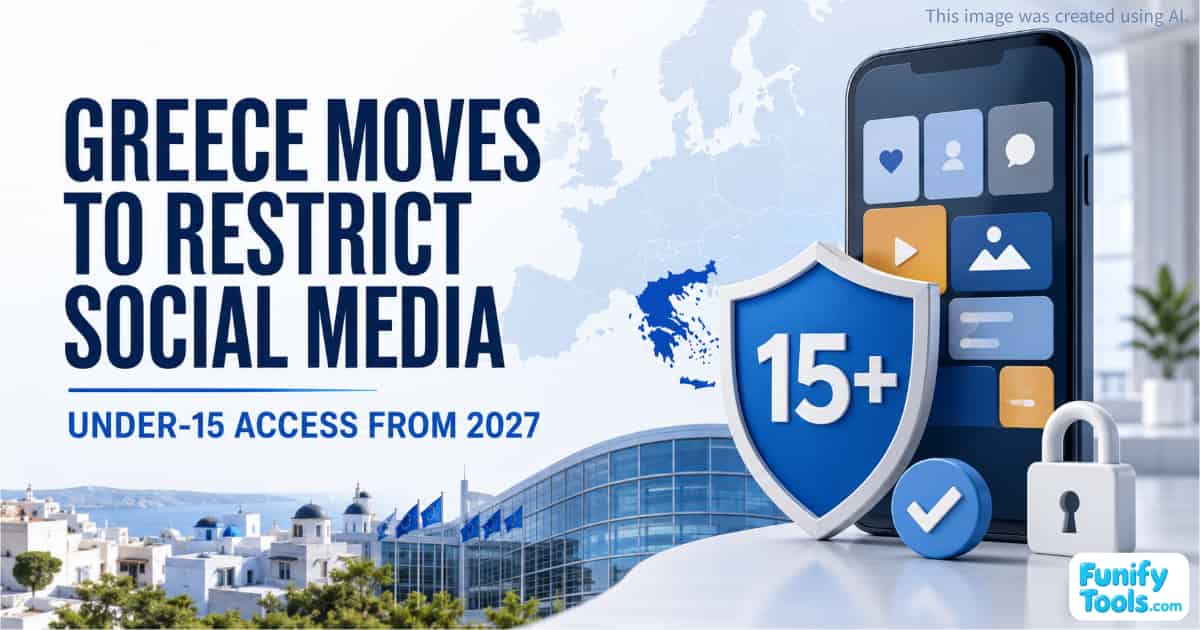
Greece has announced plans to prevent children under 15 from using social media beginning in 2027.
Social media is no longer simply a hobby or a convenient way to communicate. It has become a major part of young people's daily lives, so a policy of this scale could have a significant impact.
A Legal Ban, Not Just a Recommendation
This policy goes beyond telling children and parents to exercise caution. The government intends to restrict access through legislation.
Major platforms such as Instagram and TikTok are expected to be covered by the rules. The pressure will also fall on the companies operating these services. Platforms that fail to implement proper age-verification measures could face fines.
In other words, the policy is designed to hold platforms responsible rather than placing the entire burden on individual children and parents.
This trend suggests that social media use among minors is no longer being treated purely as a matter of personal choice. It is increasingly being viewed as a broader social and public-health issue.
Why Are Governments Considering These Restrictions?
Concerns about depression, anxiety, sleep deprivation and excessive screen time among young people have continued to grow.
A growing number of studies and public discussions have examined possible links between these problems and social media use. The issue is particularly relevant because many children and teenagers continue looking at their phones until the moment they fall asleep.
Even from everyday observation, it is easy to understand why parents are concerned.
Social media can provide opportunities for communication, creativity and access to information. At the same time, endless scrolling, social comparison, online harassment and attention-driven recommendation systems may place additional pressure on younger users.
Governments are now asking whether children should be expected to manage all of these risks on their own.
Greece Is Not Acting Alone
What makes this development particularly interesting is that Greece is not the only country considering stronger restrictions.
Australia has already introduced a similar approach for users under 16, while European policymakers have also discussed creating broader and more consistent standards for protecting minors online.
What once looked like an isolated policy experiment is gradually becoming an international trend.
The specific age limits, enforcement methods and legal responsibilities may differ from country to country. However, the overall direction is becoming clearer: governments are placing greater responsibility on social media platforms to identify and protect younger users.
Many Parents Support Stronger Rules
Public opinion also appears to be broadly supportive of stronger protections.
Many parents feel that their children spend too much time on social media and that voluntary limits are difficult to maintain. Even when families create their own rules, children remain surrounded by friends, school conversations and online trends that encourage continued use.
As a parent, I can understand this concern.
It is difficult to expect individual families to manage the issue entirely on their own when the platforms themselves are designed to keep users engaged for as long as possible.
That is one reason legal restrictions can seem appealing. They create a common standard rather than leaving every household to negotiate the problem independently.
Can Social Media Really Be Blocked?
The biggest question is whether such a ban can actually be enforced.
There are many possible ways to bypass age restrictions. Children may use a VPN, enter a false date of birth, borrow a parent's account or create an account using someone else's information.
Completely preventing every underage user from accessing social media would therefore be extremely difficult.
Age verification also creates privacy concerns. If platforms must confirm a user's age, they may need to collect identification documents, facial information or other sensitive personal data.
This creates a difficult balance:
- Weak verification may be easy to bypass.
- Strong verification may require excessive personal information.
- Platform-level restrictions may reduce access but may not eliminate it.
- Children may move to smaller or less regulated services.
For these reasons, the real effect of the policy may be closer to reducing access and usage time than achieving a perfect ban.
Even if some users find ways around the rules, however, additional friction could still reduce casual or habitual use among younger children.
The Responsibility of Social Media Platforms
The policy also reflects a major change in how governments view technology companies.
For many years, online platforms were treated largely as neutral services that users chose to access. Governments are now increasingly questioning whether platforms should be responsible for the effects of their design.
Features such as autoplay, infinite scrolling, personalized recommendations and frequent notifications are designed to encourage continued engagement.
Adults may find these features difficult to resist, and younger users may be even more vulnerable.
That is why current discussions are moving beyond age limits alone. Policymakers are also considering whether platforms should change their default settings, recommendation systems and data-collection practices for minors.
The debate is no longer simply about whether children should use social media. It is also about how social media services should be designed when children are likely to use them.
Could South Korea Introduce Similar Restrictions?
These developments naturally raise questions about what may happen in South Korea.
South Korea does not currently have a direct nationwide ban preventing children below a particular age from using social media. However, if more countries introduce restrictions and produce measurable results, similar discussions could eventually emerge here.
Mental-health concerns among young people are unlikely to disappear, and smartphone use is already deeply integrated into education, entertainment and social relationships.
Any Korean policy would need to consider several complicated issues:
- How users' ages would be verified
- Whether privacy could be protected
- Which platforms would be included
- How overseas services would be regulated
- Whether parental consent would provide an exception
- How educational and messaging services would be treated
- Whether restrictions would genuinely improve young people's well-being
A simple ban may sound straightforward, but implementing one fairly and effectively would be much more complicated.
From Personal Choice to Digital Protection
Technology usually develops in the direction of greater convenience and access. At the same time, society sometimes reaches a point where it begins reconsidering whether certain limits are necessary.
Social media appears to be entering that stage.
It is increasingly being treated not merely as a tool that anyone should be free to use without restrictions, but as a digital environment that may require age-appropriate safeguards and active management.
Greece's proposed restrictions may not completely prevent children under 15 from accessing social media. However, they represent another important sign that governments are becoming more willing to regulate platforms in the name of child protection.
The key question is no longer whether social media affects young people. The debate is now about how much responsibility should fall on children, parents, platforms and governments—and which protections can work without creating even greater privacy problems.
Thank you for reading. Have a wonderful day, and stay happy!
This article is also available in Korean: Read the Korean version