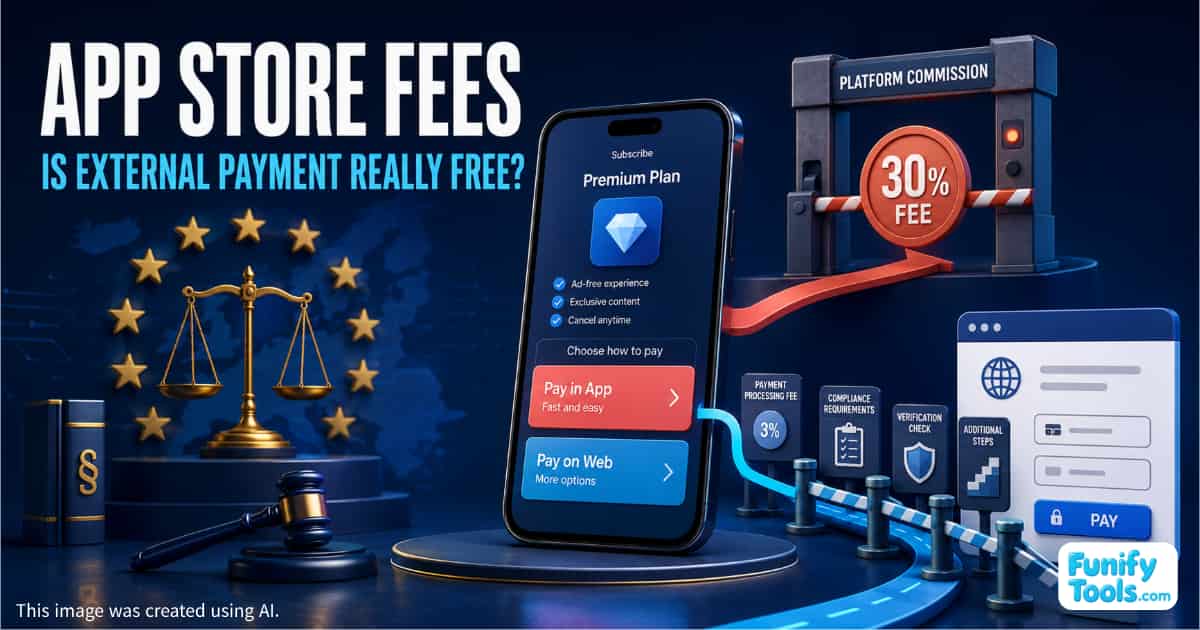
Have you ever wondered why the price of a subscription can differ depending on whether you pay through an app or on the web?
This complexity is often more than a marketing decision. In many cases, it comes from the fees and rules built into mobile app ecosystems. In Europe, the Digital Markets Act, or DMA, was introduced partly to prevent dominant platforms from exercising excessive control over payment flows and to give businesses and consumers greater choice.
Recently, however, European app developers and consumer organizations have reportedly urged EU regulators to take stronger action. Their argument is that although external payment options may appear to be available, additional fees and complicated conditions can still make them difficult to use in practice.
Reports have referred to App Store commissions of approximately 13% to 20% on purchases made within apps. They have also raised concerns that transactions directed to external payment channels could still incur additional charges of around 5% to 15%.
This raises an important question: if developers must continue paying substantial fees even when customers complete their purchases elsewhere, how much freedom does external payment actually provide?
Why Developers Want to Offer Web Payments
Consider a typical subscription-based app that operates in the European market.
When users subscribe within the app, the developer may have to pay a platform commission. To reduce that expense, the company may want to display a message such as, “Subscribe on our website for a lower price.”
Some customers may also prefer paying on the web. A website may offer more payment methods, make it easier to enter a promotional code, or provide clearer subscription options.
In theory, allowing developers to direct customers to external payment systems should increase competition. Developers could reduce their payment-processing costs and pass some of those savings on to consumers through lower prices or better benefits.
In practice, the situation can be much more complicated.
External Payments May Still Carry Additional Costs
Developers and consumer groups argue that if a platform charges additional fees on transactions generated through external links, the payment route becomes more complicated without delivering meaningful savings.
A developer may technically be allowed to offer web payments but still find it difficult to reduce the subscription price by a significant amount. The business may also end up maintaining separate prices for in-app and web purchases.
This can create an awkward experience for customers. They must decide where to subscribe, compare prices, leave the app, open a web browser, and then possibly return to the app after completing the purchase.
Each additional step creates another opportunity for the customer to abandon the transaction.
As a result, developers may gain the formal right to direct users elsewhere without receiving the practical freedom to compete effectively on price.
Why Payment Friction Matters for Subscription Apps
Even minor complications can have a significant effect on a subscription business.
If the payment conversion rate drops slightly, the company may need to spend more on advertising to acquire each paying customer. A longer or less familiar checkout process can also generate more customer support requests.
Developers may then feel pressured to compensate in other ways. They might raise subscription prices, divide features across more pricing tiers, or create increasingly complicated discounts and bundles.
This is where the debate becomes ironic. A policy intended to increase consumer choice could, if poorly implemented, make prices and subscription structures even more difficult to understand.
For consumers, meaningful choice is not simply about having two payment buttons. It also depends on whether those choices are easy to understand, reasonably priced, and practical to use.
The EU's Enforcement Against Apple
EU regulators imposed a €500 million fine on Apple for violating the DMA, after which Apple reportedly revised some of its terms.
Developer organizations have argued that the revised policies still fail to satisfy the purpose of the law and have called for stronger enforcement.
Apple also announced that further policy changes would take effect in January 2026, although the full practical implications were not yet clear when the proposals were being discussed.
The dispute therefore continues to focus not only on whether Apple allows external payment links, but also on the conditions attached to those links.
A platform can technically comply with a requirement while still creating fees, warnings, restrictions, or additional steps that make the alternative less attractive. Regulators must therefore consider how the rules operate in the real world rather than looking only at whether an external payment option exists on paper.
Formal Permission vs. Meaningful Choice
The central question is whether external payments are merely permitted in legal language or whether developers and consumers can use them as a genuine alternative.
If similar fees are reintroduced under different names, or if the conditions are so complicated that developers avoid external payments altogether, the system may do little to encourage competition.
On the other hand, clear rules and predictable costs could give smaller developers a better opportunity to compete. They might be able to lower prices, offer additional benefits, or experiment with more flexible subscription models.
This distinction matters because the DMA is not simply trying to add another checkout route. Its broader goal is to reduce the power of digital gatekeepers and create a market in which businesses can compete more freely.
Why This Matters to App Developers Outside Europe
This debate is relevant to app businesses outside the European Union as well.
A South Korean app developer planning to enter the European market, for example, cannot treat the decision as a simple choice between in-app billing and web billing. The company must calculate the actual revenue remaining after platform commissions, external-payment fees, processing costs, taxes, customer support expenses, and changes in conversion rates.
Those calculations will affect far more than the payment page. They can influence:
- Subscription prices
- Free-trial periods
- Promotional campaigns
- Discount policies
- Bundled plans
- Customer support
- The overall user experience
A payment policy that appears cheaper at first may not be more profitable if too many users abandon the process. Likewise, a more expensive payment option may still be worthwhile if it provides a smoother and more trusted customer experience.
The Real Meaning of Choice in the App Economy
The dispute over Apple's App Store fees should not be viewed only as a disagreement over commission percentages.
It is part of a larger debate about what meaningful choice should look like in the app economy.
Allowing external payments is important, but permission alone may not be enough. If fees continue to follow the transaction, conditions remain difficult to understand, or the user experience discourages people from choosing an alternative, competition may remain limited.
The real test is whether developers can offer genuinely different prices and benefits—and whether consumers can select those options without unnecessary confusion or inconvenience.
That is why the debate surrounding Apple and the EU Digital Markets Act is likely to continue. It is not simply about where a payment takes place. It is about who controls the relationship between an app developer and its customers, how much that access should cost, and what genuine consumer choice should mean in a platform-dominated market.
Thank you for reading, and I hope you have a wonderful day!
This article is also available in Korean: Read the Korean version