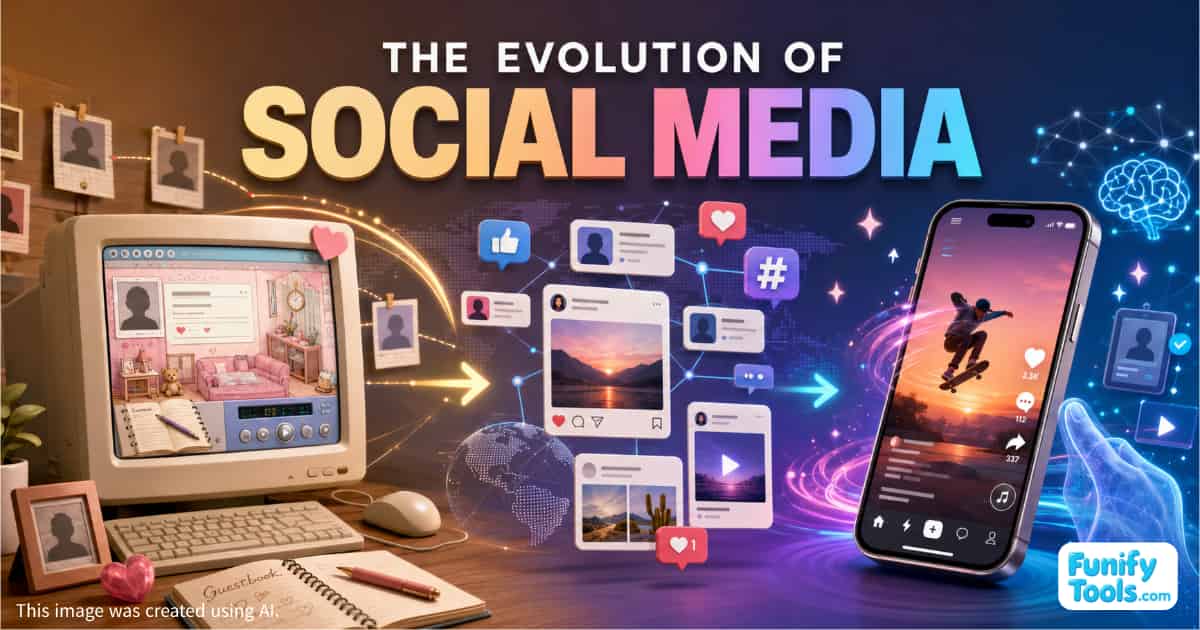
These days, many people wake up and instinctively open Instagram or YouTube before doing anything else. We use social media to catch up on the news, see what our friends are doing, and even discover products to buy.
Social media has become such a natural part of everyday life that we rarely stop to think about how it reached this point. Looking back at its evolution, however, can give us valuable clues about where it may be heading next.
To put it simply, a social networking service, or SNS, is an online service that allows people to introduce themselves, build relationships, and discover new people and information through those connections.
Unlike traditional personal websites, where someone would simply publish content for visitors to read, social media platforms are built around connections such as friends, followers, and subscribers. These networks allow a post to travel beyond its original audience and reach friends of friends—or, today, potentially millions of strangers.
Before Social Media: Bulletin Boards and Online Communities
If we trace the roots of social media far enough back, we arrive at online services such as bulletin board systems, Usenet, and early online communities.
At the time, people did not necessarily think of these spaces as “social networks.” They were mainly places where users with shared interests could exchange messages, join discussions, and chat with one another. By today's standards, they looked like a mixture of an online forum, a community platform, and a messaging service.
Even then, however, the idea of making friends online was beginning to take shape.
SixDegrees and the Birth of the Modern Social Network
SixDegrees, launched in 1997, is often described as one of the first recognizable social networking sites.
Users could create profiles, add friends, and explore connections through friends of friends. In other words, it already included some of the fundamental features that would later become familiar through platforms such as Facebook.
SixDegrees was ahead of its time, though. Internet connections were still slow, personal computers were not yet universally available, and the number of people regularly using the internet was relatively limited. As a result, the service never achieved the kind of mass adoption that later social networks would enjoy.
The Rise of First-Generation Social Networks
The situation changed rapidly in the early 2000s.
Broadband internet became more widely available, while digital cameras, MP3 files, and Flash-based web content became part of everyday online culture. People began to enjoy creating and decorating their own personal spaces on the internet.
This was the environment in which early social networking platforms such as Friendster and MySpace emerged. Users could customize their profiles, play background music, display personal photos, and collect large numbers of friends.
MySpace also became an important promotional platform for musicians. Artists could upload their music directly, communicate with fans, and build an audience without relying entirely on traditional record labels or media outlets.
Cyworld and South Korea's Early Social Media Culture
In South Korea, Cyworld became so popular that it effectively served as the country's national social network.
Users created miniature homepages, uploaded daily photos, wrote diary entries, and visited one another through a feature commonly known as “wave riding.” They could also use a virtual currency called Dotori, or “acorns,” to purchase background music, decorative skins, and other profile items.
For many Koreans, the memories remain vivid: visiting a friend's Minihompy, leaving a message in the guestbook, checking the latest photos, and choosing the perfect song to represent a particular mood.
In some ways, Cyworld combined features that we now associate with Instagram feeds, Stories, personal profiles, and digital customization. Its greatest strength was that it brought real-world friendships into a carefully designed online space.
Facebook and the Social Media Mainstream
By the mid-to-late 2000s, the platforms that would define modern social media began to appear.
Facebook initially started as a network for university students in the United States. After opening to the general public, it expanded rapidly across the world.
Real-name profiles, mutual friendships, the News Feed, and the Like button became standard elements of online social interaction. Social media was no longer simply a collection of personal homepages. It was becoming a vast public square where information, opinions, photos, and personal updates moved continuously in real time.
YouTube, Twitter, and the Expansion of Social Media
YouTube emerged around the same period. At first, it appeared to be a straightforward video-sharing website. Over time, however, features such as subscriptions, comments, creator channels, and personalized recommendations turned it into a video-centered social network.
Twitter took a different approach. It focused on short posts, rapid communication, and real-time conversations organized through hashtags.
People began opening Twitter to follow immediate reactions to politics, social issues, sports, entertainment, and breaking news. As this behavior became common, social media platforms gradually began performing many of the functions once associated primarily with newspapers and television.
Smartphones Changed Everything
When smartphones became widely adopted in the 2010s, social media use did not simply grow—it exploded.
People could take a photo, edit it, and share it instantly from almost anywhere. Notifications arrived throughout the day, keeping users continuously connected to their online networks.
Instagram became the leading example of visually driven social media by combining attractive photography, filters, hashtags, and short videos. It also helped create the modern influencer economy.
As brand accounts, advertising tools, product tags, and in-app shopping features were added, social media evolved from a communication channel into a major infrastructure for marketing and commerce.
Snapchat and the Rise of Disappearing Content
Snapchat gained popularity among younger users by introducing photos and videos that disappeared after a limited period of time.
This concept was significant because it changed the expectation that everything posted online had to remain permanently visible. The temporary, informal nature of disappearing content made communication feel more spontaneous.
Instagram and Facebook later adopted the same format through their Stories features. It became a clear example of how an idea introduced by one service could quickly become an industry-wide standard.
In South Korea, Facebook and Instagram gradually replaced Cyworld as the dominant social platforms, while KakaoTalk became the center of everyday private communication.
TikTok and the Short-Form Video Revolution
A major shift arrived in the late 2010s with TikTok and its highly personalized recommendation algorithm.
Earlier social networks mainly showed users content from people they had chosen to follow. TikTok changed that model. Its main feed could be filled almost entirely with videos selected by an algorithm, regardless of whether the viewer followed the creators.
This marked a fundamental change in the structure of social media. The social graph—who you know and who you follow—became less important than the platform's ability to predict what would hold your attention.
In an environment where viewers swipe away within seconds, content has become shorter, faster, and more visually intense. YouTube Shorts and Instagram Reels are direct responses to this shift, demonstrating how deeply the short-form video format has reshaped the industry.
AI, Regulation, and Privacy
Today, no discussion of social media would be complete without mentioning artificial intelligence, regulation, and privacy.
Recommendation algorithms make it easy to discover relevant and entertaining content, but they can also contribute to compulsive use. They may amplify misinformation, hateful content, political manipulation, and social division.
This raises a difficult question: who should decide which posts are promoted, limited, or hidden?
Governments around the world are strengthening privacy protections and introducing new rules for large online platforms. At the same time, users are becoming more aware of how their personal information is collected and how algorithms influence what they see.
From One Giant Public Square to Many Smaller Communities
Some users have grown tired of centralized platforms and are turning toward privacy-focused messaging services, decentralized social networks, and smaller online communities.
Services such as Mastodon and Bluesky explore more open or distributed approaches to social networking. Meanwhile, Telegram channels and Discord servers often function as private or semi-private communities organized around shared interests.
The social internet may therefore be moving away from the idea of everyone gathering in one enormous public square. Instead, people are increasingly spreading out across smaller rooms, side streets, and specialized communities that better reflect their interests and values.
Social Media Is Also a History of Human Relationships
The history of social media is not only a history of technology. It is also a history of how our habits, identities, and relationships have changed.
During the era of early online communities and Cyworld, the experience was often about inviting people into a personal space and leaving signs that they had visited.
During the Facebook and Twitter era, social media became a public square for exchanging news, opinions, and real-time reactions.
Today, platforms such as TikTok, Instagram, and YouTube place us inside an endless stream of short, attention-grabbing videos selected by artificial intelligence.
Future social networks will likely become even more closely connected to AI. At the same time, the tension between personalization, privacy, platform power, and government regulation will continue.
Large platforms are unlikely to disappear, but more people may choose smaller communities that better match their interests and offer a stronger sense of control.
Individual services will rise and fall, but the desire to connect with other people online is unlikely to go away. Understanding the history of social media helps us recognize where a new platform fits within this larger story.
It may also help us choose the parts of social media that genuinely benefit us—and use them in a way that does not leave us constantly distracted or exhausted.
Thank you for reading, and I hope you have a wonderful day!
This article is also available in Korean: Read the Korean version