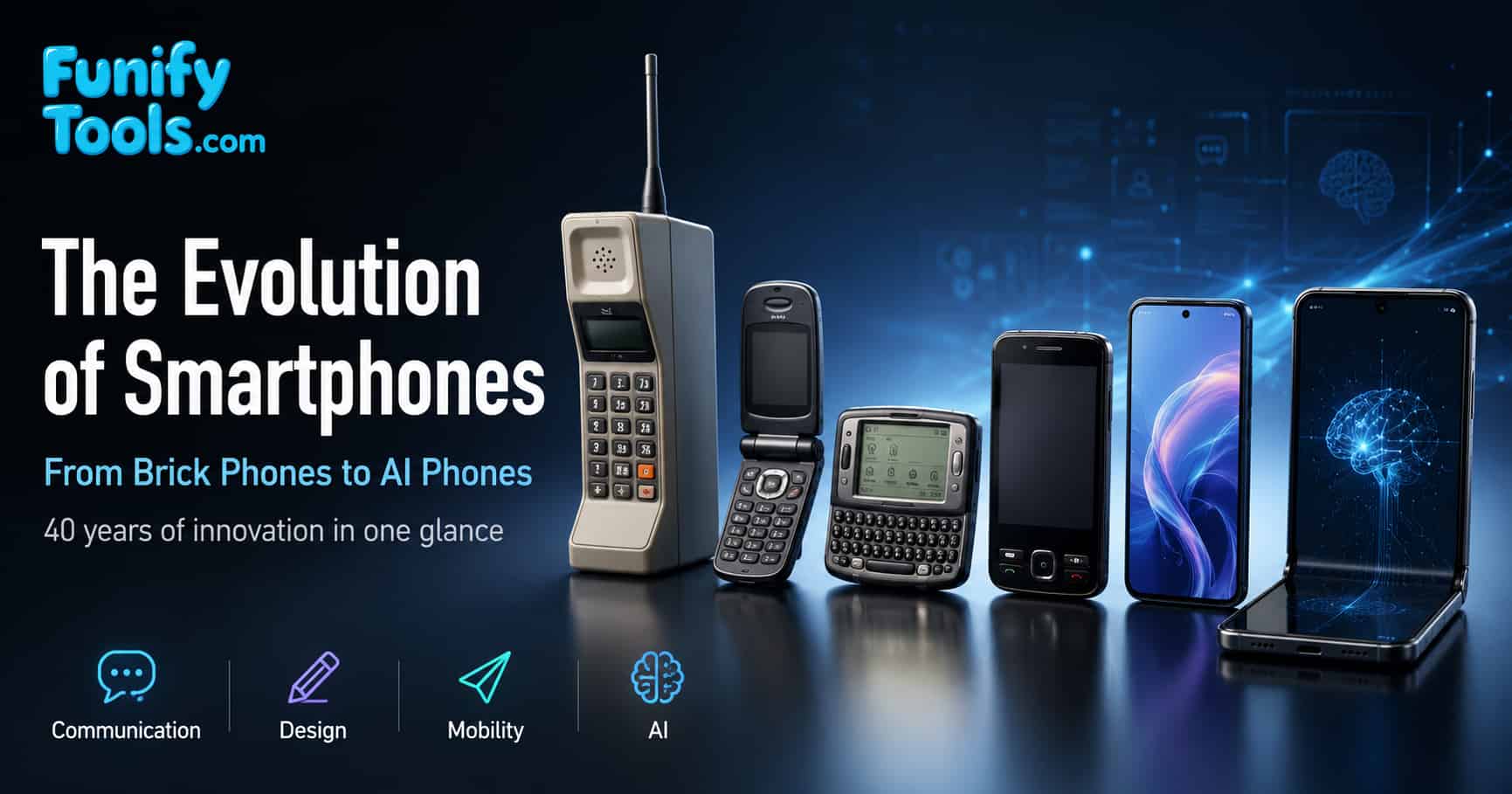
From Brick Phones to AI: 40 Years of Smartphones
The smartphone in our hand today feels almost ordinary. We wake up with an alarm, check messages, take photos, pay for coffee, navigate the city, watch videos, translate text, and ask AI to help us write or summarize something. All of that now happens through one small device.
But it was not always like this. The smartphone was not born as a perfect glass rectangle with a bright display and an app store. It came from decades of experiments: heavy portable phones, flip designs, business communicators, email devices, camera phones, touchscreens, app ecosystems, 5G, foldables, and now AI-powered personal assistants.
The story is not only about Motorola and Apple. It is also about Samsung, LG, Pantech, Nokia, BlackBerry, Google, and many other companies that each pushed the idea of a mobile computer forward. Some survived, some disappeared, but their ideas remain inside the phones we use today.
So today, let us follow that journey from the early brick phones to modern AI smartphones, and look at how a device once used only for calls became an extension of memory, creativity, work, and everyday life.
1980s
The Miracle of Carrying a Telephone
In 1983, the Motorola DynaTAC 8000X changed the meaning of a telephone. It weighed almost 1 kilogram, offered only about 30 minutes of talk time, and was extremely expensive. By today's standards, it looks awkward and impractical. But at the time, it represented something powerful: freedom from the wall.
Before mobile phones, a phone call was tied to a place. You called from home, from the office, or from a public phone. The DynaTAC made the phone personal and portable. Even if only a small number of people could afford it, the idea itself was revolutionary.
Six years later, in 1989, the Motorola MicroTAC introduced a flip design. Opening the lid before making a call felt futuristic, almost like a scene from a science fiction movie. That physical gesture became part of mobile phone culture, and foldable design would later become especially important in Korea's mobile industry.
At that time, South Korea's own mobile technology journey was only beginning. GoldStar, now LG Electronics, and Samsung Electronics were still heavily dependent on foreign components and know-how. But the ambition was already there: Korean companies wanted to build their own phones, not simply follow the global leaders forever.
We will build our own phones.
That simple desire would become one of the driving forces behind Korea's later rise in the global mobile market.
1990s
The Birth of the Smartphone Idea
In 1993, the IBM Simon Personal Communicator arrived. It combined phone calls, memo, calendar, email, fax, and a touchscreen in one device. It was bulky, slow, and far from the smooth smartphone experience we know today. Still, it showed the basic concept clearly: a phone could also be a small computer.
That idea was ahead of its time. The hardware was not ready, networks were limited, batteries were weak, and ordinary users did not yet expect a phone to handle information work. But looking back, IBM Simon feels like a preview of the future.
In 1996, the Nokia 9000 Communicator introduced a clamshell design with a full QWERTY keyboard. It looked like a tiny laptop hiding inside a phone. For business users, it was a serious tool: email, documents, contacts, and communication could all travel together.
In 1999, the RIM BlackBerry 850 introduced push email, which changed professional communication. Messages arrived automatically, without the user needing to refresh manually. From that point, people were no longer simply carrying a phone. They were carrying a personal communication terminal.
Meanwhile, Korea's mobile industry was going through its own turning point. In 1994, Samsung Electronics established its Wireless Communications Division and began developing fully domestic handsets. The global market was still dominated by Motorola and Nokia, and early Korean phones struggled with quality and reliability.
Then, on March 9, 1995, Samsung held what became known as the Mobile Phone Burning Ceremony at its Gumi factory. About 150,000 defective phones were destroyed in front of employees. It was dramatic, but the message was clear: quality had to become a matter of survival.
Let this fire remind us never to create such shame again.
The event became part of Samsung's quality story. Whether viewed as symbolic leadership or intense corporate discipline, it marked a change in mindset. Korean phones could not win globally through price alone. They had to become reliable, refined, and technically competitive.
In 1999, Samsung released the Anycall SCH-800, which became a symbol of Korean technological independence. LG's Cyon and Pantech's SKY also began building their own identities, focusing on design, emotional user interfaces, and features tailored to local users.
This was the period when phones started becoming personal objects, not just communication tools. Shape, color, ringtone, display, and brand identity all began to matter.
2000s
The OS Wars and the Golden Age of Korean Phones
In 2000, the Ericsson R380 became one of the first Symbian OS smartphones, showing that mobile phones were becoming software platforms. By 2003, the Nokia 6600 brought camera, Bluetooth, and multimedia features into a widely recognized smartphone form.
This was also the golden age of feature phones. Before the iPhone changed everything, phone makers competed fiercely through hardware design: thinner bodies, brighter displays, better cameras, sliding mechanisms, rotating screens, music playback, TV reception, and emotional interfaces.
- Samsung Anycall V200 (2003) helped popularize the camera phone concept.
- Anycall SGH-T100 showed the appeal of color TFT LCD displays.
- Pantech SKY became known for stylish slide designs and emotional UI ideas.
- LG Cyon experimented with TV phones, touch phones, and ultra-slim models.
When the Motorola Razr V3 became a global design icon in 2004, Korean manufacturers were also moving quickly. They were not always the most globally dominant, but they were aggressive, creative, and technically ambitious.
Then came 2007, the turning point. Apple introduced the first iPhone. Steve Jobs presented it as three products in one: a widescreen iPod, a revolutionary mobile phone, and an internet communicator. The key was that these were not separate devices. They were one device.
These are not three separate devices. This is one device. And we are calling it iPhone.
Buttons disappeared. The screen became the center of the experience. Touch gestures replaced many physical controls. Instead of asking users to adapt to tiny menus and keypads, the phone started adapting its interface to the task.
The following year, the HTC Dream, also known as the T-Mobile G1, introduced Google's Android OS to consumers. By 2009, Samsung entered the Android market with the Galaxy i7500, and LG's Optimus and Pantech's Vega later joined the race. From then on, smartphones became a platform war: iOS versus Android, app stores versus app stores, ecosystems versus ecosystems.
2010s
Popularization and the Era of Samsung vs. Apple
In 2010, Samsung released the Galaxy S, marking the real beginning of Samsung's Android smartphone leadership. The same year, the iPhone 4 turned smartphones into design objects with glass, stainless steel, and the Retina Display.
By this time, smartphones were no longer only for early adopters. They were becoming mainstream. People began to expect mobile internet, social media, high-quality cameras, maps, games, music, banking, and messaging in one pocket-sized device.
In 2011, the Galaxy Note arrived with a 5.3-inch display and the S Pen. Many people initially wondered whether it was too large. But the Note helped create the phablet category and proved that users wanted bigger screens for reading, drawing, watching, and working.
LG also tried bold ideas. The LG G2 introduced a rear-button layout in 2013, and later LG experimented with dual cameras, modular design, and unusual form factors. Pantech's Vega series also had loyal fans who liked its distinct design and software personality.
Pantech eventually disappeared from the smartphone market, and LG closed its smartphone business in 2021. Still, their experiments did not vanish completely. Dual cameras, rear controls, modular thinking, emotional UI ideas, and bold industrial design all became part of the broader smartphone DNA.
In 2015, Samsung's Galaxy S6 Edge brought a dual-curved display to global attention. In 2017, the iPhone X removed the home button and introduced Face ID, accelerating the shift toward all-screen devices. After that, the front of the smartphone became simpler and simpler: less button, more screen.
The 2010s were the decade when the smartphone became the remote control for daily life. It changed photography, music, maps, shopping, transportation, dating, banking, education, and work. It was no longer a phone with smart features. It was a personal computer that also happened to make calls.
2020s
AI, Foldables, and the Complete Smartphone
In the 2020s, the smartphone entered a more mature but still interesting phase. Performance improved, cameras became computational, screens became smoother, and 5G made mobile connectivity faster. At the same time, the basic rectangle design became so polished that true differentiation became harder.
Foldables became one answer. Samsung's Galaxy Z Fold line showed that a phone could open into a tablet-like screen. The idea was not simply to make the device bigger, but to change the relationship between portability and productivity.
Apple's iPhone 12 introduced 5G and MagSafe, strengthening the accessory ecosystem around the phone. Google Pixel devices pushed computational photography and AI features. Samsung continued to refine foldables and Galaxy AI features. Across the market, the smartphone started becoming less about raw specifications and more about intelligent assistance.
By the mid-2020s, phones such as the iPhone 17, Galaxy Z Fold series, Google Pixel series, and the next Galaxy S generation are no longer just communication devices. They can edit photos, summarize text, translate conversations, clean up images, suggest replies, and support natural interaction.
This is the rise of the AI phone. The phone is no longer waiting passively for commands. It is starting to understand context, learn user habits, and help create things. In a way, it is moving from tool to partner.
What Changed Most?
If we look back at 40 years of smartphone history, the biggest change is not only size, speed, or screen quality. The real change is the relationship between humans and devices.
The DynaTAC gave people freedom from fixed places. IBM Simon showed that a phone could hold information. BlackBerry made messages immediate. Anycall and Korean feature phones proved that mobile devices could express identity and design taste. The iPhone made touch the center of computing. Android made smartphones available across many brands and price ranges. Foldables challenged the screen itself. AI phones are now beginning to understand and assist us more personally.
Each stage changed what people expected from a phone. At first, the question was, "Can I call from anywhere?" Then it became, "Can I send email?" Then, "Can I browse the web?" Then, "Can I take good photos?" Now the question is becoming, "Can this device understand what I need before I explain everything?"
Looking Back at 40 Years of Smartphones
The DynaTAC (1983) gave us freedom.
The IBM Simon (1993) gave us the idea of a pocket computer.
The BlackBerry era gave us always-on communication.
The Anycall era gave Korea confidence and pride.
The iPhone (2007) changed the experience.
And today's AI smartphones are beginning to share our thoughts and creativity.
The history of the smartphone is ultimately the story of humanity's desire to communicate more freely. From telephone wires to mobile calls, from email to touchscreens, from app stores to AI assistants, the direction has always been the same: we want technology to come closer to our lives.
The next stage may already be unfolding. As AI becomes central, and as foldables, wearables, and mixed-reality devices connect more closely, the smartphone may become less of a single object and more of a personal hub. The screen may matter less than the experience. Intelligence may matter more than raw hardware. Continuity may matter more than a single device.
Holding a smartphone today, it is easy to forget how long the journey has been. But inside that small device are decades of experiments, failures, rivalries, and brave ideas. The next time it helps you write a message, capture a memory, find a place, or understand the world a little faster, it is worth remembering that this convenience was built step by step.
Thank you for reading. Stay curious, and stay happy!
This article is also available in Korean: Read the Korean version