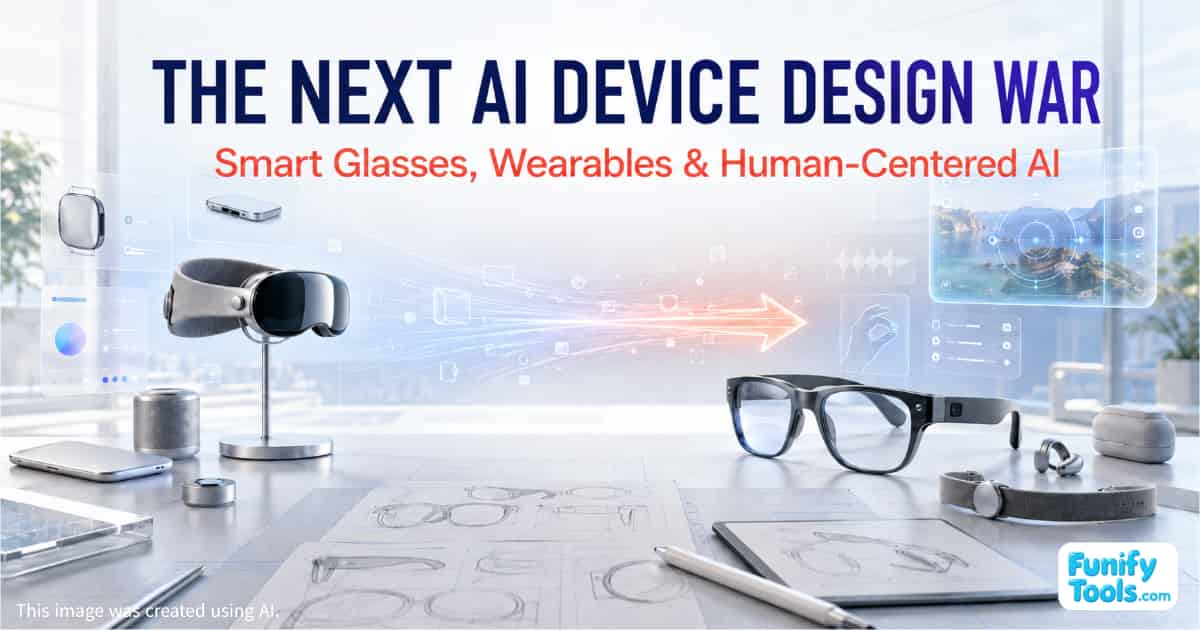
Alan Dye's move from Apple to Meta is far more significant than a typical executive job change. On the surface, it may look like one senior designer simply left one technology company for another. Look more closely, however, and the move offers valuable clues about how major technology companies are preparing for the AI era—and how the devices we use may change as a result.
Dye joined Apple in 2006 and led its Human Interface Design team from 2015. During his time at the company, he helped shape the look and feel of major products and platforms, including the iPhone X, Apple Watch, Vision Pro, iOS, macOS, watchOS, and visionOS.
In simple terms, he was deeply involved in creating the distinctive experience people associate with using an Apple product: the way interfaces move, respond, communicate information, and connect software with hardware.
Dye joined Meta as chief design officer on December 31, 2025, as the company accelerated its efforts to build AI-powered consumer devices. Reuters
Why Meta Recruited Alan Dye
From Meta's perspective, the reason for hiring Dye is relatively clear.
Meta no longer wants to be viewed primarily as the company behind Facebook and Instagram. It has spent years investing in virtual reality, augmented reality, wearable computing, and artificial intelligence in an effort to secure a leading position in the next generation of personal technology.
The company already offers Quest headsets and has worked with EssilorLuxottica brands Ray-Ban and Oakley on AI-enabled smart glasses. These products are part of Meta's larger ambition to establish a computing platform that extends beyond smartphones and conventional social networks.
Building capable hardware is only one part of that challenge. Even an advanced device can fail if people find it confusing, uncomfortable, distracting, or difficult to trust.
The point where hardware, software, and human behavior meet is the interface—and designing that interface is especially difficult for devices worn on the face or body.
That is where Dye's experience becomes valuable.
Meta is not simply hiring someone who knows how to make screens look attractive. It is bringing in a designer with extensive experience coordinating software behavior, visual systems, interaction patterns, and physical devices across a large consumer ecosystem.
Meta's New Design Studio
Meta has placed Dye at the center of a new creative studio focused on bringing together design, technology, fashion, hardware, software, and AI.
Meta CEO Mark Zuckerberg described intelligence itself as a new kind of design material. The idea is that AI should not be treated merely as another feature added to a product. Instead, it should influence how the entire experience is designed.
This is particularly important for smart glasses.
A conventional app normally waits for the user to tap a button or choose an option. An AI-enabled wearable may respond to voice, movement, visual surroundings, personal context, and information gathered throughout the day.
That creates much more complicated design questions:
- When should the device provide information?
- How should it indicate that a camera or microphone is active?
- How can it respond without interrupting the user?
- What should happen when the AI is uncertain?
- How should private information be displayed or spoken?
- Which actions require explicit confirmation?
- How can the system feel helpful without becoming intrusive?
Meta's new design organization is intended to address these issues across hardware and software instead of treating them as separate problems.
Why Smart Glasses Are So Difficult to Design
Smart glasses may appear simpler than smartphones because they have fewer visible controls. In reality, that simplicity makes them considerably harder to design.
A smartphone has a large screen, established gestures, familiar menus, and decades of interface conventions. Smart glasses have far less visual space and must often work without requiring users to hold or constantly look at a screen.
Their interfaces may depend on:
- Voice commands
- Eye movement
- Head position
- Hand gestures
- Audio feedback
- Small visual overlays
- Cameras and environmental sensors
- Context-aware AI responses
Every interaction must be carefully timed. Too much information can overwhelm or distract the wearer. Too little feedback can leave the user unsure whether the device understood a command.
The device must also function in public. A design that works in a private office may feel awkward on a crowded train or while speaking to another person.
This is one reason experienced interface leadership matters. The challenge is not simply fitting a smartphone interface into a smaller display. It is creating a new interaction language appropriate for a device that may always be present.
The Importance of Human-Centered AI Design
Earlier generations of software generally followed predictable paths. Users selected commands, and the program returned predefined results.
AI systems behave differently. Their responses can vary depending on the user, the context, the available data, and the way a question is asked.
This means AI design must account for uncertainty.
A well-designed AI experience should help users understand:
- What the system can and cannot do
- When it is listening or observing
- Which information it is using
- How confident it is in a response
- Whether an action has actually been completed
- How to correct a mistake
- How to control personal data
These are not merely visual design decisions. They involve psychology, language, privacy, accessibility, safety, and trust.
In the AI era, the best interface may not be the one with the most impressive animation. It may be the one that quietly communicates the right information at the right time and allows users to remain in control.
What Alan Dye Brings from Apple
Apple has long treated interface design as part of the product itself rather than as decoration added near the end of development.
Its strongest products coordinate hardware, software, animation, sound, typography, gestures, and physical feedback. When these elements work together, the user does not need to think about the technology underneath them.
Dye spent years working within that environment.
His experience with Apple Watch is particularly relevant because a smartwatch must present useful information in a very limited space. His work related to Vision Pro and visionOS is also closely connected to Meta's interest in spatial computing, headsets, and augmented-reality devices.
This does not mean future Meta products will simply look like Apple products. Meta has different platforms, business goals, engineering systems, and design traditions.
However, its devices may become more consistent and carefully integrated. Small details—including feedback animations, transitions, voice behavior, gesture recognition, and privacy indicators—could receive greater attention.
Meta Wants to Become a Serious Consumer Hardware Company
Meta has released ambitious hardware before, but its long-term challenge has been turning experimental technology into products that feel natural enough for everyday use.
The recruitment of Dye suggests that Meta wants design to play a more central role as it develops a broader consumer-device portfolio.
It sends a message that the company does not want its smart glasses, headsets, and future wearables to remain interesting technical demonstrations. It wants them to become polished products that ordinary consumers can comfortably use.
That requires more than improved processors or better AI models.
A successful wearable must also have:
- A clear purpose
- Comfortable physical design
- Predictable controls
- Strong privacy signals
- Useful battery life
- Consistent software
- Socially acceptable behavior
- A reason to become part of everyday life
Design is the discipline that brings these requirements together.
What the Change Means for Apple
Dye's departure was also important for Apple, although it does not necessarily indicate a design crisis.
Apple appointed veteran designer Stephen Lemay to succeed him. Apple CEO Tim Cook said Lemay had played an important role in the design of every major Apple interface since 1999, presenting the appointment as a continuation of the company's established design culture. Reuters
Promoting a longtime internal designer sends a message of stability. It suggests that Apple considers its design capabilities to be distributed across a team rather than dependent on a single high-profile leader.
Apple also has a structural advantage: it controls much of the relationship between its hardware, operating systems, chips, applications, and services. One executive's departure is unlikely to cause an immediate collapse in design quality.
Still, the timing attracted attention because Dye's move followed other senior leadership changes, including the departure of longtime chief operating officer Jeff Williams and changes involving AI chief John Giannandrea.
Rather than automatically describing this as a crisis, it may be more accurate to view it as part of a broader period of generational transition inside Apple.
A New Kind of Silicon Valley Talent War
The competition for technology talent is also changing.
For many years, the most highly publicized recruitment battles focused on engineers, machine-learning researchers, and algorithm specialists. Those people remain extremely valuable, but advanced AI models are gradually becoming available to more companies.
As the underlying technology improves, differentiation increasingly depends on how people encounter and use it.
Several companies may have access to capable language models, computer-vision systems, and voice assistants. The winner may be the company that combines those technologies into the most useful, understandable, and trustworthy experience.
This makes designers who can integrate hardware, software, and human behavior increasingly valuable.
The modern AI talent race is therefore not only about who can build the smartest model. It is also about who can turn that intelligence into a product people genuinely want to use.
The Interface May Become the Main Competitive Advantage
Smartphone competition has often centered on screen quality, cameras, processors, battery life, and application ecosystems.
AI wearables introduce a different set of competitive factors.
Users may judge these devices by questions such as:
- Does the assistant understand me naturally?
- Does it respond at the right moment?
- Can I trust it around private conversations?
- Does it help without demanding constant attention?
- Is it socially comfortable to use?
- Can I quickly stop or correct it?
- Does it explain what it is doing?
These details may be more important than raw AI benchmark scores.
A model can be extremely capable, but if the interface feels unpredictable or intrusive, users may avoid the product. Conversely, a slightly less powerful model may succeed if the overall experience feels reliable and natural.
This is why the design competition between Apple, Meta, Google, OpenAI, and other technology companies could become just as important as the race to build larger models.
Privacy Will Be Part of the Product Design
AI glasses and wearable devices raise privacy concerns that conventional screens do not.
A smartphone is usually visible when someone is taking a photograph or recording a video. Smart glasses can make those actions much less obvious.
Designers must therefore consider both the wearer and the people around them.
Important questions include:
- How clearly should recording be indicated?
- Can bystanders understand when sensors are active?
- Should certain features be disabled in sensitive locations?
- How much information should be processed locally?
- What data should be sent to the cloud?
- How long should recordings or contextual information be retained?
- How can users review and delete stored information?
Privacy cannot simply be hidden inside a settings menu or legal document. It must be communicated through lights, sounds, animations, physical controls, and predictable system behavior.
For AI wearables, privacy design may become part of the product's public identity.
Will Meta's Products Become More “Apple-Like”?
It is reasonable to expect Dye's influence to appear in Meta's future products, but “Apple-like” should not be interpreted too literally.
Meta is unlikely to copy Apple's visual style directly. The more meaningful influence may appear in the way products are organized and refined.
Potential changes could include:
- More consistent interface behavior across devices
- Greater coordination between hardware and software teams
- Clearer visual and audio feedback
- More deliberate gesture design
- Better onboarding for unfamiliar technology
- Stronger attention to accessibility and privacy
- Fewer disconnected experimental features
- A more coherent product identity
These improvements may not always be visually dramatic. Good interaction design is often most successful when users barely notice it.
Apple and Meta Are Competing for the Next Computing Platform
The larger story is not limited to one designer.
Apple and Meta are both trying to shape what comes after the smartphone.
Apple has Vision Pro, a mature device ecosystem, custom chips, and deep integration across hardware and software. Meta has Quest, rapidly developing AI capabilities, established social platforms, and consumer smart glasses produced with major eyewear brands.
Their approaches are different.
Apple has generally emphasized carefully controlled, premium hardware and tightly integrated experiences. Meta has been more willing to release products earlier, experiment publicly, collect feedback, and expand through partnerships.
Dye's move does not erase those differences. Instead, it may bring more design discipline to Meta's experimental speed.
That combination could make the competition considerably more interesting.
Design in the AI Era
The role of design is expanding as AI becomes more deeply embedded in everyday products.
Traditional interface design focused largely on presenting fixed functions in a clear and attractive way. AI systems do not always behave predictably. They interpret language, infer intent, generate responses, and adapt to context.
Designers must therefore create experiences for systems that may respond differently each time.
They need to decide:
- How much autonomy an AI should have
- When it should ask for permission
- How uncertainty should be displayed
- What happens when it makes a mistake
- How users can interrupt it
- How its behavior changes across locations and situations
- How the system can earn trust over time
This requires more than conventional visual-design skills. It demands an understanding of human behavior, ethics, privacy, accessibility, and the social consequences of technology.
Designers capable of solving these problems are becoming some of the most strategically important people in Silicon Valley.
Final Thoughts
Alan Dye's move from Apple to Meta is about more than one executive changing companies.
It reflects Meta's determination to become a serious creator of AI-powered consumer hardware. It also shows that the next stage of the AI competition will be fought not only through models, chips, and computing power, but through design.
Once AI performance becomes less distinctive on its own, the user experience may become the decisive battleground.
The companies that succeed will be those that make AI feel understandable, useful, trustworthy, and natural in everyday life. Smart glasses and next-generation wearables will test those abilities more severely than traditional screens ever did.
Apple has years of experience integrating hardware and software into carefully controlled products. Meta has scale, ambition, AI expertise, and a willingness to experiment with new device categories.
Bringing one of Apple's most experienced interface leaders into Meta gives that competition a new dimension.
It will be worth watching how Dye's design philosophy influences Meta's smart glasses, headsets, and future wearables—and how Apple responds as the fight to define the next personal computing platform becomes more intense.
Thank you for reading, and have a wonderful day!
This article is also available in Korean: Read the Korean version