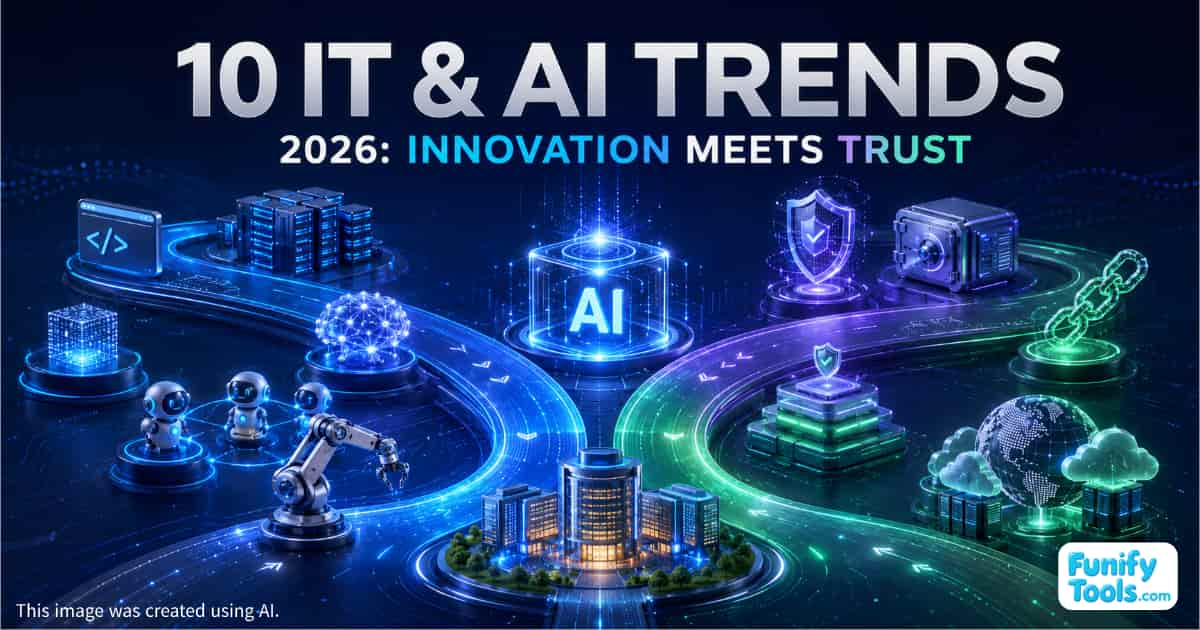
Today, let's take a closer look at the major IT trends shaping 2026.
Based on Gartner's Top Strategic Technology Trends for 2026, we will explore how AI is likely to evolve and what these changes could mean for businesses.
Looking at the broader picture, experts appear to believe that the next phase of AI will be defined less by competition between individual models and more by competition between systems. Even when companies use the same underlying models, their results can vary dramatically depending on how effectively they connect them, operate them securely, and scale them at a reasonable cost.
With that perspective in mind, let's examine Gartner's ten strategic technology trends for 2026.
If we had to summarize the direction of AI in 2026 in one sentence, it would be:
Practical technologies that generate value and operate reliably will take priority over impressive technology demonstrations.
1. AI-Native Development Platforms: A New Default for Software Development
AI-native development platforms go far beyond making coding assistants more intelligent. They bring AI into the entire software development lifecycle, including planning, architecture, implementation, testing, deployment, and operations.
Agentic coding tools are already moving beyond code generation and into areas such as infrastructure configuration and deployment automation. As their responsibilities expand, the standards applied to development teams will also change.
Building software quickly will no longer be enough. The software must also operate reliably in production.
This shift will place greater emphasis on code quality, security, auditability, and accountability. Organizations will need to determine who reviews AI-generated code, how changes are approved, and how errors can be traced back to their source.
As a result, software development competitiveness in 2026 may depend less on how quickly a company can add features and more on how effectively it can validate AI-generated output and turn it into reliable, maintainable systems.
2. AI Supercomputing Platforms: Efficiency Matters More Than Scale
Competition in AI supercomputing will continue, but the most important advantage in 2026 may come from efficiency rather than sheer scale.
Having access to more GPUs is clearly beneficial. In real-world deployments, however, inference costs can become an even greater burden than model-training costs—especially when AI services must respond to large numbers of users around the clock.
For this reason, technologies that deliver the same level of performance at a lower cost will become increasingly important.
Organizations will divide workloads more intelligently, use caching to reduce repeated requests, and select different models according to the complexity of each task. Lightweight models may handle simple and frequent requests, while larger, more capable models are reserved for cases that genuinely require them.
The strength of an AI infrastructure platform will therefore not be measured only by the size of its computing cluster. It will be determined by how reliably, quickly, and economically that infrastructure can operate within a fixed budget.
3. Confidential Computing: The Security Foundation of the AI Era
In 2026, organizations are likely to continue strengthening the basic security foundations required for broader AI adoption.
Confidential computing, particularly technology built around trusted execution environments, or TEEs, is becoming an increasingly important part of AI security. Traditional security measures can protect data while it is stored or transmitted, but sensitive information may still be exposed while it is actively being processed.
Confidential computing is designed to protect this “data in use.”
Once AI systems begin working with financial records, healthcare information, trade secrets, or personally identifiable information, organizations must clearly define which data can be entrusted to AI and under what conditions.
This will push companies to improve data classification, access control, encryption, monitoring, and auditability.
Security should therefore not be viewed only as an obstacle that slows AI adoption. When implemented properly, it becomes a condition that allows organizations to use AI across a wider range of sensitive and valuable workloads.
4. Multiagent Systems: More Agents Require Greater Control
Multiagent systems are likely to become significantly more practical in 2026.
In 2025, much of the attention was focused on demonstrations showing how intelligent an individual AI agent could be. The next phase will involve multiple agents dividing responsibilities and completing real business processes together, almost like a team.
One agent might collect data, another might analyze it, a third might prepare a report, and another might check the result before it is delivered.
However, operational complexity increases as the number of agents grows.
More agent calls can increase costs. Broader permissions can create security risks. Inconsistent results can raise questions about reproducibility and accountability. When a workflow fails, an organization must be able to determine which agent made the mistake and why.
The goal, therefore, should not be to create as many agents as possible. It should be to control them effectively.
Orchestration, detailed logging, continuous evaluation, and rollback capabilities will become essential. Organizations need observability that shows what each agent did, why it did it, which tools it accessed, and how well it performed.
In 2026, successful agent operations will depend as much on governance and control as on intelligence.
5. Domain-Specific Models: One General-Purpose Model Is Not Enough
Domain-specific models are likely to gain further momentum in 2026.
General-purpose models have become remarkably capable, but no single model can perform every business task equally well. Fields such as law, manufacturing, finance, and medicine use precise terminology and operate under detailed rules.
In these areas, a model that understands the language, standards, and workflows of a particular domain can be much more valuable than a broadly capable model with limited specialist knowledge.
Even a small decrease in accuracy can create substantial risk in a regulated or highly technical environment. It can also dramatically increase the cost of human verification.
Domain-optimized models may therefore deliver a clearer return on investment by improving accuracy, reducing review time, and producing output that better fits established business processes.
Rather than relying on one model for everything, organizations are likely to assemble combinations of models. A general-purpose model may handle common tasks, while specialized models process work requiring deeper industry expertise.
The key capability in 2026 will not simply be choosing the “best” model. It will be designing the most reliable and cost-effective combination of models for each type of work.
6. Physical AI: Intelligence Moves Beyond the Screen
Physical AI is expected to become much more visible in 2026.
Until recently, many mainstream AI applications focused on tasks performed inside a screen, such as summarizing documents, searching for information, generating content, and answering customer questions.
AI is now moving into the physical world through robots, logistics systems, manufacturing equipment, autonomous machines, and workplace safety technologies.
This transition changes what matters.
Model performance alone is no longer sufficient. Outcomes also depend on sensor quality, response time, control systems, environmental conditions, safety mechanisms, and the ability to recover from failures.
The physical world is far less forgiving than a software demonstration. A system that performs well during a short presentation may still fail when required to operate safely and consistently throughout an entire working day.
For this reason, physical AI in 2026 will increasingly be evaluated through measurable operational results. Companies will want to know whether it can reduce defects, shorten production time, prevent accidents, improve warehouse throughput, or lower maintenance costs.
The market will gradually move away from impressive demonstrations and toward systems that can produce visible, repeatable results in real workplaces.
7. Preemptive Cybersecurity: From Responding to Attacks to Preventing Them
Preemptive cybersecurity is likely to spread rapidly in 2026.
As attackers use AI to increase both the speed and scale of their operations, defensive teams will find it increasingly difficult to rely only on responding after an incident has occurred.
Security systems will therefore use logs, network activity, identity signals, and behavioral data to detect warning signs earlier. They may then automatically block suspicious activity, isolate a device, restrict an account, or require additional verification.
However, automation itself is not the ultimate goal.
An automated system that produces a false positive could interrupt legitimate business operations. A system that fails to detect an actual attack could allow the damage to spread more quickly.
The real challenge is to combine prediction and automated response with safeguards that limit the consequences of mistakes.
These safeguards may include staged blocking, least-privilege access, rollback capabilities, human approval for high-impact actions, and clear escalation procedures.
The competitive advantage will not come from having the most aggressive automated defense. It will come from operating a defense system that is both intelligent and safe.
8. Digital Provenance: Proving Where Everything Came From
As AI-generated content grows and organizations depend more heavily on open-source software and external SaaS platforms, the ability to prove where digital assets originated will become increasingly important.
In the past, provenance was often investigated only after something went wrong. A security team might trace a suspicious file, library, or data source after an incident had already occurred.
In 2026, organizations will need systems that record origins and modification histories from the beginning.
They must be able to answer questions such as:
- Where did this code come from?
- Which libraries and open-source components were used?
- Who changed the software, and when?
- What data was used for training or inference?
- Which systems processed the data along the way?
- Was this image, document, or video generated or modified by AI?
Software supply chain management, data lineage, digital watermarking, and Software Bills of Materials, or SBOMs, will no longer be concerns limited to security teams.
Product, engineering, data, and operations teams will need to treat provenance as part of their everyday responsibilities.
In this environment, creating a good product will not be enough. The ability to explain how it was created will also become a competitive advantage.
9. AI Security Platforms: AI Requires Its Own Security Layer
AI security platforms are likely to establish themselves as a distinct product category in 2026.
As AI becomes more deeply embedded in business processes, the attack surface expands in ways that differ from traditional application security.
Organizations must manage not only vulnerabilities in the model itself but also threats such as prompt injection, sensitive data leakage, excessive tool permissions, malicious inputs, connector abuse, and supply chain risks introduced through external services.
Traditional tools such as web application firewalls and endpoint detection and response platforms remain important, but they are not sufficient on their own.
Companies will need dedicated security systems capable of monitoring and controlling models, prompts, connected tools, permissions, and data flows as one integrated environment.
A mature AI security platform should help organizations understand what information a model receives, which tools an agent can call, what actions it is permitted to perform, and whether its behavior has changed unexpectedly.
In 2026, the difference between companies that use AI well and those that use AI safely will become increasingly visible. The strongest organizations will be the ones capable of doing both.
AI performance alone does not create a competitive product. AI becomes truly valuable when it can operate safely and reliably at scale.
10. Geopatriation: Data Sovereignty Reshapes IT Architecture
Geopatriation is expected to become an important factor shaping IT architecture in 2026.
Companies will continue using cloud services, but the practice of placing every workload in a single global public cloud environment may become less attractive.
Regulations are becoming more detailed, geopolitical risks are increasing, and supply chains remain vulnerable to disruption. As a result, the location of data is no longer simply a technical or financial decision. It has become a matter of risk management and business strategy.
Some organizations may move sensitive data and critical workloads into local cloud regions, sovereign cloud environments, on-premises infrastructure, or hybrid systems.
The important issue is not which technology stack they choose. It is the criteria used to make that decision.
Companies must consider data residency requirements, regulatory compliance, operational resilience, vendor concentration, service continuity, national security concerns, and the potential consequences of cross-border restrictions.
In 2026, deciding where to place a workload will no longer belong solely to the infrastructure team. It will become a strategic business decision involving legal, compliance, security, finance, and executive leadership.
IT architecture will increasingly be optimized not only for performance and cost but also for sovereignty, resilience, and geopolitical risk.
The Bigger Picture for AI in 2026
The overall direction of 2026 can be summarized fairly simply: more companies will adopt AI, but the strongest organizations will be those that start small, move useful projects into production quickly, and prove their value with measurable results.
A grand long-term roadmap may look impressive, but a small project that produces visible savings or higher revenue can be far more persuasive.
This is also why smaller teams may be able to use AI as leverage and compete with much larger organizations. When AI reduces repetitive work and helps people make decisions faster, a focused team can achieve results that once required significantly more employees.
Ultimately, 2026 will not belong simply to the people who understand the latest technology trends. It will belong to the people who can turn those trends into stable, repeatable operations.
An impressive AI demonstration can be copied quickly. Reliable operations, strong security, effective governance, and continuous cost optimization are much more difficult to reproduce.
The real dividing line will therefore not be between companies that use AI and companies that do not. It will be between those that merely experiment with AI and those that can operate it safely, efficiently, and profitably.
Thank you for reading, and I hope you have a wonderful day!
This article is also available in Korean: Read the Korean version