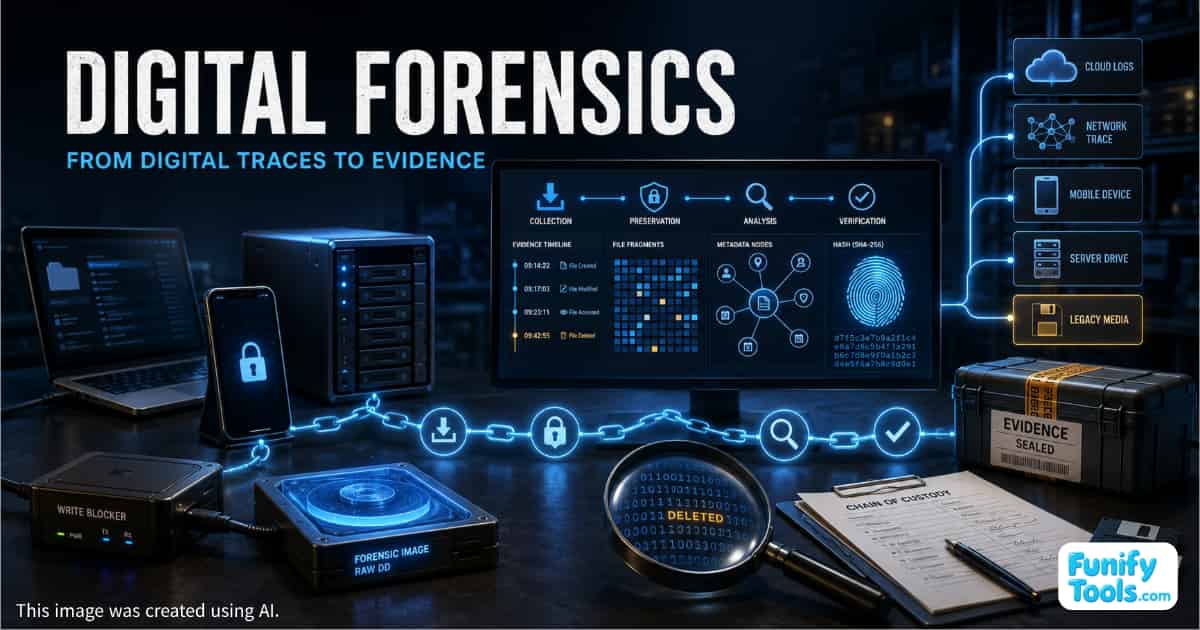
Today, we are going to take a closer look at digital forensics.
The term may sound technical, but the basic idea is relatively simple: digital forensics is the process of reconstructing events from traces left behind in digital environments.
Computers, smartphones, servers, cloud platforms, and networks preserve far more information than most people realize. When a crime, security breach, or workplace incident occurs, those records can provide crucial clues.
Modern investigations rarely involve something as simple as a single missing file or an unexplained login. Data theft, insider threats, compromised accounts, malware infections, and ransomware attacks often overlap.
In these situations, investigators cannot rely on assumptions about who did what. They must examine logs and other digital traces to determine who was involved, what happened, when it happened, and how it was carried out.
This usually involves constructing a timeline, comparing records from multiple systems, and reconstructing events as objectively as possible.
However, technical analysis is only one part of digital forensics. The reliability of the evidence is equally important.
If the original data is damaged or altered during collection, even an accurate analysis may carry less weight in court or during an internal investigation. Investigators must therefore be able to explain how the data was acquired, how it was preserved, which tools and methods were used, and whether anything changed during the process.
For this reason, digital forensics is often described as a combination of technology and procedure.
This guide explains the fundamental concepts, introduces terminology frequently encountered in professional practice and certification exams, and examines two famous cases in which digital evidence played a decisive role.
What Is Digital Forensics?
Digital forensics is the process of collecting and preserving traces from computers, smartphones, servers, cloud platforms, and networks in a form that can be used as evidence. Investigators then analyze that evidence to reconstruct what happened.
Put simply, it is the technical and procedural practice of using digital traces to establish facts.
The key point is that performing a good analysis is not enough. The evidentiary reliability of the data must be maintained throughout the entire investigation.
If the collection process is poorly handled or the original data is modified, the findings may lose credibility even when the analysis itself is correct.
Why Is the Digital Forensics Process So Strict?
Digital forensics is often connected to litigation, regulatory reviews, corporate audits, internal investigations, and law enforcement proceedings.
The objective is therefore not to produce a plausible theory. Investigators must present evidence that other people can examine, understand, and verify.
Several principles are especially important.
Integrity
Investigators must be able to demonstrate, usually with cryptographic hash values and documented procedures, that the evidence has not been altered.
Reproducibility
Another qualified examiner following the same process should be able to obtain substantially the same result.
Minimal Modification
Whenever possible, investigators should avoid analyzing the original storage device directly. Instead, they create a forensic image and conduct the examination on a verified copy.
Documentation
The investigator must record who handled the evidence, when it was collected, where it was stored, what actions were taken, and when it was transferred to someone else. This documentation forms part of the chain of custody.
Digital forensics is therefore both a technical discipline and a form of evidence management.
The Typical Digital Forensics Process
Although procedures vary depending on the investigation, a typical digital forensics workflow includes the following stages.
1. Identification
Investigators determine which devices, user accounts, applications, cloud services, and logs may contain relevant evidence. They also define the scope of the investigation.
2. Preservation
The priority is to protect the original evidence. Preservation measures may include restricting access, isolating systems, using write blockers, and documenting the condition of each device.
3. Collection or Acquisition
Investigators acquire the relevant data. This may involve creating a forensic disk image, capturing memory, backing up logs, collecting network data, or retrieving cloud audit records.
4. Analysis
The collected data is examined to reconstruct timelines, identify relevant files, correlate logs, recover deleted information, and determine how an incident unfolded.
5. Reporting
Investigators document their findings and connect each conclusion to its supporting evidence. A good report clearly distinguishes verified facts from interpretations or expert opinions.
Beginners often underestimate the importance of preservation. The urge to begin analyzing a device immediately is understandable, but accessing the original system can change timestamps, create new files, overwrite deleted data, or otherwise affect the evidence.
The reliability of an investigation can begin to deteriorate the moment the original evidence is handled improperly.
Essential Digital Forensics Terms
1. Evidence and Evidence Management
Evidence
Evidence is information that can support or refute a claim during an investigation. In digital forensics, it may include both the underlying data and the expert interpretation of that data.
Artifact
An artifact is a digital trace that may help investigators understand user or system activity.
Examples include browser history, recently opened files, login records, USB connection history, application databases, registry entries, email headers, and cloud audit logs.
An artifact is not automatically proof of a particular action. Its meaning must be interpreted in context and compared with other evidence.
Chain of Custody
The chain of custody is the documented history of the evidence after it has been identified or collected.
It records who acquired the evidence, who handled it, how it was stored, when it was transferred, and what happened to it throughout the investigation.
A broken or poorly documented chain of custody may create doubts about whether the evidence was altered, replaced, or mishandled.
Integrity
Integrity refers to the assurance that evidence has not been modified, damaged, or tampered with after collection.
Hash
A hash is a digital fingerprint calculated from data using a cryptographic hash function.
Investigators commonly calculate hash values for the original evidence and its forensic copy. Matching values provide strong support that the copied data is identical to the source at the time the hashes were calculated.
If even a small part of the data changes, the resulting hash value should also change.
2. Collection and Acquisition
Forensic Image
A forensic image is an analysis copy of a storage device created in a manner designed to preserve the original evidence.
Unlike an ordinary file backup, a forensic image may include file-system structures, deleted data remnants, unallocated space, and other information that users cannot normally see.
Bit-by-Bit Copy
A bit-by-bit copy duplicates the storage medium at a low level rather than copying only the visible files.
This approach can preserve unused and unallocated areas that may still contain fragments of deleted data.
Write Blocker
A write blocker is a hardware device or software function that prevents an examination system from writing data to the original storage device.
Its purpose is to protect the source from accidental changes during acquisition or examination.
Live Acquisition
Live acquisition is the collection of data while a computer or device is still running.
This method is often necessary when investigators need volatile information such as:
- RAM contents
- Active network connections
- Running processes
- Logged-in sessions
- Encryption keys
- Mounted encrypted volumes
- Temporary authentication tokens
The challenge is that interacting with a live system inevitably changes its state to some extent. Investigators must document those changes and balance the need to preserve volatile evidence against the risk of modifying the system.
Dead-Box Forensics
Dead-box forensics involves examining a powered-off system or removing its storage media and analyzing it offline.
This approach can make it easier to protect the original drive and create a controlled forensic image. However, volatile data stored in memory will already have been lost when the system is powered down.
3. Timelines and Digital Traces
Timeline Analysis
Timeline analysis combines file timestamps, logs, application records, system events, and other artifacts to reconstruct events in chronological order.
A timeline may reveal when a user logged in, when a malicious file was downloaded, when it was executed, which files were accessed, and when data left the system.
Timestamps
Timestamps record times associated with files, messages, events, or other digital activity.
Common examples include creation, modification, and access times. Their precise meanings vary among operating systems, applications, and file systems, so they must be interpreted carefully.
Timestamps can also be affected by time zones, clock errors, synchronization problems, file copying, system updates, and deliberate manipulation.
File Carving
File carving is a recovery technique that searches raw storage data for recognizable file signatures or structures.
It can recover files even when file-system records are missing, corrupted, or deleted. However, recovered files may be incomplete or fragmented, particularly when their data was stored in noncontiguous areas.
Unallocated Space
Unallocated space is an area that the file system currently identifies as unused.
It may still contain remnants of previously deleted files until those sectors are overwritten by new data.
Slack Space
Slack space is the unused area between the end of a file and the end of the storage cluster assigned to that file.
Fragments of previously stored data may sometimes remain in this area, making it relevant during a forensic examination.
MACB Times
MACB refers to a group of file-time attributes:
- Modified
- Accessed
- Changed
- Born
The precise interpretation of these attributes depends on the file system. “Changed,” for example, may refer to a change in metadata rather than a change in the file's content.
Metadata
Metadata is information that describes other data.
Examples include a photograph's EXIF information, a document's author, modification history, file owner, device model, location data, and the application used to create a file.
Metadata can provide valuable clues, but investigators should avoid treating it as infallible. It may be modified, removed, copied incorrectly, or generated automatically by software.
4. Incident Response and Threat Investigation
Indicator of Compromise
An Indicator of Compromise, or IOC, is a piece of information that may suggest malicious activity or a security breach.
Examples include:
- Malicious IP addresses
- Suspicious domains
- Known malware hashes
- Unusual file names
- Registry changes
- Unexpected scheduled tasks
- Abnormal login activity
An IOC is usually a lead rather than final proof. It should be examined in context and correlated with other evidence.
Tactics, Techniques, and Procedures
Tactics, techniques, and procedures, commonly abbreviated as TTPs, describe patterns in how an attacker operates.
Tactics represent the attacker's objectives, techniques describe how those objectives are pursued, and procedures refer to the specific ways the techniques are carried out.
Understanding TTPs helps investigators connect apparently separate events and recognize repeated attacker behavior.
Log Correlation
Log correlation is the process of comparing logs from several systems to reconstruct a single event.
For example, investigators may combine identity-provider logs, VPN records, endpoint telemetry, email security logs, firewall records, and cloud audit events to follow an attacker's activity across an organization.
Two Famous Digital Forensics Cases
People can lie or misremember events, but digital systems often leave records behind. Those records can appear in more places than either the suspect or the investigator initially expects.
The following cases demonstrate how digital evidence can become the decisive element in an investigation.
1. The BTK Case: The Traces Left on a Floppy Disk
BTK was the self-chosen name of the serial killer who terrorized the Wichita, Kansas, area from the 1970s through the early 1990s.
The letters stood for “Bind, Torture, Kill,” describing the methods associated with his crimes. The killer also sent letters and messages to law enforcement agencies and the media, apparently seeking attention and taunting investigators.
The murders stopped after 1991, and the investigation became a long-running cold case. There was no decisive witness, and the investigative technology available at the time could not narrow the suspect pool sufficiently.
Around 2004, media speculation suggested that BTK might have died or been imprisoned. The killer then resumed communicating, seemingly to prove that he was still alive.
Between 2004 and 2005, he sent a series of letters, packages, and other materials. Investigators collected small clues from each communication.
Eventually, the killer asked whether a floppy disk could be traced. Police responded through their established public communication method and indicated that using one would be safe.
He believed them and sent a floppy disk.
The killer may have assumed that deleting a document from the disk would remove the evidence permanently. In many situations, however, deleting a file does not immediately erase its contents.
Instead, the operating system may simply mark the space as available for future use. Until new information overwrites that area, some or all of the deleted data may remain recoverable.
Documents can also contain metadata such as author names, usernames, organization names, and information about the last person who saved the file. That metadata may be recovered along with deleted content.
Investigators examining the BTK floppy disk found metadata associated with a deleted document. Public accounts of the case indicate that it contained references to “Dennis” and Christ Lutheran Church.
This gave investigators a connection between the digital evidence and a real-world organization.
Their approach followed a recognizable forensic process:
- Recover the deleted document and its metadata from the floppy disk.
- Identify information that might reveal where or by whom it was created.
- Connect the organization named in the metadata to a person named Dennis.
- Compare that person with other investigative clues, including information associated with a vehicle.
- Seek additional physical evidence, including DNA, to confirm the identification.
The investigation ultimately led to Dennis Rader.
How One Floppy Disk Helped Solve a Decades-Old Case
Rader apparently believed that digital technology would allow him to communicate safely while continuing to taunt investigators.
Instead, the digital medium preserved one of the most direct links to his identity.
The floppy disk did not solve the case entirely on its own. Investigators still had to connect the metadata to a person, compare it with other evidence, and obtain legally sufficient confirmation.
Nevertheless, the disk provided the breakthrough that transformed a digital trace into a verified investigative lead.
2. The Silk Road Case: Capturing the Evidence Before the Laptop Closed
Silk Road was a dark-web marketplace accessible through the Tor anonymity network. Its operator used the alias “Dread Pirate Roberts,” commonly shortened to DPR.
Investigators had already collected a substantial amount of circumstantial and digital evidence. However, they still needed to connect the online identity of DPR firmly to a real person: Ross Ulbricht.
Seizing a remote server might not have been enough on its own. Servers can be accessed by several people, and the defense could challenge assumptions about who was operating the marketplace at a particular moment.
Investigators therefore wanted to capture the device being used by the suspected operator while it was still active.
On October 1, 2013, Ulbricht was arrested while using his laptop at a public library in San Francisco.
The location was unusual, but the timing and condition of the laptop were even more important. Investigators wanted to secure it before Ulbricht could close or lock it.
In an environment protected by strong encryption, powering down or locking a laptop can make the data on its storage device extremely difficult to access.
When the device is open and the user is logged in, however, investigators may be able to preserve evidence in its accessible state. That evidence could include:
- Administrative interfaces visible on the screen
- Active sessions
- Chat messages
- Authentication tokens
- Open encrypted volumes
- Encryption keys or other information in RAM
- Connections to remote systems
The operation therefore required officers to arrest the suspect and secure the active laptop almost simultaneously.
Public descriptions of the trial emphasized how quickly an agent took control of the computer before Ulbricht could close it. Investigators understood that once the screen locked or the device lost power, crucial evidence might become far more difficult to obtain.
After securing the laptop, law enforcement searched its contents under legal authority and obtained extensive evidence connecting Ulbricht to the creation and operation of Silk Road.
Why the Silk Road Case Matters to Digital Forensics
This case is frequently discussed in forensic education not because investigators performed an extraordinary hack, but because the state of the evidence at the moment of collection was critical.
The difference between an unlocked, running computer and a powered-off, encrypted computer can completely change what evidence is available.
The Silk Road investigation illustrates several important lessons:
- Volatile evidence may disappear when a device is powered down.
- Encryption changes the risks associated with seizing a live system.
- The timing of evidence collection can be as important as the analysis.
- Investigators must coordinate technical and physical operations carefully.
- Evidence must still be collected and examined through legally authorized and documented procedures.
Final Thoughts
Digital forensics is not simply the recovery of deleted data.
It is the process of reconstructing events from digital traces and presenting the results as evidence that others can understand, examine, and trust.
The credibility of the findings depends not only on the quality of the analysis but also on how the original evidence was protected, how the data was collected, and whether its integrity was maintained throughout the investigation.
Technology and procedure must work together.
Technology gives investigators the ability to find and interpret traces. Procedure provides the structure that makes those traces reliable.
When both are handled correctly, investigators can move beyond saying, “This is probably what happened,” and support the much stronger conclusion, “The evidence demonstrates what happened.”
As digital systems become more deeply embedded in everyday life, digital forensics is no longer a highly specialized technique relevant only to major criminal cases. It is increasingly becoming a practical method of investigation that businesses, public institutions, and individuals may all encounter.
I hope the concepts and terminology introduced here provide a useful foundation for understanding digital evidence when the need arises.
Thank you for reading, and I hope you have a wonderful day!
------ Additional information is provided below. ------
Digital Forensics and DFIR Certifications
The following qualifications are commonly associated with digital forensics and Digital Forensics and Incident Response, or DFIR.
South Korean Certifications
Digital Forensics Expert Levels 1 and 2
The nationally recognized Digital Forensics Expert qualifications are among the best-known digital forensics certifications in South Korea. Separate examination and registration systems are provided for candidates.
International Vendor-Neutral Certifications
GIAC DFIR Certifications
GIAC offers a broad range of certifications across digital forensics and incident response, including:
- GCFE: GIAC Certified Forensic Examiner
- GCFA: GIAC Certified Forensic Analyst
- GNFA: GIAC Network Forensic Analyst
- GCFR: GIAC Cloud Forensics Responder
- GIME: GIAC iOS and macOS Examiner
- GASF: GIAC Advanced Smartphone Forensics
- GBFA: GIAC Battlefield Forensics and Acquisition
- GREM: GIAC Reverse Engineering Malware
CFCE
The Certified Forensic Computer Examiner certification is offered through IACIS.
CCE
The Certified Computer Examiner certification is associated with ISFCE.
CHFI
The Computer Hacking Forensic Investigator certification is offered by EC-Council.
CDFE
The Certified Digital Forensics Examiner certification is offered by Mile2.
Tool- and Vendor-Specific Certifications
EnCE
The EnCase Certified Examiner certification is associated with OpenText EnCase.
Cellebrite Certifications
Cellebrite offers a mobile forensics certification track that includes qualifications such as CCO, CCPA, and CCME.
Magnet Forensics Certifications
Magnet Forensics offers MCFE and additional training and certifications covering its forensic products and areas such as cloud and video investigations.
Exterro ACE
Exterro offers ACE certification associated with its FTK digital forensics platform.
X-PERT
X-PERT is associated with X-Ways Forensics.
Oxygen Forensics Certifications
Oxygen Forensics provides training and certification related to the Oxygen Forensic Detective platform.
MSAB XRY Certification
MSAB provides certification and training for its XRY mobile forensics tools.
Nuix Training and Certifications
Nuix offers training and certification programs focused on digital investigations, forensic analysis, and eDiscovery.
This article is also available in Korean: Read the Korean version