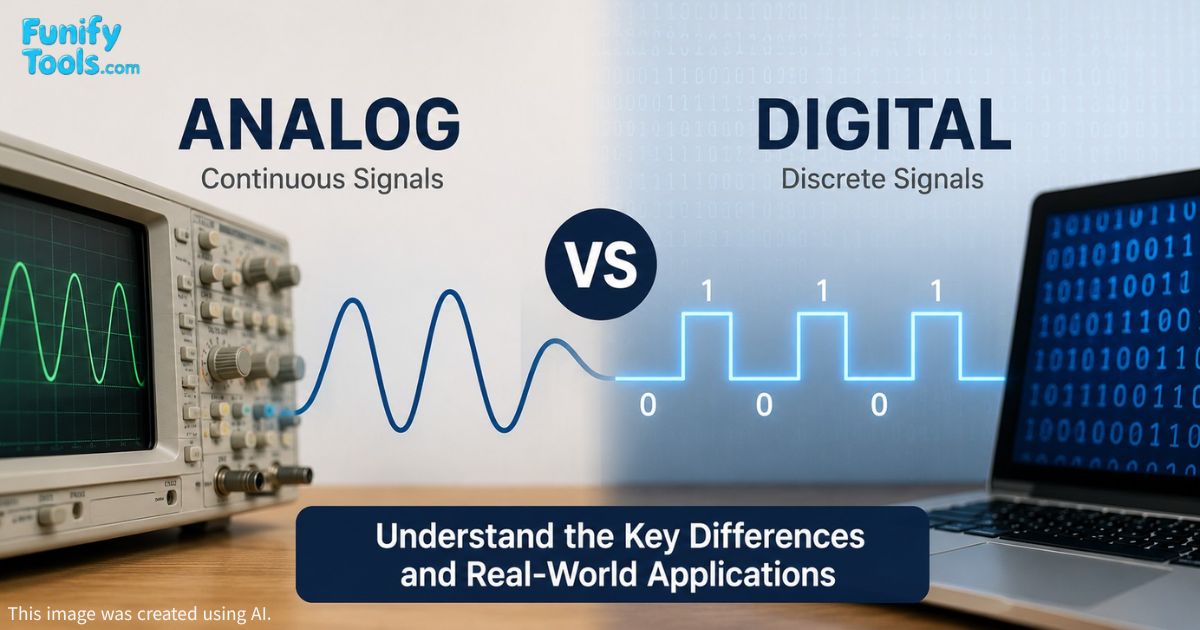
Analog represents information in a continuous, smooth way, much like the real world itself. Sound, light, temperature, pressure, and movement do not naturally appear as separate blocks. They flow.
Digital, on the other hand, represents information by converting it into numbers. The world is measured, sampled, and stored as values that computers can process. Some tiny details may be simplified during conversion, but digital information is much easier to copy, edit, store, search, and send across long distances.
If analog feels like a smooth line drawn by hand, digital feels like that same line rebuilt using many tiny dots. When there are enough dots, the result can look almost perfectly smooth to us. That simple idea is behind photos, music, video, sensors, computers, smartphones, and almost every modern device.
Introduction
Today, I wanted to write a glossary-style article about one of the most important ideas in technology: analog vs digital.
These two words appear everywhere. We hear about analog watches, digital watches, analog sound, digital music, analog signals, digital cameras, analog circuits, digital computers, and digital transformation. The words are familiar, but the difference can still feel vague.
Most people explain it quickly by saying, "analog is continuous, and digital is made of 0s and 1s." That explanation is correct, but it can feel too short. It tells us the definition, but not the feeling of the difference.
So in this article, let us slow down a little. Instead of memorizing a sentence, we will look at how analog and digital appear in real life, why each one has strengths, and why modern technology usually needs both.
What Is Analog?
Analog is a way of representing information by following continuous physical changes. The real world is full of analog signals. A voice rises and falls smoothly. Sunlight changes gradually. Temperature does not jump from 20 degrees to 21 degrees in a magical instant; it passes through countless tiny values in between.
Think of an old mercury thermometer. As the temperature rises, the mercury moves upward smoothly. There are no separate steps unless we choose to mark the scale that way. The actual physical change is continuous.
A vinyl record is another classic example. The groove in the record physically follows the shape of sound waves. When the needle moves through the groove, those tiny physical changes become sound again. This is why many people describe vinyl as warm or natural. The sound is connected directly to a physical trace.
Analog is powerful because it resembles the natural world closely. It can capture subtle changes, tiny variations, and emotional texture. But the same closeness to the physical world also makes it fragile.
Strengths of analog:
It captures smooth, natural changes.
It can represent very subtle differences.
It often feels direct and organic because it follows physical reality.
Weaknesses of analog:
It is easily affected by noise, scratches, heat, dust, and interference.
Copies usually become worse than the original.
Long-distance transmission can gradually reduce quality.
In short, analog is rich and natural, but it is sensitive. It carries the beauty of the real world, but also the messiness of the real world.
What Is Digital?
Digital records real-world information as numbers. A continuous signal is measured at regular moments, and each measurement is stored as a value. This process is called sampling.
For example, a digital audio file does not store a sound wave as one perfectly smooth physical curve. Instead, it takes many measurements per second and stores those measurements as numbers. When the sampling is frequent enough and the values are precise enough, our ears hear the result as smooth sound.
A digital photo works in a similar way. A camera sensor measures light at many tiny points called pixels. Each pixel stores information such as brightness and color. When millions of pixels are shown together, we see a complete image.
This is why digital information can feel slightly less natural in theory, but incredibly powerful in practice. Once information becomes numbers, computers can copy it, compress it, edit it, search it, transmit it, encrypt it, and restore it.
Strengths of digital:
It is resistant to noise when the signal can still be recognized correctly.
It can be copied many times without quality loss.
It is easy to store, edit, share, compress, and process.
It works naturally with computers because computers handle numbers.
Weaknesses of digital:
Some detail can be lost during conversion from analog to digital.
If sampling is too low, the result can look or sound rough.
Digital information usually needs conversion back to analog before humans can see, hear, or feel it.
Digital is not magic. It is a clever agreement: we simplify the world into numbers so machines can handle it reliably.
The Key Difference: Smooth Flow vs Measured Steps
The simplest way to compare analog and digital is to think about a hill.
An analog representation is like walking up a smooth slope. Every point exists between the bottom and the top. A digital representation is like climbing stairs. Each stair is a fixed level. If the stairs are large, the climb feels rough. If the stairs are tiny, the climb feels almost smooth.
This is the heart of the difference. Analog follows the continuous flow. Digital breaks that flow into measured pieces.
Time: Analog can follow every moment continuously. Digital samples at fixed intervals.
Value: Analog can vary smoothly. Digital stores selected numerical levels.
Noise: Analog noise becomes part of the signal. Digital noise can often be corrected if the original numbers are still identifiable.
Copying: Analog copies usually degrade. Digital copies can remain identical.
This is why old cassette tapes lose quality after copying, while a copied digital file can remain exactly the same as the original.
Everyday Examples
Imagine taking a photo of a bus on the street with your smartphone.
The real bus is analog. Sunlight reflects from its surface continuously. The color, shadow, texture, distance, and movement all exist in the physical world without being divided into pixels.
Your smartphone camera turns that analog light into digital data. The sensor measures light at millions of points, converts those measurements into numbers, and stores the image as a file. On the screen, it looks like the bus. But if you zoom in far enough, you will see the tiny blocks of information: pixels.
Music:
Vinyl records are analog. They can feel warm and natural, but scratches and dust affect the sound.
CDs and streaming files are digital. They can be copied and transmitted cleanly, but the sound depends on sampling quality, compression, and playback equipment.
Photography:
Film cameras are analog. They capture light through chemical reactions, often producing natural tones and grain.
Digital cameras store images as pixel data, making editing, copying, and sharing much easier.
Clocks:
An analog clock shows time with hands moving around a dial.
A digital clock shows time as numbers, such as 10:42.
Thermometers:
An analog thermometer shows temperature through a continuous physical movement.
A digital thermometer measures the temperature, converts it into a number, and displays the result.
Why Digital Became So Dominant
If analog feels natural, why did digital become so dominant?
The answer is reliability and scale. Digital information can travel through the internet, be stored in databases, copied to backup drives, edited by software, compressed for streaming, and protected with encryption. That makes it perfect for modern computing.
For example, when you send a photo to a friend, the file may pass through many networks and servers. If that image were transmitted as a fragile analog signal, quality would be much harder to preserve. As digital data, it can be checked, corrected, and reconstructed.
This is also why computers use digital logic. A computer does not need to understand every tiny variation in a signal. It needs clear states, such as 0 and 1, off and on, false and true. Clear states make calculation reliable.
Why Analog Still Matters
Digital may dominate modern technology, but analog has not disappeared. In fact, the world that digital systems measure is still analog.
A microphone begins with analog sound waves. A camera begins with analog light. A touchscreen senses physical pressure or electrical changes. A medical sensor reads signals from the body. A temperature sensor responds to real heat.
Most digital systems begin with analog input and end with analog output. Your voice becomes digital data during a phone call, travels through networks, and then becomes analog sound again from someone else's speaker. A digital photo becomes visible only when a screen emits analog light into your eyes.
So analog is not old-fashioned in the sense of being useless. It is the language of the physical world. Digital is the language computers use to process that world.
Analog and Digital Work Together
Analog and digital are not enemies. They are partners.
Analog excels at capturing the richness of reality. Digital excels at preserving, copying, processing, and transmitting that information. Modern technology usually depends on the conversion between the two.
A microphone captures analog sound, then an audio interface converts it into digital samples.
A digital music file is processed by software, then a speaker converts the signal back into analog sound waves.
A camera sensor captures analog light, then image-processing software turns it into a digital photo.
A smart watch senses analog body signals, then converts them into digital health data.
The better question is not "which is better?" The better question is "which is more suitable for this purpose?"
Need natural nuance and direct physical response? Analog may shine.
Need storage, copying, editing, transmission, and computation? Digital is usually the answer.
Final Thoughts
To understand computers and IT deeply, it helps to understand both analog and digital. The real world gives us continuous signals. Computers turn those signals into numbers. Then our devices turn the numbers back into something we can see, hear, and feel.
Once you notice this pattern, technology becomes easier to understand. A smartphone camera, a streaming song, a video call, a GPS sensor, a smartwatch, and even AI tools all depend on the same basic bridge between the physical world and the digital world.
Analog is the world as it flows. Digital is the world as computers can remember it.
Thank you for reading all the way through!
This article is also available in Korean: Read the Korean version