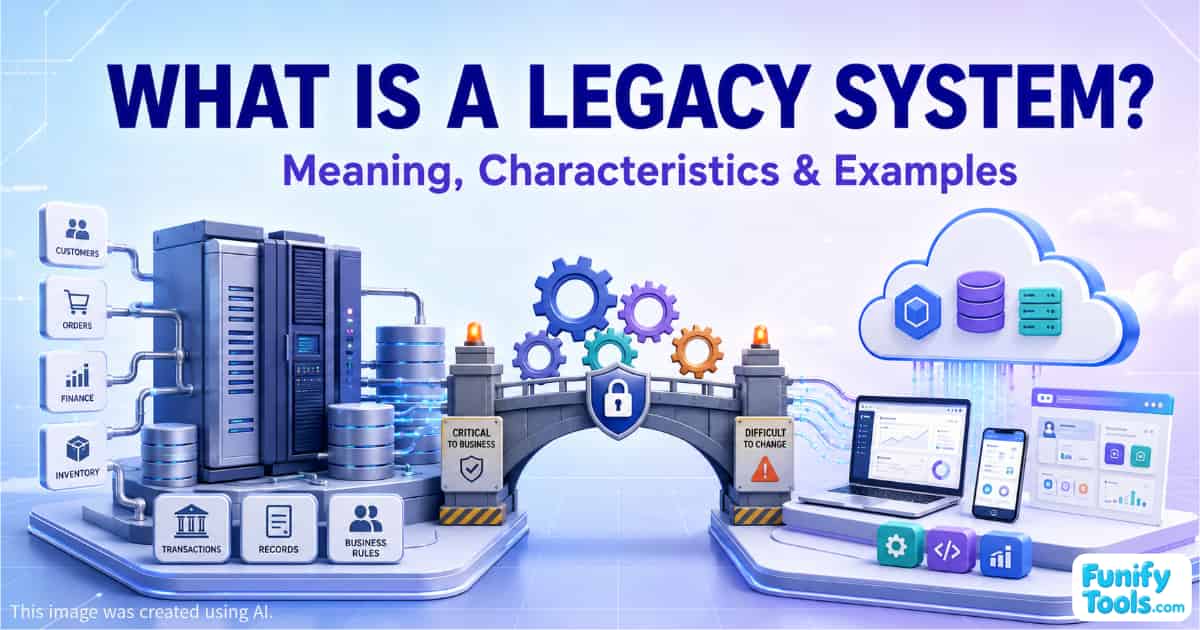
If you work in IT, you will probably hear the word “legacy” fairly often. The problem is that it can mean slightly different things to different people. Some use it to describe an old, outdated system, while others use it for a mission-critical system that everyone is afraid to touch.
To clear up this ambiguity, it helps to begin with the original meaning of the word “legacy.”
What Does “Legacy” Mean in IT?
The word “legacy” originally refers to something inherited or passed down from the past. It describes the result of earlier decisions, investments, and ways of working.
In IT, a legacy system is therefore not simply something old. The term can refer to systems, code, data, infrastructure, and operational processes created in the past that remain in use today. These technologies carry the history of an organization while continuing to support its day-to-day operations.
That combination is the key: a legacy system comes from the past, but it still plays an active role in the present.
Common Characteristics of a Legacy System
Legacy systems typically share several characteristics.
First, they still perform an important business function. Despite their age or limitations, the organization continues to depend on them.
Second, their technology stack or architecture may no longer align with modern development practices. Documentation may also be incomplete, outdated, or missing altogether.
Third, making changes can be expensive and risky. Even a seemingly minor update may produce unexpected problems elsewhere in the system.
Finally, legacy systems are often deeply connected to other applications, databases, and business processes. These dependencies make replacement, migration, or refactoring difficult.
In other words, a legacy system is often an “old but important inheritance.” Its value and its limitations usually exist at the same time.
Does a Legacy System Have to Be Old?
One important point is that age alone does not make a system legacy.
A service that was launched only three years ago can become a legacy system if it has grown rapidly, its architecture has become difficult to change, and the company's core revenue now depends on it. Once the system becomes essential but risky to modify, it may already have many characteristics of legacy technology.
The opposite can also be true. A 20-year-old COBOL-based financial system may still be carefully maintained, thoroughly tested, and well documented. Some teams might describe it as an older system rather than a problematic legacy system.
Ultimately, whether something is considered legacy depends less on its age and more on its role, dependencies, maintainability, and resistance to change.
Why Is the Meaning of “Legacy” So Ambiguous?
The term feels ambiguous because it often describes a condition rather than offering a simple judgment.
One team may use “legacy” as another name for technical debt. Another may use it to describe a stable, battle-tested platform that has reliably supported the business for years.
Both interpretations can be valid. A legacy system can be a valuable foundation that reduces costs and keeps essential operations running. At the same time, it can limit innovation, slow development, and make new features more difficult to introduce.
The same system can therefore be an asset in one context and a burden in another. This is why the word “legacy” can sound either positive or negative depending on who is using it and what problem they are discussing.
A Practical Example of a Legacy System
Imagine that an online store uses an order-processing module built in PHP 10 years ago. The code is complicated, automated testing is limited, and even small changes can cause unexpected failures.
However, 90 percent of the company's sales still pass through this module.
This would commonly be described as a legacy system—not simply because it is 10 years old, but because it supports a critical business function while remaining difficult and risky to change.
Replacing it all at once could disrupt sales, while leaving it untouched could make future improvements increasingly difficult. The company would therefore need to decide whether to maintain it, gradually modernize it, or replace it in carefully planned stages.
Legacy System vs. Outdated System
Although the terms are sometimes used interchangeably, they do not always mean exactly the same thing.
An outdated system uses technology or practices that are no longer current. A legacy system, however, is typically something inherited from the past that an organization still relies on.
A system can be outdated without being important. For example, an unused internal tool running on old software may simply be obsolete. A legacy system, by contrast, is usually connected to active business processes, data, or revenue.
This distinction explains why legacy systems cannot always be removed simply because newer technology is available.
Final Thoughts
A legacy system can be understood as a core system inherited from the past that remains important today—and is often difficult to change precisely because so much depends on it.
Rather than treating “legacy” as an automatically negative label, it is more accurate to view it as a neutral description that reflects both inherited value and present-day risk.
Once the term is understood this way, organizations can make clearer decisions about what to do next. Depending on the system's condition and business importance, the right approach may be to keep it, improve it gradually, modernize selected components, or replace it through a carefully managed migration.
Thank you for reading, and have a wonderful day!
This article is also available in Korean: Read the Korean version