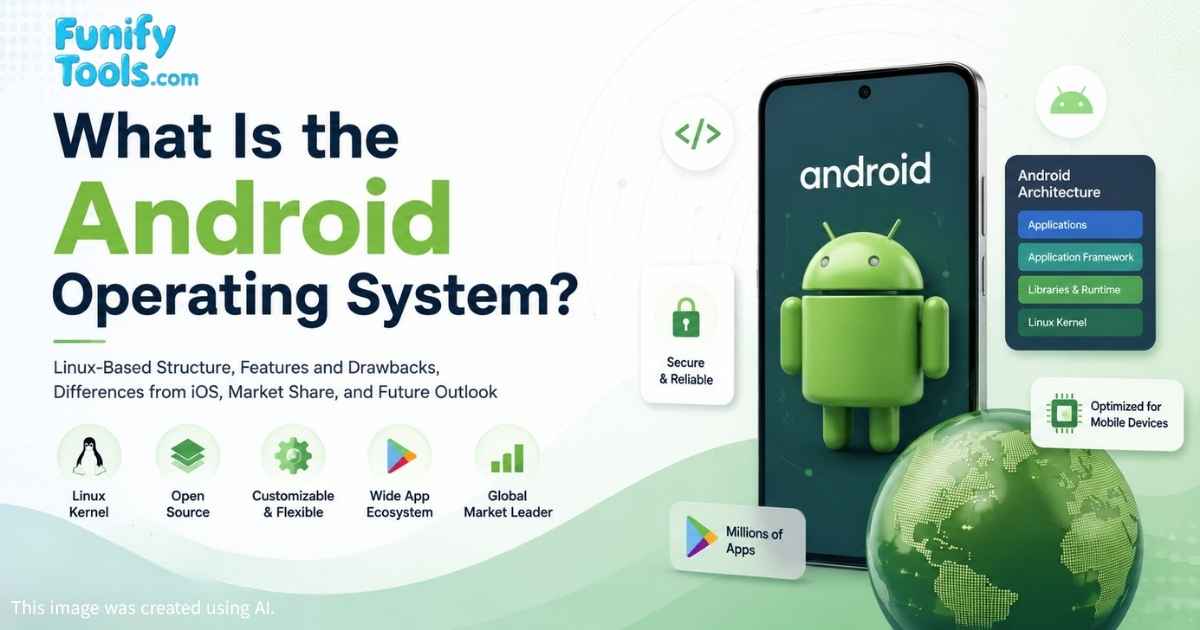
Android began in 2003 and was later acquired and developed by Google. Built on the Linux kernel, it has become the most widely used mobile operating system in the world, powering over 70% of smartphones globally.
Thanks to its open-source nature, Android has been adopted across countless manufacturers and devices, offering users freedom and variety. However, it also faces challenges such as fragmentation and delayed updates.
Today, Android extends beyond smartphones into TVs, cars, and wearables, standing as a central platform in the digital era of cloud, AI, and IoT.
In the previous article, we explored Linux. Now, let us take a closer look at Android, the mobile operating system built on the Linux kernel.
If we think of the operating system we use most in our daily lives, the answer is often Android. It powers smartphones, tablets, smartwatches, TVs, and even cars. It is one of the world's most familiar mobile operating systems, even for people who have never studied computers formally.
Every time we wake up and check notifications, unlock a phone with a fingerprint, open a map, scan a QR code, or take a photo, Android is quietly coordinating the hardware and software behind the scenes. To the user, it feels like tapping an app. Under the surface, the operating system is managing memory, network access, sensors, files, permissions, battery use, and security all at once.
This is why Android is worth understanding. It is not only the screen layout on a phone. It is the foundation that allows apps, devices, manufacturers, and services to work together in a way that feels simple enough for everyday use.
The history of Android began in 2003, when Andy Rubin and his colleagues founded a company to create an operating system for digital cameras. This early concept evolved into what we now know as Android. In 2005, Google acquired the company and set its sights on building a smartphone OS. When Apple released the iPhone in 2007, sparking a mobile revolution, Google responded by unveiling Android as its own mobile platform. In 2008, HTC launched the first Android smartphone, and soon after, major manufacturers like Samsung, LG, and Motorola joined in. From there, Android's growth accelerated quickly.
One important reason for that growth was timing. The world was moving from ordinary mobile phones to app-centered smartphones, and manufacturers needed a flexible operating system they could use without building everything from scratch. Android gave them that starting point. It provided a shared platform, while still leaving room for each company to design its own hardware, camera systems, screen sizes, and user interface style.
Linux at the Core
At its heart, Android is built on the Linux kernel. The Linux layer manages hardware-level operations, while Google added the Android framework and services on top, tailoring it for mobile devices. In simple terms, Android is rooted in Linux but has evolved into a unique mobile platform complete with app execution, touch input, graphical interfaces, and Google services.
The kernel is the part that sits close to the device hardware. It helps the phone communicate with the processor, memory, display, camera, storage, Wi-Fi, Bluetooth, and many other components. Without this layer, apps would not have a stable way to ask the device to do basic things.
Above that kernel, Android adds the parts ordinary users recognize: the home screen, notification system, app permissions, settings, app runtime, and user interface framework. This layered design is one reason Android can run on so many different devices. The hardware may vary from a budget phone to a folding flagship, but the operating system provides a common structure for apps and services.
Another defining feature of Android is its open-source foundation. Anyone can access and modify much of the source code, which allows device manufacturers to adapt it to their hardware. This flexibility enabled Android to spread across countless brands and models, leading to its overwhelming global market share. Today, more than 70% of smartphones run on Android, a testament to its worldwide dominance.
Open source does not mean every Android phone is identical or completely open in the same way. Many devices include proprietary Google apps, manufacturer features, carrier settings, and closed-source hardware drivers. Still, the open foundation gives Android a broader and more flexible ecosystem than a platform controlled by only one hardware company.
Integration with Google Services
Android's strong connection to Google's ecosystem is another major advantage. The Google Play Store provides access to millions of apps, while Gmail, Google Drive, Google Maps, Photos, and YouTube are commonly available. For many users, signing in with a Google account immediately brings contacts, app purchases, cloud files, email, browser history, and backup settings into a new device.
This integration is convenient because the phone becomes part of a larger digital environment. A photo taken on a phone can appear in cloud storage. A location searched on a computer can be opened later in Maps. A document started on a laptop can be edited from a phone. Android works especially well for users who already depend on Google services in daily life.
On top of that, each manufacturer customizes Android with its own user interface. Samsung's One UI, Xiaomi's HyperOS, OPPO's ColorOS, and other Android-based interfaces all share the same foundation but present different designs and features. Some focus on productivity, some on camera tools, some on gaming performance, and some on low-cost accessibility.
This variety is one of Android's biggest strengths. A user can choose a compact phone, a large phone, a foldable device, a stylus-focused device, a rugged phone, or a low-cost model and still remain within the Android ecosystem.
Apps, Permissions, and Daily Use
For everyday users, Android is often experienced through apps. Messaging apps, banking apps, shopping apps, games, camera tools, note apps, and streaming services all run on top of the operating system. Android provides the environment these apps need so they can access the screen, storage, internet connection, camera, microphone, location, and notifications in a controlled way.
This is where permissions matter. When an app asks to use the camera or location, Android is acting as the gatekeeper between the app and the device's private resources. Modern Android versions have improved this area by allowing one-time permissions, approximate location, background access controls, and clearer privacy indicators.
Battery management is another everyday example. A phone has limited power, so Android tries to balance performance with battery life. It may limit background activity, pause unused apps, adjust brightness, optimize network usage, or recommend settings when an app drains too much power. These decisions are part of what makes a mobile operating system different from a desktop OS.
Challenges: Fragmentation and Updates
Of course, Android also has its drawbacks. Because manufacturers modify Android differently, fragmentation becomes an issue. Even if two devices run the same version of Android, their features and update schedules may vary. Security patches often arrive late, and older devices may not support the newest versions at all. By contrast, Apple's iOS provides more uniform updates across supported devices.
Fragmentation can be confusing for users. One phone may receive a new Android version quickly, while another phone from a different brand may wait months or never receive it. Some features may exist on one device but not another. Even menus can look different depending on the manufacturer.
For app developers, fragmentation also adds work. They need to consider different screen sizes, chipsets, camera systems, Android versions, manufacturer changes, and performance levels. This is manageable, but it requires testing and careful design. Android's freedom gives the ecosystem reach, but that same freedom makes consistency harder.
Security updates are especially important because smartphones store personal data: photos, messages, passwords, payment apps, location history, and work accounts. A phone that no longer receives updates may still function, but it gradually becomes less safe. This is why update policy has become a key factor when choosing an Android device.
How Android Differs from iOS
The most common comparison is Android versus iOS. iOS is developed by Apple for Apple's own devices, while Android is developed by Google and used by many manufacturers. This difference shapes almost everything about the two platforms.
Android generally offers more hardware choice, more price ranges, more customization, and more flexibility in default apps, file handling, launchers, and device features. iOS usually offers tighter hardware-software integration, more consistent updates, and a more controlled experience across supported iPhones.
Neither approach is automatically better for everyone. A person who values customization, expandable options, and device variety may prefer Android. A person who wants long, predictable updates and close integration with Apple devices may prefer iOS. Understanding this difference helps users choose based on their own habits instead of only comparing brand names.
Expanding Beyond Phones
Despite these challenges, Android's strength lies in its freedom and flexibility. It runs on devices across many price ranges and allows users to customize settings and install apps with ease. Beyond smartphones, Android has expanded into digital ecosystems with Android TV, Android Auto, and Wear OS, deeply integrating itself into everyday life.
Android TV brings apps and streaming services to televisions and set-top boxes. Android Auto connects a phone experience to a car display so navigation, calls, messages, and music can be used more safely while driving. Wear OS adapts Android-related services for watches, where quick glances, health tracking, notifications, and voice commands matter more than large screens.
Currently, Android is effectively the global standard for mobile computing. Collaboration with manufacturers has created a vast hardware ecosystem, while millions of developers contribute to its rich app ecosystem. In emerging markets, affordable Android devices have also played a vital role in bridging the digital divide.
This accessibility is easy to overlook. For many people, an Android phone is their first computer, first camera, first map, first bank interface, first learning device, and first connection to online work or education. In that sense, Android has not simply followed the smartphone era. It helped make the smartphone era global.
Looking Ahead
The future of Android is bright. As next-generation technologies like artificial intelligence (AI), augmented reality (AR), and the Internet of Things (IoT) take hold, Android continues to evolve. Google has already integrated AI-driven features such as voice recognition, real-time translation, image search, smart replies, and personalized recommendations directly into Android. This trajectory suggests that Android is no longer just an operating system but is becoming a core digital platform for the future.
AI will likely make Android feel more helpful and more context-aware. A phone may summarize messages, organize photos, filter calls, translate conversations, recommend useful actions, or help users search across apps and files more naturally. The challenge will be balancing convenience with privacy, because smarter features often depend on sensitive personal data.
Foldable screens, tablets, cars, smart home devices, and wearable devices will also shape Android's future. The operating system needs to work across more screen sizes and input methods than ever before. Touch, voice, keyboard, stylus, car controls, remote controls, and sensors all require slightly different design thinking.
For everyday users, Android is already a familiar and convenient environment. Installing apps, checking messages, browsing the web, playing games, and taking photos all feel effortless. For IT learners and enthusiasts, Android also provides an exciting playground for experimentation, whether that means exploring its system structure, developing apps, customizing devices, or understanding how mobile security works.
Final Thoughts
Android is more than just the software that powers our smartphones. It is a global platform that combines mass accessibility with learning potential. For users, it offers convenience and variety; for developers, it provides openness and opportunity.
In this article, we explored Android's history, Linux-based foundation, Google integration, app ecosystem, strengths, weaknesses, and future direction. Its biggest advantage is flexibility, but that flexibility also creates challenges such as fragmentation and uneven updates.
Still, Android remains central to modern digital life because it meets people where they are: on affordable phones, premium devices, TVs, cars, watches, and connected services. Understanding Android helps us understand not only smartphones, but also the wider shift toward mobile-first computing.
Next time, we will turn our attention to Apple's operating systems.
This article is also available in Korean: Read the Korean version