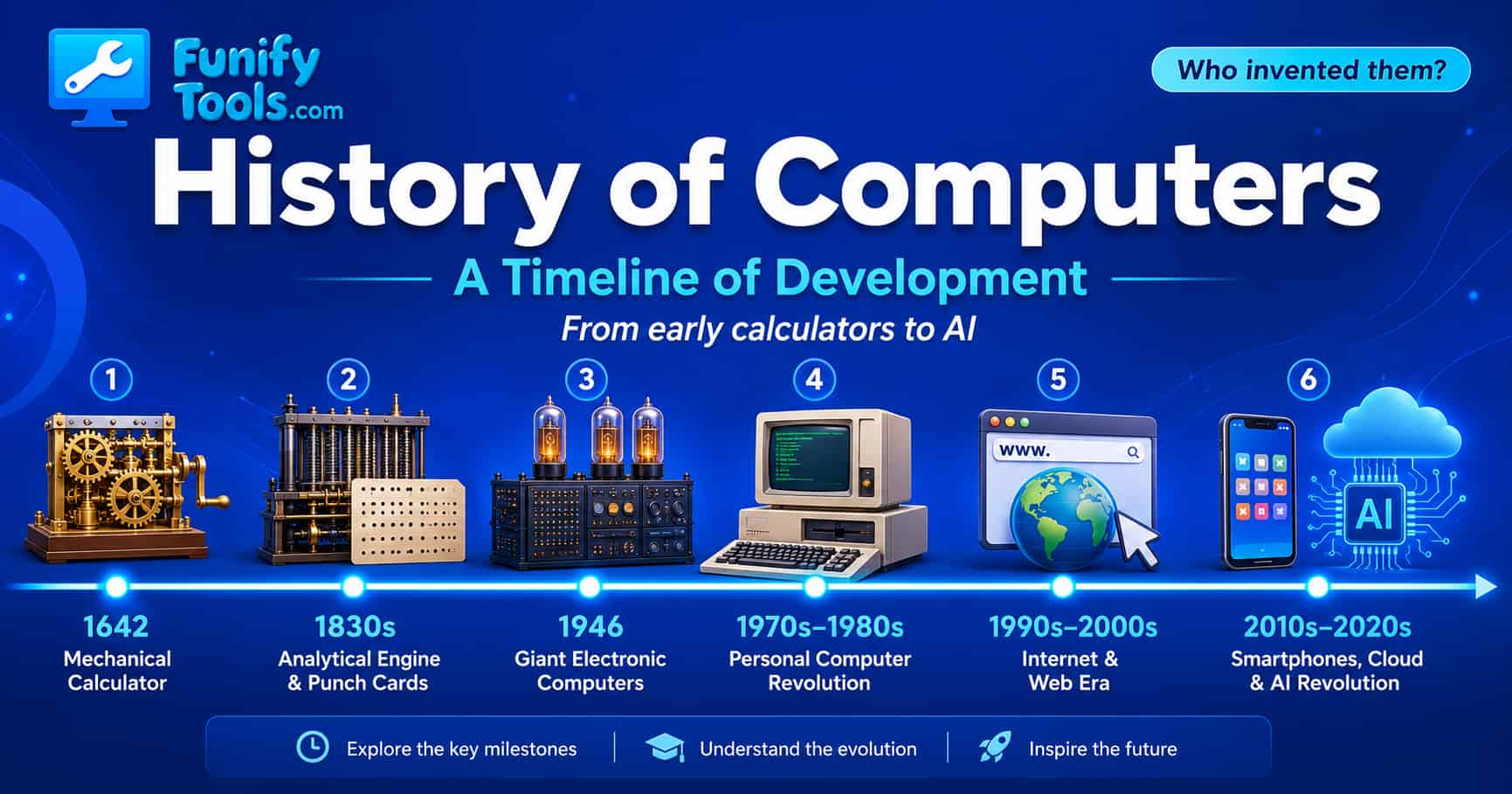
Computers have come a long way. They began as massive machines the size of a basketball court, powered simply to act as calculators. Today, thanks to continuous advancements, we carry more powerful computers right in the palm of our hands - our smartphones.
As hardware improved, software and the internet grew alongside it. When the Personal Computer (PC) arrived, computers spread into every corner of daily life. Now we’re in an age of smart devices, cloud computing, and AI, and the changes ahead are even more exciting.
When we talk about the history of computers, it is easy to imagine a straight line from old machines to modern laptops. In reality, the story is a little richer than that. Computers developed through many small and large breakthroughs: mechanical gears, punched cards, vacuum tubes, transistors, microprocessors, operating systems, networks, mobile devices, and now artificial intelligence.
Another interesting point is that the computer was not invented by one single person in one single moment. Many people contributed different ideas over a long period of time. Some designed calculating machines, some imagined programmable systems, some built electronic hardware, and others created the software and networks that made computers useful to ordinary people.
17th–19th Century: The First Calculators
In 1642, French mathematician Blaise Pascal built the Pascaline, the first mechanical calculator. Using gears and wheels, it could add and subtract, helping merchants and tax collectors save countless hours.
Later, German mathematician Gottfried Leibniz expanded on the idea with a calculator that could also multiply and divide. Human-made tools for computation were becoming more sophisticated.
These early machines were not computers in the modern sense. They could not browse the web, store photos, or run apps. But they showed an important idea: calculation could be automated. Instead of relying only on human hands and handwritten tables, people began building machines that could process numbers more reliably.
In the early 1800s, Charles Babbage designed the Difference Engine and later the Analytical Engine. What made the Analytical Engine revolutionary was that it could be programmed - an idea far ahead of its time. Working with him, Ada Lovelace wrote the first algorithm for the machine, and is now remembered as the world’s very first programmer.
Babbage's machines were never completed in the way he imagined during his lifetime, but the ideas behind them were powerful. The Analytical Engine included concepts that sound familiar today: input, output, memory, and a processing unit. Ada Lovelace also understood that such a machine might do more than arithmetic. It could, in theory, manipulate symbols and follow instructions, which is very close to how we think about software now.
1940s–1960s: The Birth of Electronic Computers
The ENIAC , built in 1946 at the University of Pennsylvania, was the first general-purpose electronic computer. It weighed over 30 tons and used 18,000 vacuum tubes, yet it could perform over 5,000 calculations per second - an incredible breakthrough for science and the military.
To modern eyes, ENIAC looks unbelievably large and inefficient. It filled a room, consumed a huge amount of power, and required careful maintenance. But compared with human calculation or earlier mechanical machines, it was astonishingly fast. It showed that electronic circuits could perform calculations at a speed that changed what scientists and engineers could attempt.
A replica of the first working transistor
Soon after, the invention of the transistor in 1947 made computers smaller, faster, and more reliable. By the 1960s, integrated circuits (ICs) packed even more power into tiny chips.
This shift from vacuum tubes to transistors was one of the biggest turning points in computer history. Vacuum tubes were bulky, hot, and prone to failure. Transistors did a similar job while being much smaller and more dependable. Once engineers could place many electronic components onto integrated circuits, computers could shrink in size while growing in capability.
During this time, machines like the IBM 1401 entered offices, banks, and government agencies. Payroll, accounting, census data, and scientific calculations that once took days were now done in hours. Computers were no longer just for labs - they had become essential tools for society.
Still, these computers were not personal devices. They were expensive machines owned by organizations. Users often interacted with them through punched cards, terminals, or operators rather than directly sitting in front of a friendly screen. The idea of having your own computer at home was still unusual.
1970s–1980s: The PC Revolution
In 1971, Intel introduced the 4004 microprocessor, paving the way for personal computers.
The microprocessor was important because it placed the core processing power of a computer onto a single chip. This made computers cheaper, smaller, and easier to produce. Instead of building large systems from many separate components, manufacturers could create compact machines that individuals and small businesses could realistically use.
By 1977, the Apple II was launched, followed by the IBM PC in 1981. Computers began appearing in schools and homes, with floppy disks used for programs, simple games, and word processing. The "PC era" had officially begun.
This was the period when computers started moving from specialized rooms into ordinary desks. People used them to write documents, manage spreadsheets, learn programming, play games, and run business software. For many families and students, the first experience with computing came through these early personal computers.
The PC revolution also created a larger software market. A computer became more useful when people could install programs for different tasks. Word processors, spreadsheet programs, educational software, and games helped show that a computer was not only a calculating machine. It was a general-purpose tool.
1990s: The Internet Goes Mainstream
In 1995, Windows 95 transformed the way people used computers. Its Start button and easy-to-use interface made PCs accessible to everyone, and its success was explosive.
At the same time, the internet spread rapidly. Browsers like Netscape and Internet Explorer opened the doors to the World Wide Web. Suddenly, email, instant messaging, and online games became part of everyday life.
Before the internet became common, a home computer was mostly a standalone machine. You used whatever software and files were stored locally. Once the web arrived, the computer became a window to the outside world. Information, communication, shopping, communities, and entertainment all started moving online.
This changed how people thought about computers. A PC was no longer just a device for writing documents or playing offline games. It became a communication tool. Families got email addresses, students searched for information online, companies built websites, and new internet-based businesses began to appear.
2000s: Web 2.0 and the Multimedia Boom
The 2000s brought high-speed internet into our daily lives. With ADSL and cable, browsing became faster, and people could easily enjoy music, photos, and videos.
Google rose as the world’s go-to search engine. In Korea, Naver and Daum became major portals, offering news, communities, and Q&A services. Blogging culture took off, and early forms of social networking, like Cyworld, started appearing.
In 2005, YouTube was launched, allowing anyone to upload and share videos. From tutorials to music and gaming, an explosion of creative content reshaped culture. At the same time, online shopping, internet banking, and digital payments became everyday habits.
This was the age of Web 2.0, where people weren’t just reading the web - they were creating it.
The phrase Web 2.0 matters because it describes a shift in participation. Earlier websites often felt like digital brochures or information boards. In the 2000s, users became writers, uploaders, reviewers, sellers, community members, and content creators. Comment sections, blogs, video platforms, forums, and social networks made the web feel more alive.
At the same time, computers became stronger multimedia machines. Digital cameras, MP3 players, CD burners, webcams, and faster graphics cards changed what people expected from a PC. The computer was now a place to store photos, edit videos, listen to music, chat with friends, and manage more parts of daily life.
2010s: The Smartphone and Cloud Era
The 2010s gave us the "computer in your pocket." With the iPhone (2007) and Android smartphones, people gained instant access to the internet, maps, photos, and games - all on the go. App stores exploded with millions of apps, and messaging apps like KakaoTalk and WhatsApp replaced traditional texting.
Social media platforms like Facebook, Instagram, and Twitter connected people globally in real time. Everyday life turned into shareable content, and new jobs like influencers and YouTubers emerged.
Meanwhile, cloud services such as Google Drive, Dropbox, and OneDrive changed how we worked. Suddenly, files could be accessed anywhere, and multiple people could edit documents together in real time. Remote and home-based work began taking root.
This decade changed the meaning of "using a computer." Many people began doing everyday computing on phones instead of desktop PCs: taking photos, sending messages, watching videos, checking maps, paying for products, reading news, and editing documents. The computer became more personal because it was always with us.
Cloud computing also made the boundary between devices less important. A file could start on a laptop, be edited on a phone, and be shared from a tablet. Apps and data were no longer tied to one machine in the same way. This helped prepare the world for remote work, online classes, streaming services, and subscription-based software.
2020s: The Rise of AI
From 2022 onward, we’ve seen a true revolution. Tools like ChatGPT and other generative AI systems have shown that computers can now write, code, translate, and even create art and music.
AI is already being used in business for automation and data analysis, and in daily life for learning, creativity, and personal assistance.
What makes this era feel different is that computers are no longer only following exact instructions written by humans. With modern AI systems, they can recognize patterns, generate responses, summarize information, create images, assist with programming, and help people explore ideas. The computer is becoming less like a passive tool and more like an interactive assistant.
Of course, AI also brings new questions. How should we check accuracy? How should creative work be credited? How do we protect privacy and avoid misuse? Just as the internet created both opportunities and problems, AI is creating a new stage of computer history that society is still learning how to handle.
Looking ahead, AI-powered computers will only get smarter - driving innovation in self-driving cars, personalized medicine, smart cities, and more. The possibilities are endless, and it’s exciting to imagine what comes next.
Wrapping Up
This has been a quick journey through the history of computers, from early calculators to the AI revolution. The big picture is this: technology keeps shrinking in size but growing in power and impact.
From Pascal's mechanical calculator to Babbage's programmable vision, from ENIAC's room-sized hardware to the personal computer, from the web to smartphones and AI, each step made computing more accessible. What began as a tool for calculation became a tool for communication, creativity, business, education, entertainment, and problem solving.
So, who invented the computer? The honest answer is that many people did. Pascal, Leibniz, Babbage, Lovelace, the engineers behind ENIAC, the inventors of the transistor, microprocessor pioneers, software developers, internet builders, and many others all contributed pieces of the story. The modern computer is the result of centuries of accumulated ideas.
Thanks for reading, and I’ll see you in the next post!
This article is also available in Korean: Read the Korean version