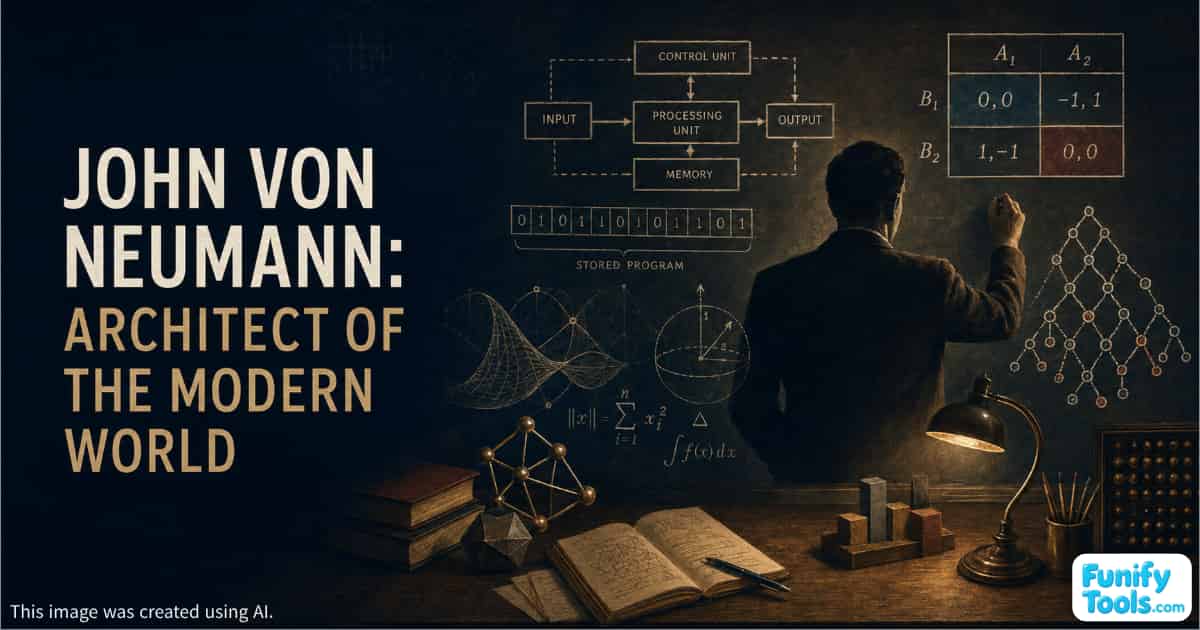
There have been many kinds of geniuses throughout history, each with a different way of thinking. Some explain the world by reducing it to a handful of fundamental principles. Others rapidly assemble ideas from different fields and turn them into practical systems that people can immediately use. Albert Einstein and James Clerk Maxwell belong largely to the first group, while John von Neumann and Claude Shannon are outstanding examples of the second.
The contrast becomes especially clear when we compare Einstein with von Neumann. Einstein was a theoretical genius who explored the underlying principles of nature and rewrote our understanding of the universe. Von Neumann was a systems-oriented genius who moved effortlessly among mathematics, physics, economics, and computation. He transformed difficult problems into forms that could be calculated, then turned those calculations into methods and tools.
That is why it is nearly impossible to discuss the history of computers without mentioning John von Neumann. Today, let us take a closer look at the person behind that remarkable legacy.
John von Neumann
Born: December 28, 1903
Died: February 8, 1957
John von Neumann was a Hungarian-born American mathematician and scientist. Beginning with pure mathematics, he went on to connect physics, economics, and computing, helping establish many of the standards on which modern science and technology still depend.
Von Neumann amazed those around him with his extraordinary memory and mental arithmetic from an early age. His true gift, however, was his ability to turn principles into structures—and then transform those structures into practical methods and tools.
Born in Budapest, Hungary, he studied mathematics and chemical engineering at several European universities. After settling in Princeton in 1930, he moved freely between pure theory and real-world problems. In 1933, he joined the original faculty of the Institute for Advanced Study in Princeton, expanding the scope of his research even further.
After becoming a US citizen, von Neumann worked across academia, industry, and government, using computation to address problems in science, defense, and economics. His ability to establish a theoretical foundation and immediately connect it to practical work left a powerful impression on both fellow scholars and policymakers.
Building New Foundations in Mathematics
Mathematics was the first field in which von Neumann established his reputation.
In set theory, he developed the cumulative hierarchy, commonly known as the von Neumann universe , which formally describes how sets can be constructed in successive stages within an axiomatic system. He also helped establish the standard modern construction of ordinal and cardinal numbers, treating ordinals as transitive sets and cardinals as initial ordinals.
Through the axiom of regularity, which rules out infinitely descending membership chains, he contributed to a more stable foundation for set theory. In measure theory and the mean ergodic theorem, he precisely identified the conditions under which time averages and spatial averages correspond.
Von Neumann also refined the language of operator theory in topological groups and functional analysis, helping mathematicians systematically study spectra and the properties of operators.
His work with Francis Murray on operator algebras became especially influential. Today, these structures are known as von Neumann algebras. Their classification into Types I, II, and III created a bridge between infinite-dimensional analysis and statistical mechanics.
Tools involving traces, direct-integral decompositions, and duality were further developed within this framework. They later became part of the common mathematical language used in mathematical physics, probability theory, and information theory.
Giving Quantum Mechanics a Mathematical Language
Quantum mechanics was still a new and rapidly developing field when von Neumann gave it a rigorous mathematical foundation using Hilbert spaces and operator theory.
He represented quantum states as unit vectors or density matrices in a Hilbert space and observables as self-adjoint operators. Through the spectral theorem and projection-valued measures, he established a precise relationship between measurement results and operator spectra.
Von Neumann's model of quantum measurement described how a physical system and a measuring device could first interact through unitary evolution before the process concluded with a projection. This framework gave physical meaning to mathematical concepts such as compatibility, commutants, and simultaneous decomposition.
The von Neumann entropy defined within this framework,
became the standard quantitative measure of uncertainty in a mixed quantum state. It later emerged as a central concept in quantum information theory, where it is used to discuss entanglement, channel capacity, and thermodynamic irreversibility.
Von Neumann's precise mathematical language gave physicists and mathematicians a shared grammar. It also helped lay the foundation for modern quantum computing and information science.
Turning Strategic Decisions Into Mathematics
Von Neumann's influence extended far beyond mathematics and physics.
In 1928, he proved the minimax theorem, demonstrating that an optimal strategy always exists in a two-player zero-sum game. By expressing strategic choices through mixed strategies and expected values, the theorem brought game theory into the domain of rigorous mathematics.
It provided a solid foundation for analyzing situations in which the outcome for each participant depends on the choices made by others.
In 1944, von Neumann and economist Oskar Morgenstern published Theory of Games and Economic Behavior. The book systematically described the assumptions underlying rational choice and connected them to decisions under uncertainty, helping formalize expected utility theory.
Their analysis extended beyond two-player zero-sum games to situations involving multiple participants and non-zero-sum outcomes. Cooperative concepts such as coalitions and characteristic functions helped place strategic interaction at the center of economic analysis.
The book brought together utility, lotteries, mixed strategies, and early equilibrium concepts within a unified framework. Its language would later influence management, public policy, market design, and the broader study of human decision-making.
Helping Create the Language of Mathematical Economics
Von Neumann also introduced tools from functional analysis—including fixed-point methods, convex sets, and duality—into economics.
Fixed-point arguments based on convexity became a standard method for proving the existence of economic equilibria. Separation theorems and Lagrangian duality clarified the relationship between prices and optimization.
These ideas are especially visible in the von Neumann growth model, which shows how the maximum balanced growth rate of an economy can be determined together with a corresponding price system.
His work also contributed to a deeper understanding of systems of inequalities and the duality of linear programming. Production, allocation, and price formation could now be analyzed within a shared language of optimization.
These methods later spread into financial risk assessment, industrial investment planning, production management, and the analysis of market competition. By bringing mathematics and economics together, von Neumann helped establish the foundations of practical decision-making systems that remain influential today.
Mathematics in a Time of War
As the political situation in Europe deteriorated during the late 1930s, von Neumann—like many European-born scientists—felt both a practical need and a moral responsibility to contribute to research supporting the free world against the expansion of Nazism.
His expertise happened to be exceptionally well suited to the problems of wartime science. The mathematical instincts he had developed through operator theory and functional analysis, his knowledge of fluid dynamics and shock waves, and his ability to structure complex calculations could be applied directly to artillery trajectories, blast pressure, and implosion.
Working as an adviser to the US Army's Ballistic Research Laboratory and several government committees, he developed analytical solutions and numerical models that could quickly be put to practical use.
Los Alamos wartime badge photo of John von Neumann, via Wikimedia Commons
At Los Alamos, von Neumann played a major role in the mathematics of shaped charges and explosive lenses. His calculations supported the timing and wavefront control needed to achieve a symmetrical implosion.
Self-similar solutions describing powerful explosions became associated with the names of Taylor, Sedov, and von Neumann. He also analyzed the interaction of blast waves reflected from the ground and concluded that the most effective height for a nuclear detonation would be above the surface rather than directly on it.
This analysis influenced both delivery methods and procedures for estimating damage.
After the war, von Neumann remained involved in nuclear strategy and long-range missile development. He served as a member of the United States Atomic Energy Commission and advised on key decisions concerning early intercontinental ballistic missile programs, including Atlas and Titan.
The Stored-Program Computer
During and after the war, demand for computation increased rapidly. Existing machines, however, often had to be physically rewired whenever researchers wanted to solve a different problem. This created a severe bottleneck.
Von Neumann, who had already been promoting applied computation at Princeton, believed the solution had to come from changing the structure of the machine itself.
While serving as a consultant on the EDVAC project at the University of Pennsylvania's Moore School, he systematically documented the stored-program concept: instructions and data would be kept in the same memory and processed sequentially.
He divided the computer into five functional components:
- An arithmetic unit
- A control unit
- Memory
- Input
- Output
By standardizing binary computation and centrally controlled execution, the design made it possible to change a program without physically rewiring the machine.
This concept was implemented in the IAS machine at Princeton, whose design influenced research institutions around the world. Its philosophy and structure also shaped commercial computers such as the IBM 701 and IBM 704.
Von Neumann did not merely contribute to a machine designed for one specific calculation. He helped establish the basic architecture of the general-purpose computer—one that could be programmed to solve many different scientific and industrial problems.
Algorithms, Sorting, and Randomness
Von Neumann understood that building the hardware was not enough. Once programmable computers existed, researchers also needed reliable methods for selecting algorithms, producing random values, and evaluating computational costs.
The merge sort method he proposed in 1945 was designed with slow sequential storage and limited main memory in mind. It divided data into smaller sorted groups and repeatedly merged them, making it possible to sort large datasets efficiently and reliably. The method became a standard approach to external sorting.
He also recognized that physical sources of randomness could contain bias. To correct this, he proposed a simple extraction method involving pairs of coin tosses. If the two outcomes differed, one sequence could be mapped to zero and the reverse sequence to one; matching outcomes would be discarded.
This provided a simple but powerful principle for extracting unbiased results from a biased random source.
Von Neumann experimentally examined early pseudorandom number generators such as the middle-square method while openly acknowledging their limitations. He repeatedly emphasized that choosing an algorithm required considering both the number of operations needed as the input grew and the cost of reading and writing data.
This way of thinking helped anticipate the later development of computational complexity and algorithm engineering. In many respects, he helped establish the practical discipline of software designed to run on stored-program computers.
Self-Replicating Machines and Cellular Automata
Von Neumann's work on cellular automata asked whether a machine could reproduce itself through rules alone.
He designed a theoretical universal constructor operating on a two-dimensional grid according to local interactions with neighboring cells. The goal was to determine whether a sufficiently complex machine could read a description of itself, construct a copy, and pass that description to the new machine.
His work on self-reproduction was organized and published after his death. It became one of the earliest foundations of artificial life and complexity research.
At the same time, von Neumann believed that simulation could be trusted only when its numerical foundations were sound. His contributions included von Neumann stability analysis for numerical solutions of linear partial differential equations, as well as work involving error analysis, the Jacobi method, and numerical approaches to gas dynamics.
He predicted that computer simulations of airflow would eventually replace a substantial portion of physical wind-tunnel testing—the practice of placing aircraft wings or vehicle models inside large controlled chambers to measure drag, lift, and other aerodynamic properties.
Building on these foundations, von Neumann and Stanislaw Ulam helped develop the Monte Carlo method, which uses randomness to approximate solutions to complex problems. The method spread into nuclear physics, materials science, operations research, and many other fields.
After the war, von Neumann also used ENIAC code to perform automated Monte Carlo calculations, helping push scientific culture further toward computer-based simulation.
Weather Forecasting and Early Climate Science
In 1946, von Neumann established a meteorology project at the Institute for Advanced Study in Princeton, helping create a framework for numerical weather forecasting.
In 1950, working with Jule Charney and others, he used ENIAC to demonstrate one of the world's first computer-generated numerical weather forecasts.
As an early contributor to climate modeling, von Neumann also discussed the possibility that carbon dioxide released through industrial activity could raise the Earth's average temperature. He even considered—with attention to both potential benefits and risks—whether humanity might deliberately alter the reflectivity of the cryosphere, the snow- and ice-covered parts of the planet.
His structural thinking about cellular automata, rigorous standards for numerical analysis, and probabilistic approach through Monte Carlo methods formed a connected body of ideas. Together, they influenced weather forecasting, climate science, engineering, finance, and eventually modern machine learning.
Technology, Society, and the Possibility of a “Singularity”
Near the end of his life, von Neumann became increasingly concerned that technology could collide with existing social systems and produce a sudden transformation resembling a “singularity.”
He warned that the combination of nuclear weapons, long-range missiles, automation, and computerized forecasting could push the speed and consequences of decision-making beyond what human institutions were prepared to manage.
In the field of climate science, he also considered the possibility that industrial carbon emissions could raise global temperatures. More broadly, he argued that the secondary effects of powerful technologies needed to be anticipated and managed through policy and institutions.
Von Neumann emphasized that the ability to do something did not necessarily mean that it should be done. He believed there had to be a clear boundary between what calculation made technically possible and what political and ethical judgment should permit.
For that reason, he argued that technological development should be accompanied by verification procedures, safeguards, restrictions on use, and clear assignments of responsibility.
His central question—how society can safely absorb tools that are becoming faster and more powerful—remains relevant to today's debates about nuclear deterrence, climate governance, and artificial intelligence policy.
The Man Behind the Mathematics
As a person, von Neumann was known for thinking rapidly, seeing connections across an unusually broad range of subjects, and possessing a lively sense of humor.
One famous story concerns the naming of information theory. When a colleague was considering what to call the field, von Neumann supposedly recommended the word “entropy.” The term was already connected to physics, he reportedly explained, and because most people did not fully understand it, anyone using the word would have an advantage in a debate.
He was also known at Princeton for being sociable and witty. According to another frequently repeated story, after a car accident, he explained that the trees on the right side of the road had been passing him in an orderly fashion at 60 miles per hour—until one of them suddenly stepped into his path.
Whether every detail of these stories is accurate or exaggerated, they reflect something genuine about his personality. He could lighten the mood in demanding research environments and connect ideas that initially seemed unrelated.
Collaboration as Part of His Genius
The same personality shaped the way von Neumann worked.
In meetings and at the blackboard, he could rapidly reduce a complicated problem to its essential structure, convert that structure into a computational procedure, and prepare it for practical use.
His humor was not merely a display of wit. It was also a tool for explanation. He could translate difficult concepts into the language of the person standing in front of him, allowing teams to work together more quickly.
His ability to make people comfortable in social settings and his thoughtful treatment of colleagues also influenced the collaborative culture around him. He brought researchers from different fields together and encouraged them to exchange ideas.
In that sense, his humor served not only as social lubrication but also as a mechanism for turning interdisciplinary conversation into practical results.
Informal portrait of John von Neumann in New Mexico, circa 1943–1947, via Wikimedia Commons
Books, Awards, and a Lasting Name
Von Neumann's name continues to live on through his books, awards, and the many concepts named after him.
His best-known works include:
- Mathematical Foundations of Quantum Mechanics from 1932
- Theory of Games and Economic Behavior from 1944
- First Draft of a Report on the EDVAC from 1945
- Theory of Self-Reproducing Automata, published posthumously in 1966
During his lifetime, he received honors including the Medal for Merit and the Medal of Freedom. Other major recognition, including the Enrico Fermi Award, followed.
After his death, his legacy was commemorated through awards and lectures in computing and optimization, university buildings, and even the naming of a crater on the Moon.
In 2005, the United States Postal Service included him in a commemorative series honoring American scientists. The stamp offered another symbolic reminder that von Neumann was not simply a specialist within one discipline. He was a person whose work transformed an entire generation of science and engineering.
IEEE John von Neumann Medal, image by Tiginbeg, via Wikimedia Commons
Why John von Neumann Still Matters
Looking back over von Neumann's life, one principle becomes especially clear: he did not treat theory as decoration.
He first organized ideas into a solid foundation and then carried them directly into real-world problems. That is why his achievements did not disappear like a brief flash of brilliance. They remained more like a lamp that continued to burn long after his death.
He refined the language of quantum theory, expressed strategic behavior through mathematics, helped design the architecture of programmable computers, and brought algorithms and randomness into practical computation. These were not isolated accomplishments. Each one strengthened the others and contributed to a larger intellectual system.
That is how the blackboard of a research institute, the demands of an experimental laboratory, and the decisions made in government meeting rooms could all be connected within the same way of thinking.
From computer architecture and scientific computing to finance, policy analysis, weather forecasting, and climate modeling, we continue to think through methods that von Neumann helped establish.
Most importantly, he never built a wall between basic theory and practical application. He refined concepts carefully, then transformed them into methods that many people could use. His openness, humor, and ability to collaborate made that process even faster.
Learning about John von Neumann is therefore not simply an exercise in praising a great figure from the past. It is an opportunity to practice transforming our own work into better structures.
The data, models, policies, and products we work with today are waiting for the same questions:
Have we established a solid foundation?
Have we connected calculation to reality?
Have we turned our ideas into procedures that many people can use?
John von Neumann helped move his era forward by answering those questions with extraordinary discipline. His approach remains just as valuable when we face the problems of tomorrow.
Thank you for reading, and I hope you have a wonderful day!
This article is also available in Korean: Read the Korean version