10-second lesson
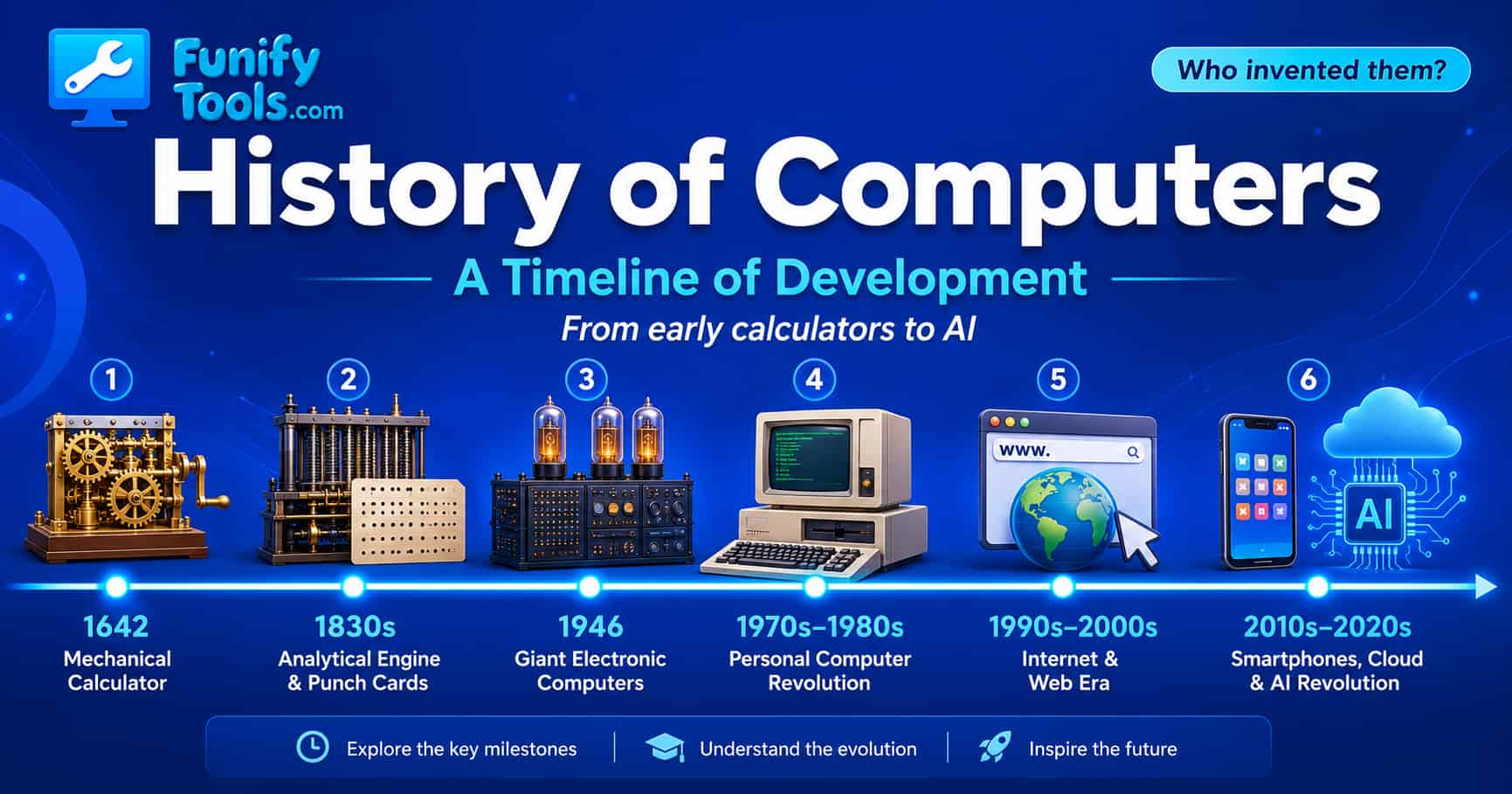
- No single person invented the computer; modern computers came from many ideas built over centuries.
- Blaise Pascal built an early mechanical calculator in the 1600s to help with arithmetic.
- Charles Babbage designed the Difference Engine and Analytical Engine, early visions of programmable machines.
- Ada Lovelace recognized that such machines could process more than numbers, which made her a pioneer of programming.
- Alan Turing gave computing its theoretical foundation with the idea of a universal machine.
- John von Neumann helped define the stored-program architecture used by most modern computers.
- Early electronic computers such as ENIAC showed that large-scale automatic calculation was possible.
- The computer was not one invention in one moment; it was a chain of mechanical, mathematical, electronic, and architectural breakthroughs.
The People Behind the Computer
Asking who invented the computer sounds simple, but the honest answer is not one name. The computer is the result of many people solving different parts of the same long problem: how to make machines calculate, remember, follow instructions, and eventually process information automatically.
Some pioneers built mechanical calculators. Others developed the mathematics of computation. Some imagined programmable machines before the technology existed. Others built electronic hardware or designed the architecture that still shapes computers today.
Blaise Pascal and Mechanical Calculation
Blaise Pascal was a French mathematician and inventor who built the Pascaline in the 1640s. It was a mechanical calculator designed to help with arithmetic, especially addition and subtraction. Pascal was still very young when he made it, and one reason was practical: his father worked with tax calculations.
The Pascaline was not a computer in the modern sense. It could not run programs or store complex instructions. But it showed an important idea: a machine could handle calculation that humans normally did by hand. That idea became one of the roots of computing.
Charles Babbage and the Dream of a Programmable Machine
Charles Babbage is often called the father of the computer because his designs went far beyond simple calculators. His Difference Engine was meant to compute mathematical tables more reliably than human clerks. His later Analytical Engine was even more ambitious.
The Analytical Engine included ideas that feel surprisingly modern: a processing unit, memory, input, output, and instructions. Babbage never completed the machine in his lifetime, but the design showed that computation could be generalized. A machine did not have to solve only one kind of arithmetic problem. It could, in theory, follow different instructions.
Ada Lovelace and the Idea of Programming
Ada Lovelace worked with Babbage's ideas and wrote notes about the Analytical Engine. She is often remembered for describing what many consider the first computer program, an algorithm intended for a machine that had not yet been built.
What makes Lovelace especially important is that she saw beyond calculation. She understood that a programmable machine could manipulate symbols, not just numbers. In other words, if information could be represented in a suitable form, a machine could process it. That insight points directly toward modern computing.
Alan Turing and the Theory of Computation
Alan Turing gave computer science one of its deepest foundations. His idea of a Turing machine was not a physical computer you could buy or build in a workshop. It was a mathematical model that explained what computation means.
Turing showed that a simple theoretical machine could follow rules and perform any computable process, given enough time and memory. This helped define the limits and possibilities of computation. During World War II, Turing also played a major role in codebreaking work, which pushed forward practical computing and cryptographic thinking.
John von Neumann and the Modern Computer Architecture
John von Neumann helped describe the stored-program architecture, one of the most important ideas in modern computer design. In this model, both data and instructions are stored in memory, and the processor fetches and executes those instructions step by step.
This sounds ordinary now because nearly every general-purpose computer works this way. But it was a major leap. A machine could be changed by loading a different program into memory, instead of being physically rewired for each new task.
Electronic Computers and the Team Effort
By the 20th century, computing moved from mechanical designs to electronic machines. Projects such as ENIAC showed that electronic computers could perform calculations at speeds far beyond human ability. These machines were huge, expensive, and difficult to program, but they proved the direction was real.
It is also important to remember that many early computing achievements were team efforts. Engineers, mathematicians, programmers, operators, and institutions all contributed. The history of computers is not only a list of famous names; it is also the story of many people whose work made the machines usable.
The Simple Version to Remember
If you want one clean answer, say this: the modern computer was not invented by one person. Pascal helped mechanize arithmetic. Babbage imagined programmable machinery. Lovelace saw the power of symbolic processing. Turing defined computation. Von Neumann shaped the architecture that modern machines still use.
The computer is a layered invention. Each generation added a new idea: calculation, programmability, theory, electronics, memory, and architecture. That is why computers feel like one device today, but their history is really a long chain of breakthroughs.
This article is also available in Korean: Read the Korean version