Supported categories
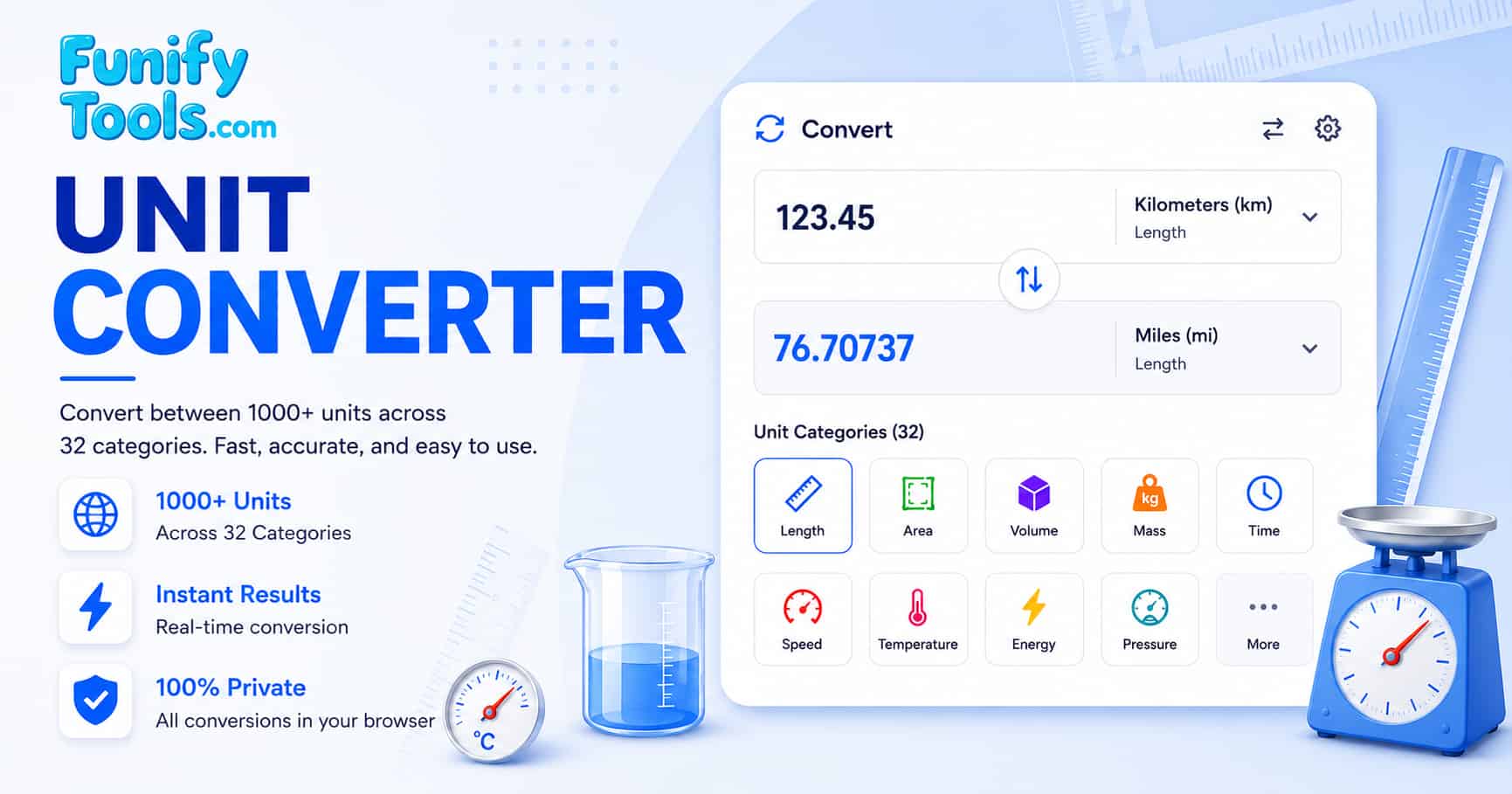
This page supports ten measurement categories: length, area, weight, volume, temperature, pressure, speed, fuel efficiency, data size, and time. Each category includes both metric and non-metric units, and several also include traditional or regional units that are still widely used in construction, agriculture, and maritime contexts. Understanding how to convert between these units is essential for measurement conversion in science and engineering, where precision directly affects experimental outcomes and structural safety.
The metric system (SI units) is the global standard used in scientific research, medicine, and most countries worldwide. However, the imperial and US customary systems remain dominant in the United States, Liberia, and Myanmar, while traditional units such as the Japanese shaku and ken or the Korean pyeong are still commonly referenced in real estate and construction across East Asia. This converter helps bridge these systems so you can handle cross-border measurements without searching for a separate tool.
- Length supports mm, cm, m, km, in, ft, yd, mile, shaku, ken, cho, ri, and nautical mile.
- Area supports square meter, are, hectare, square kilometer, square foot, square yard, acre, and pyeong.
- Weight supports mg, g, kg, t, kt, grain, oz, lb, and don.
- Volume supports cc, ml, dl, l, cubic centimeter, cubic meter, cubic inch, cubic foot, cubic yard, gallon, barrel, and fl oz.
- Temperature supports Celsius, Fahrenheit, Kelvin, and Rankine.
- Pressure supports atm, Pa, hPa, kPa, MPa, dyne per square centimeter, mb, bar, kgf per square centimeter, psi, mmHg, inHg, mmH₂O, and inH₂O.
- Speed supports meters per second, kilometers per hour, miles per hour, knots, Mach, and related distance per time variants.
- Fuel efficiency supports km/l, mi/gal, and l/100km.
- Data size supports bit, B, KB, MB, GB, TB, PB, and EB.
- Time supports ms, s, min, h, and d.
Whether you are a student preparing for an exam, a professional checking specifications, or someone who simply needs a quick everyday conversion, this tool gives you all the major units in one place without switching between multiple websites. Each category uses known conversion factors so you can review results confidently for everyday, educational, and planning purposes.
How the conversion logic works
Most categories use a base unit method. The entered value is first converted to an internal reference unit, then converted again to each available output unit. This two-step approach ensures consistency and reduces rounding errors across all conversions within a category. For a deeper understanding of why standard unit definitions matter, you can explore SI base units and derived units explained.
For example, when you enter 5 kilometers into the length converter, the tool first converts 5 km to 5,000,000 millimeters (the base reference unit), then multiplies that millimeter value by the appropriate conversion factor for each target unit. This means 5 km simultaneously becomes 5,000 m, 500,000 cm, 196,850.4 in, 16,404.2 ft, 3.107 mi, and so on - all from a single input. The same principle applies to every category, ensuring that all output values are mathematically consistent with one another.
- Length uses a millimeter based reference.
- Area uses square meters.
- Weight uses milligrams.
- Volume uses cubic centimeters or milliliters.
- Speed uses meters per second.
- Data size uses bits.
- Time uses milliseconds.
By normalizing every input to a single reference unit, the converter avoids the complexity of maintaining hundreds of direct unit-to-unit formulas and delivers reliable results for both common and rare conversion pairs. This architecture also makes it easy to add new units in the future without rewriting the entire conversion engine.
Unit conversion reference table
The table below summarizes the base reference unit used for each category, the number of supported units, and a common real-world scenario where that type of conversion is frequently needed. This reference is especially useful for students who are learning dimensional analysis and want to understand how different unit families relate to one another.
| Category | Base reference unit | Supported units | Common use case |
|---|---|---|---|
| Length | Millimeter | 13 | Construction and interior design measurements |
| Area | Square meter | 8 | Land and real estate area calculations |
| Weight | Milligram | 9 | Cooking, shipping, and laboratory work |
| Volume | Cubic centimeter | 12 | Fuel, liquid storage, and recipe scaling |
| Temperature | Celsius | 4 | Weather, cooking, and scientific experiments |
| Pressure | Atmosphere | 14 | Tire pressure, weather forecasting, and diving |
| Speed | Meter per second | 12 | Driving, aviation, and sports analytics |
| Fuel efficiency | km/l equivalent | 3 | Vehicle fuel economy comparison |
| Data size | Bit | 8 | Storage device capacity and file size planning |
| Time | Millisecond | 5 | Project scheduling and duration tracking |
Metric vs imperial comparison table
Choosing between metric (SI) and imperial (US customary) units can be confusing, especially when reading international product specifications, traveling abroad, or collaborating with teams in different countries. The table below shows direct equivalent values between the two systems for the most frequently used everyday measurements. For a broader overview of how these systems differ across industries, refer to metric vs imperial system differences and conversion.
| Measurement type | Metric unit | Imperial equivalent | Conversion factor |
|---|---|---|---|
| Length | 1 meter (m) | 3.28084 feet (ft) | 1 m = 3.28084 ft |
| Length | 1 kilometer (km) | 0.621371 miles (mi) | 1 km = 0.621371 mi |
| Length | 1 centimeter (cm) | 0.393701 inches (in) | 1 cm = 0.393701 in |
| Area | 1 square meter (m²) | 10.7639 square feet (ft²) | 1 m² = 10.7639 ft² |
| Area | 1 hectare (ha) | 2.47105 acres (ac) | 1 ha = 2.47105 ac |
| Weight | 1 kilogram (kg) | 2.20462 pounds (lb) | 1 kg = 2.20462 lb |
| Weight | 1 gram (g) | 0.035274 ounces (oz) | 1 g = 0.035274 oz |
| Volume | 1 liter (l) | 0.264172 gallons (gal) | 1 l = 0.264172 gal |
| Volume | 1 milliliter (ml) | 0.033814 fluid ounces (fl oz) | 1 ml = 0.033814 fl oz |
| Speed | 1 km/h | 0.621371 mph | 1 km/h = 0.621371 mph |
| Pressure | 1 bar | 14.5038 psi | 1 bar = 14.5038 psi |
| Temperature | 0 °C | 32 °F (freezing point) | °F = (°C × 9/5) + 32 |
This comparison table is especially valuable for international travelers, import-export professionals, and students who frequently switch between measurement systems. By keeping these core conversion factors in mind, you can quickly estimate values without needing a calculator for rough everyday approximations.
Temperature conversion table
Temperature is one of the most commonly converted measurement types, yet it is also one of the most error-prone because the formulas involve both scaling factors and offset adjustments. The table below provides a quick lookup for common reference points across Celsius, Fahrenheit, and Kelvin. For a deeper dive into the mathematical principles behind these conversions, see temperature conversion formulas Celsius Fahrenheit Kelvin.
| Description | Celsius (°C) | Fahrenheit (°F) | Kelvin (K) |
|---|---|---|---|
| Absolute zero | -273.15 | -459.67 | 0 |
| Freezing point of water | 0 | 32 | 273.15 |
| Cold winter day | -10 | 14 | 263.15 |
| Cool autumn day | 10 | 50 | 283.15 |
| Room temperature | 20 | 68 | 293.15 |
| Warm summer day | 30 | 86 | 303.15 |
| Human body temperature | 37 | 98.6 | 310.15 |
| Boiling point of water | 100 | 212 | 373.15 |
| Common oven baking temperature | 180 | 356 | 453.15 |
| High oven roasting temperature | 220 | 428 | 493.15 |
This temperature reference table covers the most frequently encountered values in daily life, from weather and cooking to scientific experiments. The converter on this page handles all four temperature scales including Rankine, which is used in certain thermodynamic engineering contexts. Simply enter any value in one scale and instantly see the equivalent in all others without manual calculation.
Common conversion formulas table
While this converter handles all calculations automatically, understanding the underlying formulas can help you verify results and build confidence in your measurements. The table below lists the most widely used conversion formulas across different categories. These formulas are the same ones used by engineers, scientists, and educators worldwide. For additional formula references and worked examples, explore common unit conversion formulas and examples.
| Category | From | To | Formula |
|---|---|---|---|
| Length | Inches | Centimeters | cm = in × 2.54 |
| Length | Feet | Meters | m = ft × 0.3048 |
| Length | Miles | Kilometers | km = mi × 1.60934 |
| Area | Square feet | Square meters | m² = ft² × 0.092903 |
| Area | Acres | Hectares | ha = ac × 0.404686 |
| Weight | Pounds | Kilograms | kg = lb × 0.453592 |
| Weight | Ounces | Grams | g = oz × 28.3495 |
| Volume | Gallons | Liters | l = gal × 3.78541 |
| Volume | Cubic feet | Cubic meters | m³ = ft³ × 0.0283168 |
| Temperature | Celsius | Fahrenheit | °F = (°C × 9/5) + 32 |
| Temperature | Fahrenheit | Celsius | °C = (°F − 32) × 5/9 |
| Temperature | Celsius | Kelvin | K = °C + 273.15 |
| Speed | km/h | m/s | m/s = km/h ÷ 3.6 |
| Speed | mph | km/h | km/h = mph × 1.60934 |
| Pressure | psi | bar | bar = psi × 0.0689476 |
| Data size | bit | byte (B) | B = bit ÷ 8 |
This formulas table serves as a quick reference for the most essential conversion calculations used in everyday life, education, and professional work. Bookmark this page or print the table for offline use when you need to verify conversions without internet access. For more complex or less common conversions, simply use the interactive converter above which handles all supported unit pairs automatically.
Special cases
Not every category follows a simple multiplication rule. This page keeps the original special handling where needed to guarantee accurate results for the three most mathematically complex categories. These special-case conversions require additional logic beyond the base unit method because their scales are non-linear, offset-based, or inversely proportional.
Temperature
Temperature conversion uses offset and factor logic because units such as Celsius and Fahrenheit do not share the same zero point. Converting from Fahrenheit to Celsius, for example, requires subtracting 32 and then multiplying by 5/9. This offset-based approach is built directly into the converter so you do not need to memorize formulas. Kelvin and Rankine are absolute temperature scales that start at absolute zero, making them essential for thermodynamic calculations in physics and engineering. The converter handles all four scales simultaneously - enter any value in Celsius, Fahrenheit, Kelvin, or Rankine, and instantly see the equivalent in all other temperature units.
Fuel efficiency
Fuel efficiency uses category-specific formulas because units like km/l, mi/gal, and l/100km are inversely related. A vehicle that consumes 8 liters per 100 kilometers, for instance, will return approximately 29.4 miles per gallon in the imperial system. Understanding these relationships is important when comparing vehicles across different markets. In Europe and most of Asia, fuel consumption is typically expressed as liters per 100 kilometers, while the United States and the United Kingdom use miles per gallon. Because these two metrics are inversely proportional - a lower l/100km value means better efficiency, while a higher mpg value means better efficiency - the conversion cannot be a simple multiplication and requires a reciprocal formula.
Pressure
Pressure values are normalized against atmospheric pressure in the internal calculation path used by the original logic. This method ensures that conversions between pascal, bar, psi, mmHg, and other pressure units remain consistent regardless of the input unit you choose. Pressure measurement is critical in many real-world applications: tire pressure is measured in psi or bar depending on the country, blood pressure is recorded in mmHg worldwide, weather forecasts use hectopascals or millibars, and scuba divers monitor tank pressure in bar or psi. Having all these units available in a single converter makes it easy to switch between professional, medical, and recreational contexts without confusion.
Practical uses
Unit conversion is a skill that applies to nearly every aspect of daily life and professional work. Below are some of the most common scenarios where this converter can save you time and reduce errors.
- Academic work: Check homework, lab values, or exam practice problems quickly across multiple unit systems. Students in physics, chemistry, engineering, and even geography frequently need to convert between metric and imperial units for problem sets and lab reports.
- Travel and cooking: Convert recipe ingredients, fuel consumption data, and speed limits when visiting countries that use different measurement systems. For example, a recipe that calls for 500 grams of flour can be converted to ounces or cups, and highway speed limits in km/h can be translated to mph for drivers accustomed to imperial units.
- Digital storage planning: Review storage units such as bit, byte, KB, MB, GB, TB, PB, and EB to compare hard drives, SSDs, and cloud storage plans. Understanding the difference between decimal (GB) and binary (GiB) interpretations is important when estimating actual usable storage capacity.
- Engineering and trade work: Compare speed, pressure, and temperature values across metric and imperial systems used in different industries. Mechanical engineers working with international suppliers, for instance, often need to convert between psi and bar or between Fahrenheit and Celsius on a daily basis.
- Everyday reference: Use one page for study, work, travel, cooking, fitness tracking, and everyday unit checks without needing multiple apps or bookmarks. Whether you are tracking your running distance in kilometers versus miles, checking weather forecasts in Celsius versus Fahrenheit, or measuring ingredients for a new recipe, this converter covers it all.
References
The following authoritative sources provide the official definitions and standards for the units used in this converter. These references are maintained by international scientific and regulatory organizations and are the foundation for all measurement science worldwide.
Wikipedia: Conversion of units | NIST: SI Units | BIPM: International System of Units (SI)
All conversions provided by this tool are for general reference and educational purposes. For critical applications in medicine, aviation, or legal contexts, always verify results against certified standards and official reference materials. Core SI definitions and many standard conversion factors used in this calculator are based on internationally accepted references such as NIST and BIPM.