Why flour density varies
A flour measurement converter is useful because flour is not a single fixed-density ingredient. Flour density shifts with milling style, protein level, particle size, brand, age, humidity, storage, and how you fill a measuring cup. One cup of all-purpose flour may weigh close to 120 g with a careful spoon-and-level method, but the same cup can weigh much more if the flour is packed, scooped straight from the bag, or compressed during storage.
This is why a grams-to-cups flour conversion is always an estimate, not an absolute. A kitchen scale gives the most repeatable baking measurement, while cups are convenient for quick home cooking. The goal of this calculator is to bridge those two worlds: enter grams when you want accuracy, enter cups when you are following a volume-based recipe, and adjust grams per cup when your flour or measuring method differs from the default.
For bread, pizza dough, pastry, pancakes, cakes, cookies, and quick breads, a small flour measurement difference can change the result. Too much flour may make dough stiff, dry, or crumbly. Too little flour may make batter loose, sticky, or slow to set. When a recipe says 2 cups of flour, the real weight behind that instruction depends on the flour type and technique, which is why grams per cup matters so much.
Grams vs cups
Grams measure weight. Cups measure volume. That simple difference explains most flour conversion confusion. Water is often easy to convert because its density is stable in a kitchen context, but flour is powdery, airy, and compressible. A cup can hold more or less flour depending on how much air remains between the particles.
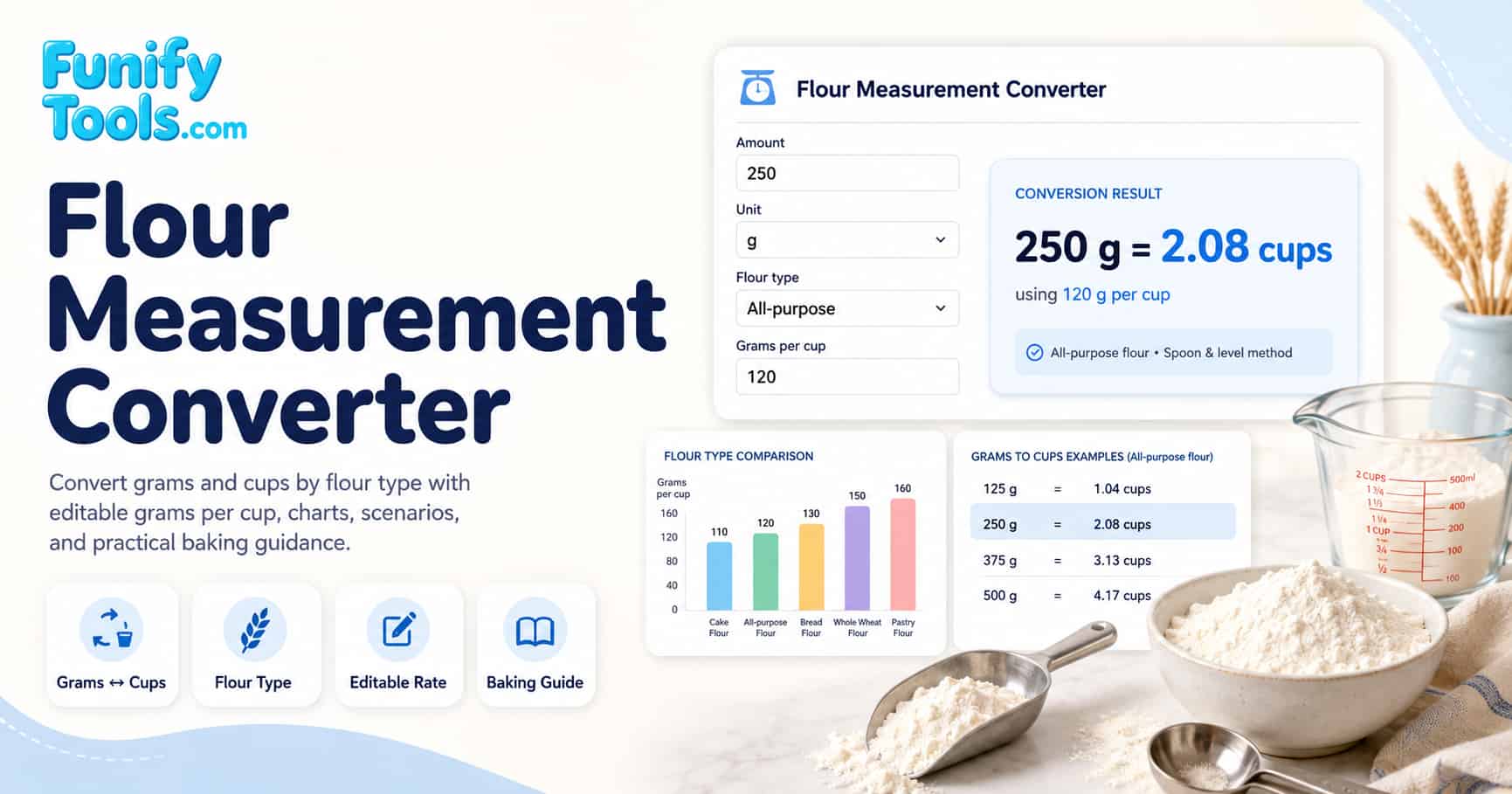
When you convert flour grams to cups, the formula is cups = grams / grams per cup. When you convert flour cups to grams, the formula is grams = cups x grams per cup. This page uses those formulas with type-aware defaults for all-purpose flour, bread flour, cake flour, and whole wheat flour. The editable grams per cup field lets you make the conversion match your actual ingredient instead of forcing every recipe into one average.
If you bake often, use grams for flour, sugar, butter, and water whenever possible. If you are converting an old family recipe, a blog recipe, or a cookbook recipe written in cups, use a flour cups to grams calculator first, then write the gram value into your notes. When you want to compare other conversion assumptions, a quick Google search for grams per cup flour chart can show how different baking sources define one cup of flour. After a few bakes, you will have a more reliable version of the recipe.
Standard grams per cup by type
The defaults below are practical baking averages, not laboratory constants. They are designed for everyday recipe conversion and quick flour measurement checks. Different brands may publish slightly different values, and professional bakers may use their own house standard. If your recipe source gives a flour weight, trust that recipe source first. If the source only gives cups, these values are a strong starting point.
- All-purpose flour: about 120 g per cup.
- Bread flour: about 130 g per cup.
- Cake flour: about 100 g per cup.
- Whole wheat flour: about 130 g per cup.
All-purpose flour is the general baseline for cookies, muffins, biscuits, pancakes, and many cakes. Bread flour is often heavier per cup because it has more protein and a stronger structure. Cake flour is lighter and softer, so one cup often weighs less. Whole wheat flour includes bran and germ, which changes both density and water absorption. A good flour measurement calculator should recognize these differences instead of using one number for every flour type.
Flour type comparison table
| Flour type | Grams per cup | Protein content | Best uses | Texture |
|---|---|---|---|---|
| All-purpose | 120 g | 10–12% | Cookies, muffins, pancakes, cakes, biscuits | Medium, versatile |
| Bread | 130 g | 12–14% | Yeast bread, pizza dough, bagels, sourdough | Strong, chewy |
| Cake | 100 g | 7–9% | Layer cakes, cupcakes, pastries, tender cookies | Soft, tender |
| Whole wheat | 130 g | 13–15% | Whole grain bread, hearty muffins, rustic loaves | Dense, absorbent |
This table helps you quickly compare flour types when choosing a substitute or adjusting a recipe. For a more precise conversion, use the calculator above with your specific flour type and grams per cup value. If you need to learn more about how protein content affects baking behavior, a flour protein content baking guide can explain the science behind gluten formation and water absorption.
Measuring methods
The measuring method can change the conversion more than the flour type. If you want repeatable cups, choose one method and use it every time. A recipe developed with spoon-and-level flour may turn dense if you scoop and sweep. A recipe developed with packed flour may seem too wet if you use a light spooned cup.
- Spoon and level: fluff, spoon into the cup, and level with a straight edge.
- Scoop and sweep: dip the cup into the bag, then level. This packs more flour.
- Sift first when a recipe demands extra lightness.
For most home baking, spoon and level is the best volume method because it leaves more air in the cup and creates less compression. Scoop and sweep is fast, but it can add enough flour to noticeably affect cookies, biscuits, and bread dough. If you are new to this technique, search Google for the spoon and level flour method and compare the visual examples with your own measuring routine. If the recipe says "sifted flour," sift before measuring. If it says "flour, sifted," measure first and sift after. That difference in wording is small, but it can change the final weight.
Set a custom rate
The best grams per cup value is the one from your own kitchen. Weigh one level cup of your flour with your usual method and record the result. Enter that value in the calculator to keep hydration steady across seasons, brands, and recipe styles. This is especially helpful if you bake sourdough bread, yeasted bread, pizza dough, laminated pastry, or cakes where texture depends on small measurement differences.
- Use the same method you will use during baking.
- Repeat a few times and average the results for stability.
- Keep separate rates for all-purpose flour, bread flour, cake flour, and whole wheat flour.
- Update the value when you switch brands or notice seasonal humidity changes.
A simple test: place a bowl on the scale, tare it to zero, fill a measuring cup with your normal technique, level it, then pour the flour into the bowl. Repeat three times. If the results are 118 g, 123 g, and 121 g, use about 121 g per cup. That value will make your personal flour grams to cups conversion more accurate than a generic chart.
How to use conversions in recipes
When converting a recipe, start by identifying whether the recipe is weight-based or volume-based. If the recipe lists flour in grams, keep it in grams whenever possible. If the recipe lists flour in cups, convert the cups to grams and write down the converted number. This makes the next bake easier and lets you compare results.
For cookies, too much flour often makes the dough dry and the cookies cakey instead of chewy. For cake, too much flour may make the crumb tight or heavy. For bread, flour and water work as a pair, so the conversion changes dough hydration. A few grams may not matter in a rustic loaf, but it can matter in enriched doughs, thin pizza crust, or delicate pastry.
If you are scaling a recipe up or down, convert flour to grams before scaling. For example, it is easier to double 240 g of all-purpose flour to 480 g than to manage 2 cups plus technique differences twice. A reliable baking conversion workflow is: convert cups to grams, scale the gram value, then adjust by feel only after mixing.
Worked examples
Example 1: 250 g all-purpose flour to cups. Using 120 g per cup, 250 / 120 = about 2.08 cups. In a practical kitchen, that is a little more than 2 cups. If you are baking something sensitive, weigh 250 g instead of rounding to cups.
Example 2: 1.75 cups bread flour to grams. Using 130 g per cup, 1.75 x 130 = about 228 g. If the same recipe used all-purpose flour at 120 g per cup, 1.75 cups would be 210 g. That 18 g difference can make dough firmer and increase gluten strength.
Example 3: 3 cups cake flour to grams. Using 100 g per cup, 3 x 100 = 300 g. If you accidentally use an all-purpose flour rate of 120 g per cup, the same 3 cups becomes 360 g. That is a major difference for cake texture, which is why cake flour conversions should use a lighter grams per cup value.
Example 4: 500 g whole wheat flour to cups. Using 130 g per cup, 500 / 130 = about 3.85 cups. Whole wheat flour absorbs more water than white flour, so the converted cup amount is only part of the story. The dough may still need extra rest time or a little more liquid.
Substitutions and blends
Switching all-purpose and bread flour changes protein, gluten development, water absorption, and final texture. Replacing all-purpose flour with bread flour can make bread chewier and cookies tougher. Replacing bread flour with all-purpose flour can make dough softer and less elastic. Replacing all-purpose flour with cake flour can make cakes tender but may weaken structure in recipes that need strength.
If you blend flour types, compute a weighted grams per cup and test a small batch first. A blend is not just a math problem because each flour also behaves differently with water, fat, sugar, and mixing time. Still, a weighted rate gives you a better starting conversion than guessing.
- All-purpose 70 percent and whole wheat 30 percent at 120 and 130 g per cup gives about 123 g per cup.
- Adjust hydration a few percent to restore dough feel.
- For tender cakes, avoid replacing all cake flour with bread flour unless the recipe is intentionally sturdy.
- For pizza or bagels, bread flour usually gives better chew than cake flour or low-protein flour.
Hydration and dough feel
In bread baking, hydration means water weight divided by flour weight. If a recipe has 350 g water and 500 g flour, the hydration is 70 percent. If you mis-measure flour by volume, the hydration changes even when the water amount stays the same. That is why bread dough can feel perfect one day and sticky or tight the next.
When converting cups to grams for bread, pizza dough, focaccia, naan, tortillas, or sourdough, pay attention to dough feel after mixing. Whole wheat flour often needs more water and more resting time because bran absorbs moisture slowly. Bread flour can also absorb more water than all-purpose flour. Cake flour usually absorbs less and is not ideal for chewy bread structures. For deeper comparison, search Google for protein content flour absorption to see why higher-protein flours often behave differently in dough.
A good process is to hold back a small amount of liquid, mix, rest for 10 to 20 minutes, then decide whether to add more. The calculator gives the flour conversion, while your hands tell you how the dough is responding.
Storage and humidity
Store flour airtight in a cool, dry place. Humid days can push grams per cup upward through subtle packing and moisture absorption. Dry winter air can make flour feel lighter and looser. If you live in a humid climate, near the coast, or in a kitchen without stable temperature control, your flour measurement may drift through the year.
Whole grain flour contains more natural oils and is more sensitive to storage conditions, so it can benefit from refrigerator or freezer storage if you keep it for a long time. Let chilled flour come closer to room temperature before using it in temperature-sensitive doughs. Cold flour can slow fermentation and affect butter handling in pastry.
Keep a seasonal note and revisit your grams per cup when the weather changes. This small habit can improve consistency in pancakes, muffins, sandwich bread, sourdough, cookies, and cakes. If your recipe suddenly behaves differently even though you followed the same steps, flour moisture and density are worth checking.
Common flour conversions
Use these quick references when you need a fast estimate. The calculator above is still better for exact values because it lets you choose flour type and edit grams per cup.
- 1 cup all-purpose flour = about 120 g.
- 2 cups all-purpose flour = about 240 g.
- 3 cups all-purpose flour = about 360 g.
- 1 cup bread flour = about 130 g.
- 2 cups bread flour = about 260 g.
- 1 cup cake flour = about 100 g.
- 2 cups cake flour = about 200 g.
- 1 cup whole wheat flour = about 130 g.
- 250 g all-purpose flour = about 2.08 cups.
- 500 g bread flour = about 3.85 cups.
For search-friendly recipe notes, you can write conversions in both directions: "250 grams flour to cups" and "2 cups flour in grams." This helps you recognize the same amount whether a recipe uses metric baking measurements or U.S. cup measurements.
Common conversion table
| Amount | All-purpose (120 g/cup) | Bread (130 g/cup) | Cake (100 g/cup) | Whole wheat (130 g/cup) |
|---|---|---|---|---|
| 1 cup | 120 g | 130 g | 100 g | 130 g |
| 1/2 cup | 60 g | 65 g | 50 g | 65 g |
| 1/3 cup | 40 g | 43 g | 33 g | 43 g |
| 1/4 cup | 30 g | 33 g | 25 g | 33 g |
| 250 g | 2.08 cups | 1.92 cups | 2.50 cups | 1.92 cups |
| 500 g | 4.17 cups | 3.85 cups | 5.00 cups | 3.85 cups |
This quick reference table shows common flour conversions across all four flour types. Bookmark this page or use the calculator above for precise values with your own grams per cup setting. For more detailed baking measurement comparisons, a flour measurement conversion table can help you cross-check values from different recipe sources and baking standards.
Troubleshooting
- Dough too dry: reduce cups slightly or raise water a few percent.
- Dough too sticky: add a small dusting and rest the dough to hydrate evenly.
- Inconsistent cups: standardize your measuring method or switch to a scale.
- Cake crumb too dense: check whether you used all-purpose flour weight for cake flour.
- Cookies spread too much: confirm that the flour was not under-measured and that butter temperature was correct.
- Bread feels tight: confirm the flour weight, then increase hydration gradually instead of adding all the water at once.
- Recipe works with one brand but not another: weigh one cup of each brand and enter the custom grams per cup value.
If you are troubleshooting a recipe, change one variable at a time. First standardize the flour measurement, then adjust liquid, mixing, resting, oven temperature, or bake time. This makes it easier to know whether the issue came from conversion math or from technique.
Troubleshooting table
| Symptom | Likely cause | Solution |
|---|---|---|
| Dough feels stiff or dry | Too much flour measured by volume | Reduce flour by 10–15 g or increase liquid gradually |
| Dough is sticky after mixing | Insufficient flour or low absorption rate | Add flour in small increments and rest the dough |
| Cake crumb is dense and heavy | Used all-purpose flour weight for cake flour | Switch to cake flour at 100 g per cup or reduce total flour |
| Cookies spread too much | Under-measured flour or warm butter | Check flour weight and chill dough before baking |
| Bread feels tight and dry | Hydration too low for the flour type | Increase water by 2–5% and confirm flour weight |
| Results vary between brands | Different milling and protein levels | Weigh one cup of each brand and set a custom grams per cup |
| Inconsistent cup measurements | Different measuring methods each time | Standardize on spoon and level or switch to a kitchen scale |
This troubleshooting table helps you quickly diagnose common baking problems related to flour measurement. For a deeper dive into each issue, explore the sections above or use the calculator to test different flour types and grams per cup values. If you are still unsure about the right approach, a flour baking troubleshooting guide can provide additional insights from experienced bakers and pastry chefs.
Frequently searched questions
How many grams are in a cup of flour? A common answer is about 120 g for all-purpose flour, about 130 g for bread flour, about 100 g for cake flour, and about 130 g for whole wheat flour. The exact answer depends on flour type and measuring method.
Is 1 cup of flour always 120 grams? No. 120 g is a useful all-purpose flour average, but it is not universal. Flour can be lighter or heavier depending on brand, humidity, sifting, and whether it is spooned, scooped, or packed.
Should I use grams or cups for baking? Use grams for the most consistent results. Cups are convenient, but grams remove the biggest source of flour measurement variation. If a recipe only uses cups, convert cups to grams and keep that value for future bakes.
Why does my flour conversion not match another chart? Flour conversion charts often use different assumptions. Some use 120 g per cup, some use 125 g, and some separate values by flour type. This calculator lets you edit grams per cup so you can match your recipe source or your own kitchen measurement.
References
Flour grams per cup charts | Spoon and level method | Protein and absorption
This guide is for practical home cooking and baking measurement. For commercial production, nutrition labeling, or professional formula development, use controlled weighing, ingredient specifications, and test batches.