Measure and area
For a rectangular room, area = length × width. Measure from finished wall to finished wall where possible, and check the longest span and widest point if walls are not perfectly square. Round consistently, such as to the nearest 0.1 ft or 0.01 m. Accurate measurement is the foundation of every room layout project, whether you are planning a bedroom renovation, arranging a living room furniture layout, or estimating usable space in a home office. Even small measurement errors can lead to furniture that does not fit or walkways that are too narrow for comfortable daily use.
Units and conversion
Keep source measurements in one unit. If you measure in meters, the result is square meters. If you measure in feet, the result is square feet. For comparison charts and saved notes, the calculator keeps results consistent across unit choices. When working with international floor plans or comparing properties listed in different unit systems, you may need to convert between square feet and square meters. Understanding how to convert square meters to square feet helps you compare room sizes across different listing platforms and countries.
Furniture and flow
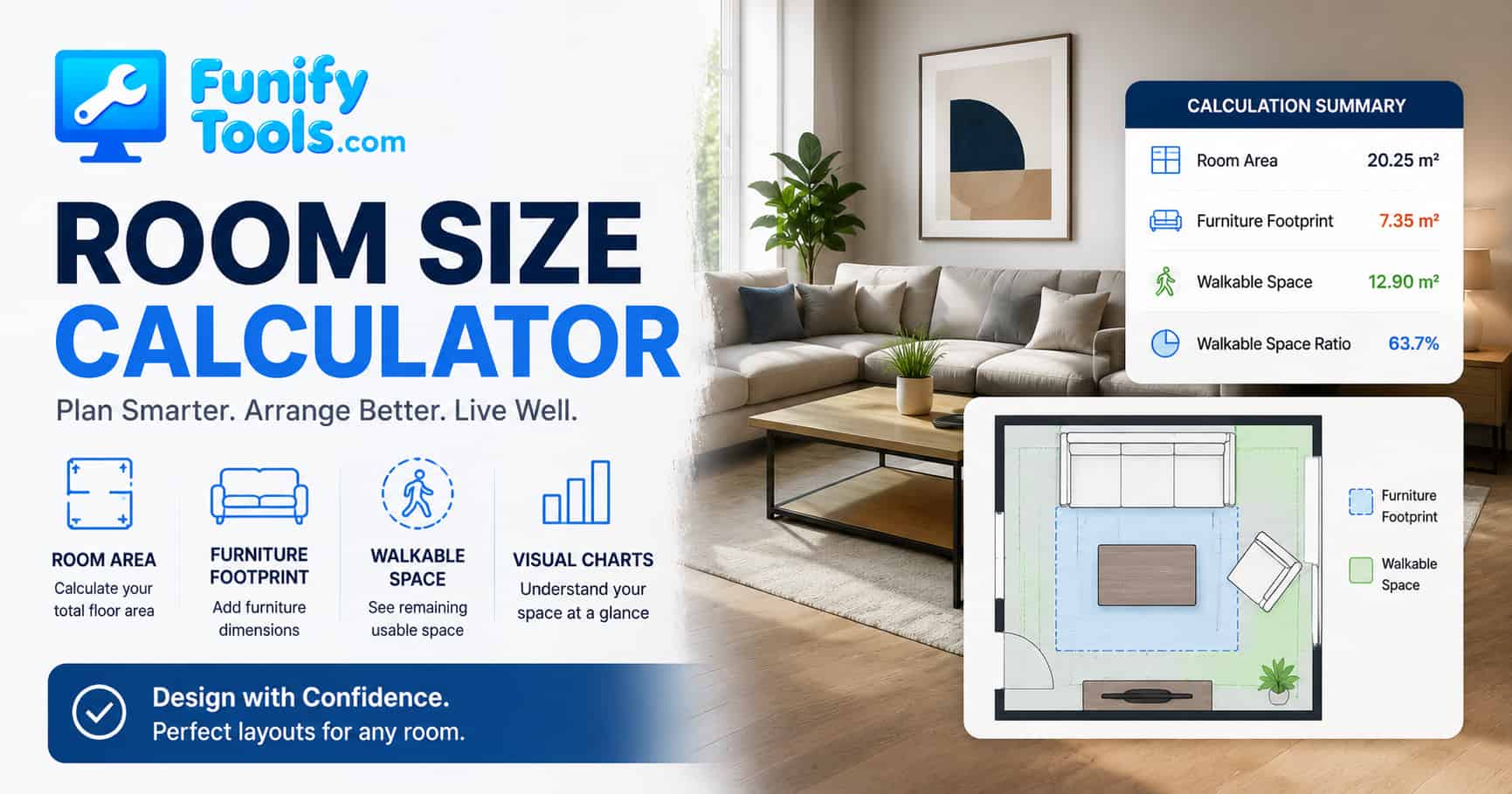
Furniture footprint is the floor area occupied by items such as a bed, sofa, desk, dining table, wardrobe, or cabinet. In this calculator, enter that footprint as an estimated percentage of the room, and the calculator converts it into area before subtracting it from total room area. For deeper planning, check recommended clearance space between furniture pieces to ensure every zone of the room remains functional.
- Keep main paths as continuous as possible from the door to the bed, desk, window, or closet.
- Leave enough space for chairs to pull out and doors or drawers to open fully.
- Use tape on the floor to mock up large pieces before ordering furniture.
- Consider traffic flow through the room; high-traffic zones need wider clearance than quiet corners.
Irregular rooms
For L-shaped or complex rooms, split the floor plan into rectangles and add the rectangle areas together. Add closets and useful alcoves if they are part of the usable floor area. Subtract built-ins or unusable corners only when they genuinely reduce layout space. Many older homes and apartments have non-rectangular layouts, so learning how to measure an L-shaped room for flooring can save time and prevent material waste during renovation projects.
Clearance cheat sheet
| Zone | Common target | Why it matters |
|---|---|---|
| Main walkway | About 36 in / 90 cm | Comfortable everyday movement |
| Bed side | About 24 in / 60 cm | Getting in and out of bed |
| Sofa to table | About 18 to 24 in / 45 to 60 cm | Reach and passage |
| Desk chair pull-out | About 30 in / 75 cm | Chair movement and posture |
| Door swing | Full door swing arc | Avoids clashes with furniture |
Layout examples
Bedrooms usually work best when the bed is placed first, then side tables, wardrobes, and desk space are added around circulation. Living rooms often start with a seating group and a focal point. Home offices should prioritize screen glare, cable routes, chair movement, and access to storage. Each room type has unique constraints, and reviewing small bedroom layout ideas for maximum space can provide inspiration for making the most of limited square footage.
Case study
A 12 by 10 ft room has 120 ft² of floor area. If a sofa uses 18 ft², a desk uses 12.5 ft², and a bookcase uses 3 ft², total furniture footprint is 33.5 ft², or about 27.9% furniture coverage. Entering 27.9 in the calculator leaves about 86.5 ft² of remaining space, or about 72.1% of the room. If the same room were furnished more densely with a queen bed (about 20 ft²), two nightstands (about 6 ft² total), a dresser (about 8 ft²), and a wardrobe (about 10 ft²), the furniture footprint would rise to 44 ft², or about 36.7% coverage, leaving only 76 ft² or 63.3% of the room open.
Room size by furniture type
Different furniture arrangements require different minimum room dimensions. The table below shows common room sizes and the furniture types they typically accommodate.
| Room type | Minimum size | Fits comfortably | Typical coverage input |
|---|---|---|---|
| Small bedroom | 8 x 10 ft (80 ft²) | Twin bed, desk, small wardrobe | 30% to 45% |
| Medium bedroom | 10 x 12 ft (120 ft²) | Queen bed, two nightstands, dresser | 30% to 42% |
| Large bedroom | 12 x 14 ft (168 ft²) | King bed, nightstands, dresser, seating | 30% to 42% |
| Small living room | 10 x 12 ft (120 ft²) | Sofa, coffee table, TV stand | 25% to 38% |
| Medium living room | 12 x 16 ft (192 ft²) | Sectional, coffee table, media console | 26% to 36% |
| Home office | 8 x 10 ft (80 ft²) | Desk, chair, bookshelf, filing cabinet | 20% to 32% |
These estimates assume standard furniture sizes and comfortable clearance around each piece. Use them as starting percentages, then verify with actual measurements before purchasing.
Space usage comparison
The way you allocate floor area between furniture and open space directly affects how the room feels and functions. The table below compares three different furnishing strategies for the same room size.
| Scenario | Furniture footprint | Remaining space | Furniture coverage | Feel |
|---|---|---|---|---|
| Minimalist | 25 ft² | 143 ft² | 14.9% | Spacious, flexible |
| Moderate | 55 ft² | 113 ft² | 32.7% | Comfortable, balanced |
| Fully furnished | 85 ft² | 83 ft² | 50.6% | Cozy, limited walk space |
As furniture coverage approaches or exceeds 50%, the room may feel crowded. Use the calculator to experiment with different coverage percentages and find the balance that works for your space.
References
Wikipedia Floor plan | Wikipedia Ergonomics | Wikipedia Square foot | Wikipedia Square metre