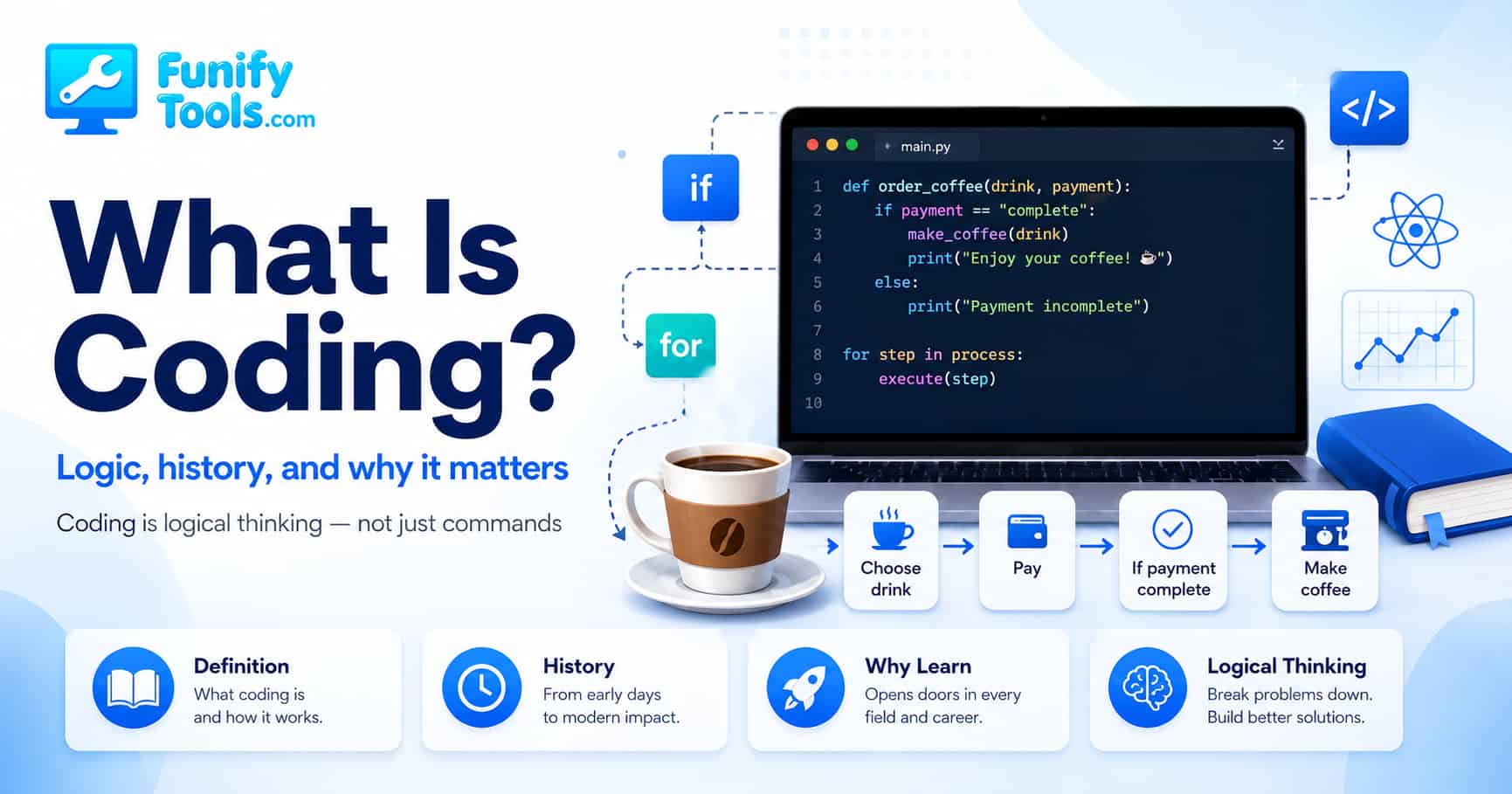
Coding Is Logical Thinking — Not Just Commands
The word coding shows up everywhere now. Schools talk about it, companies look for it, parents wonder if their kids should learn it, and people who have never written a single line of code still hear the word almost every day. But when someone asks, “What exactly is coding?”, the answer often becomes strangely vague.
The dictionary-style definition is simple enough: coding is the act of writing instructions that a computer can understand. In other words, it is the process of creating a program. That definition is technically correct, but it feels a little too small. It makes coding sound like typing commands into a machine, almost like filling out a form.
To me, coding is much more than that. Coding is the practice of turning human thoughts into a clear structure. It is taking an idea that may feel messy, emotional, or abstract in your head and breaking it into steps, conditions, decisions, and results. A computer cannot understand “make this feel convenient” or “do this in a smart way.” It needs something much more exact. So the person writing code has to translate the idea into a logical flow.
That is why coding is not only a technical skill. It is also a way of thinking. Before you write code, you have to decide what should happen first, what should happen next, what should happen only under certain conditions, and what should happen when something goes wrong. In that sense, coding is less about memorizing commands and more about learning how to organize thought.
This is also why beginners often feel confused at first. They think they are struggling because they do not know enough syntax. Of course syntax matters, but the bigger challenge is usually the thinking process behind the syntax. A programming language is just the surface. Underneath it, coding is about asking better questions: What problem am I solving? What information do I need? What are the possible cases? What should the computer do in each case?
The Logic of Buying Coffee
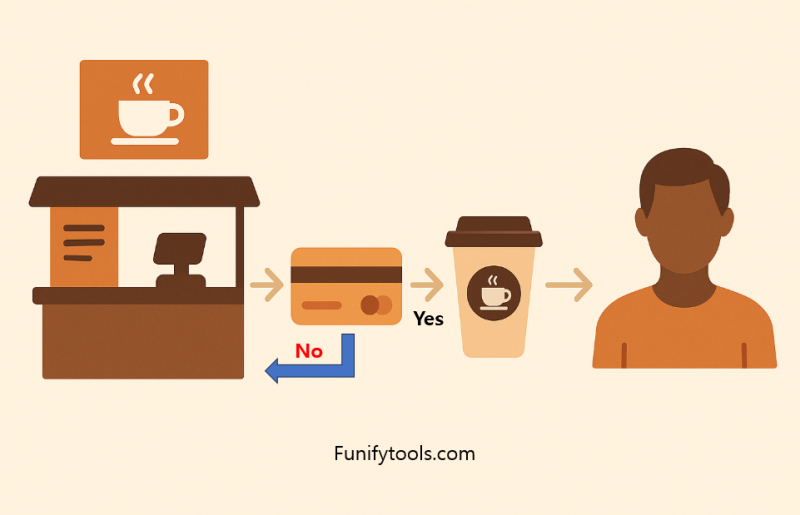
Let’s start with something simple: buying a cup of coffee in the morning. You walk into a café, look at the menu, choose a drink, pay for it, wait for the barista to make it, and then receive your coffee. It feels like an ordinary daily routine. But if you look at it carefully, it already has the shape of an algorithm.
There is an order. There are conditions. There are possible exceptions. If the café is open, you can go in. If the drink is available, you can order it. If the payment is successful, the barista starts making the coffee. If the payment fails, the order does not move forward. If the drink takes time, you wait. If your name is called, you pick it up.
A simple rule like “If payment is complete, then make coffee” is already very close to how code works. Computers operate through this kind of structured logic. They do not understand intention the way people do. They do not assume context unless someone has written that context into the system. They simply follow the flow they are given.
That may sound mechanical, but it is also what makes coding powerful. Once a process is expressed clearly enough, it can be repeated, tested, improved, and scaled. A person might forget a step. A person might do something differently each time. A computer, however, can run the same logic again and again with incredible speed and consistency.
Of course, real-life situations are more complicated than a single coffee order. What if the customer wants oat milk? What if the shop runs out of ice? What if a discount coupon is used? What if the customer orders three drinks and one of them needs to be canceled? Every extra case adds a new branch to the logic. And that is exactly what happens in programming. A simple idea grows into a system as more real-world conditions are added.
This is why coding can feel surprisingly familiar once you stop thinking of it as “computer language” only. We already use logical structures in daily life. We make plans, compare options, follow rules, handle exceptions, and repeat routines. Coding simply forces us to make that thinking more precise.
A Short History of Coding
The history of coding is longer than many people imagine. It did not suddenly appear with modern laptops, smartphones, or the internet. The idea of giving structured instructions to a machine goes back much further.
In the early 19th century, Charles Babbage designed the concept of a mechanical computing machine called the Analytical Engine. It was never completed in the way modern computers are built today, but the idea behind it was remarkable. It suggested that a machine could follow a sequence of operations to perform calculations.
Ada Lovelace, who studied Babbage’s work, is often remembered for recognizing something even bigger: such a machine would not only be useful for numbers. If information could be represented in the right form, a machine could potentially manipulate symbols, patterns, and more abstract ideas. That way of thinking is one reason she is often associated with the earliest ideas of programming.
Later, punched cards became an important part of computing history. Machines could read holes punched into cards and use them as instructions or data. This may sound primitive compared with today’s software, but the basic idea is still familiar: information is encoded into a format a machine can process.
As computers became electronic and more powerful, programming languages began to develop. Instead of writing instructions only in low-level machine code, people created languages that were easier for humans to read and write. Over time, languages such as Fortran, COBOL, C, Java, Python, JavaScript, and many others appeared, each shaped by the needs of its time.
That history matters because it reminds us that coding has always been about translation. Humans have ideas, goals, calculations, and processes. Machines need exact instructions. Coding sits between the two. It is the bridge between human intention and machine execution.
Why Coding Is Not Only for Engineers
Many people still believe coding belongs only to engineers, computer science majors, or people who are naturally good at math. That belief is understandable, but it is no longer accurate. Coding is now connected to almost every field, even when the final job title has nothing to do with software engineering.
Writers use digital publishing tools. Designers work with interactive interfaces. Marketers analyze data. Economists build models. Scientists process experimental results. Journalists investigate large datasets. Teachers create digital learning materials. Small business owners manage websites, online stores, analytics, and automation tools. In all of these areas, understanding even the basic logic of coding can change the way a person works.
This does not mean everyone has to become a full-time developer. That is not the point. The point is that coding teaches a type of thinking that is useful far outside the programming world. It teaches you to break big problems into smaller parts. It teaches you to define terms clearly. It teaches you to notice hidden assumptions. It teaches you to test whether your idea actually works instead of only believing that it should work.
For humanities majors, coding can be useful because language, structure, interpretation, and logic are already familiar territories. A well-written essay has a flow. A strong argument has premises and conclusions. A historical analysis depends on causes, effects, and context. Coding is different in form, but it also asks for structure and clarity.
For science and engineering majors, coding is useful in a more direct way. Experiments, simulations, data analysis, modeling, automation, and visualization all depend heavily on computational thinking. A scientist who can code can often test ideas faster. An engineer who can code can build tools around their own workflow. A researcher who can code can handle data without waiting for someone else to prepare everything.
But the deeper point is this: coding is not about what you study. It is about how you approach problems. Whether you come from literature, design, business, physics, psychology, economics, or computer science, the habit of thinking in clear steps is valuable.
Why Logic Matters More Than Ever
We live in a world that increasingly runs on systems. Apps recommend what we might like. Search engines rank information. Delivery platforms calculate routes. Banks detect suspicious transactions. Streaming services decide what to show next. Artificial intelligence tools generate text, images, code, summaries, and suggestions. Behind these experiences are rules, data, models, and code.
That does not mean every person needs to understand every technical detail. Most of us use electricity without being electrical engineers. We drive cars without knowing every part of the engine. But a basic understanding of how digital systems think can make us less passive. It helps us ask better questions about the tools we use every day.
For example, when an app recommends a video, it may feel personal, almost as if the app understands your taste. But underneath that experience, there is a system looking at signals: what you clicked, how long you watched, what similar users watched, what content is trending, and many other factors. Coding is one part of the larger structure that makes this possible.
Once you understand that digital systems are built from logic, you start to see the world differently. A website is not just a page. It is a set of instructions running in a browser. A login button is not just a button. It is a flow involving input, validation, authentication, errors, and responses. A shopping cart is not just a list of products. It is a system that tracks state, price, quantity, discounts, taxes, and payment status.
This is why coding has evolved from being only a career skill into something closer to digital literacy. In the past, being able to read and write text was the foundation for participating in society. Today, we still need that, of course. But we also benefit from understanding how digital tools are built, how they make decisions, and why they sometimes fail.
Logical thinking is especially important because technology often hides complexity behind simple interfaces. The screen may look clean, but the logic underneath may be complicated. If we only see the surface, we become dependent on whatever the system gives us. If we understand the structure even a little, we gain more control.
Coding Starts Before the Keyboard
One of the biggest misunderstandings about coding is that it begins when you start typing. In reality, the most important part often happens before the first line of code is written.
Imagine you want to build a simple calculator. A beginner might immediately ask, “What programming language should I use?” That is a fair question, but it is not the first question. Before choosing a language, you need to define the problem. What kind of calculator is it? Does it handle only addition and subtraction? Does it support decimals? What happens if the user types a letter instead of a number? Should it show an error message? Should it remember previous results?
These questions may feel small, but they are the real beginning of coding. The code itself is only the final expression of many decisions. A person who can think clearly about the problem will usually write better code, even if their syntax is not perfect yet. A person who skips the thinking stage may write code quickly, but the result often becomes confusing, fragile, or difficult to fix.
This is why good programmers spend a lot of time reading, planning, naming things, testing assumptions, and revising. The public image of coding is someone typing very fast in a dark room. The real work is often much slower and more thoughtful. It involves asking, “What am I actually trying to make happen?” and “What cases am I forgetting?”
In that sense, coding is closer to writing than many people expect. A writer drafts, edits, reorganizes, and clarifies. A programmer does the same thing, but with logic. Bad code is often not bad because the computer cannot run it. Bad code is bad because people cannot understand it later, or because it fails when reality becomes slightly more complicated than expected.
Reading the Flow of Thought
Before jumping into programming languages, it helps to learn how to read code as a flow of thought. Beginners often believe they must memorize every symbol before they can understand anything. But that is not always true. Even if you do not know a language deeply, you can often follow the broad logic if you know what to look for.
For instance, the word if appears in many programming languages. On the surface, it means almost exactly what it means in everyday English: if this condition is true, do something. But the deeper meaning is more interesting. An if statement is a way of imagining possible situations and preparing a response for each one.
Think about a website login form. If the email is empty, show a message. If the password is too short, show a warning. If the account exists and the password is correct, allow the user to log in. If not, reject the attempt. That entire experience is built from conditions. The user only sees a clean form, but the system underneath is constantly checking cases.
The same idea appears in daily life. If it rains, take an umbrella. If the traffic is heavy, leave earlier. If the store is closed, try another one. Coding turns this everyday conditional thinking into a form a machine can execute.
The for loop works differently, but it is just as natural once you understand the idea. A loop is about repetition. Instead of writing the same action again and again, you tell the computer to repeat it under a defined rule.
For example, suppose you have a list of ten names and you want to print a greeting for each person. You could write ten separate lines. But that would be clumsy. A loop lets you say, in effect, “For each name in this list, print a greeting.” The computer repeats the action while following the structure you gave it.
This is the heart of reading code. You are not only translating grammar. You are tracing the author’s thinking. You are asking: Where does the logic begin? What condition is being checked? What gets repeated? What happens when the input changes? What result is the code trying to produce?
Once you start reading code this way, programming becomes less intimidating. The symbols still matter, but they are no longer random marks on a screen. They become signs of decisions, patterns, and structure.
Why Beginners Should Not Fear Syntax Too Much
Syntax is important. A missing comma, bracket, quotation mark, or semicolon can break a program. That part can be frustrating, especially at the beginning. It can feel unfair that one tiny character causes the whole thing to fail.
But beginners should not confuse syntax errors with failure. Syntax errors are normal. They are part of learning. Even experienced developers make them. The difference is that experienced developers know how to read the error, narrow down the problem, and fix it without panicking.
Learning to code is not about never making mistakes. It is about learning how to debug. Debugging means finding out why something does not work the way you expected. Sometimes the problem is a typo. Sometimes the logic is wrong. Sometimes the input is different from what you assumed. Sometimes the code works, but the original idea was incomplete.
This habit of debugging is one of the most valuable parts of coding. It teaches patience. It teaches careful observation. It teaches you not to trust your first assumption too quickly. When something fails, you learn to ask, “What did I expect to happen? What actually happened? Where is the difference coming from?”
That mindset is useful far beyond software. Many real-world problems are debugging problems. A business process is slow. A study result looks strange. A design is confusing users. A personal habit is not working. In each case, the solution begins by observing the system, identifying the gap, and adjusting the logic.
Coding and Creativity
Some people imagine coding as the opposite of creativity. They picture it as cold, strict, and mechanical. But that view misses a lot. Coding can be deeply creative because it gives you a way to build things from ideas.
A painter uses color and shape. A musician uses sound and rhythm. A writer uses words. A programmer uses logic, data, and interaction. The materials are different, but the creative process is surprisingly similar. You start with something vague, make a rough version, test it, revise it, and slowly shape it into something useful or meaningful.
This is why coding can be exciting even for people who do not see themselves as “tech people.” You can make a small tool that solves your own problem. You can build a personal website. You can automate a boring task. You can create a visual experiment. You can analyze your own data. You can make a game, a calculator, a note app, or a simple interactive page.
The first project does not have to be impressive. In fact, it probably should not be. A tiny project that actually works teaches more than a huge idea that never gets finished. Coding becomes more enjoyable when you connect it to something you personally care about.
That is also where motivation becomes stronger. Learning a programming language only from abstract examples can feel dry. But when you use code to make something you wanted to make anyway, the logic starts to feel alive. The code is no longer just a lesson. It becomes a tool for expression.
So, What Does It Really Mean to Learn Coding?
Learning coding does not mean memorizing every programming language. Nobody does that. It also does not mean understanding every part of computer science from day one. That would be unrealistic. Learning coding means gradually becoming comfortable with structured problem-solving.
At first, you learn small pieces: variables, conditions, loops, functions, input, output, errors, and data. These pieces may seem separate, but over time they connect. You begin to see that a program is not a magic object. It is a set of decisions arranged in a specific order.
You also learn that there is rarely only one correct answer. Two people can solve the same problem in different ways. One solution may be shorter. Another may be easier to read. Another may be faster. Another may be easier to maintain. Coding is full of trade-offs, and learning to think about those trade-offs is part of becoming better.
This is another reason coding matters. It teaches you to be precise, but it also teaches you to be practical. The best solution is not always the cleverest one. Sometimes the best solution is the one that is clear, stable, and easy for someone else to understand later.
That idea is especially important in the real world. Code is rarely written once and then forgotten. It is updated, fixed, expanded, reused, and read by other people. Even when you write code only for yourself, your future self becomes another reader. Clear thinking today saves confusion tomorrow.
Final Thoughts
We do not learn coding simply to become developers. Some people will, of course, and that is a great path. But the value of coding is broader than one job title. We learn coding because it helps us turn ideas into something that can run, respond, calculate, display, store, compare, and improve.
Coding teaches us how to express thought in a form that machines can understand. Through that process, we also understand our own thinking more clearly. We notice missing steps. We find hidden assumptions. We learn how small decisions affect the whole system.
One day, when you look at a piece of source code and think, “Ah, I can see how this logic flows,” that will be an important moment. You may not know every detail yet. You may still need to search for syntax. You may still make mistakes. But you will no longer be looking at code as a wall of strange symbols. You will be reading it as structured thought.
That is the real value of learning to code. It is not only about computers. It is about learning how to think clearly in a world built on digital systems.
Thank you for reading — and I hope your journey into coding becomes not just technical, but genuinely eye-opening.
This article is also available in Korean: Read the Korean version