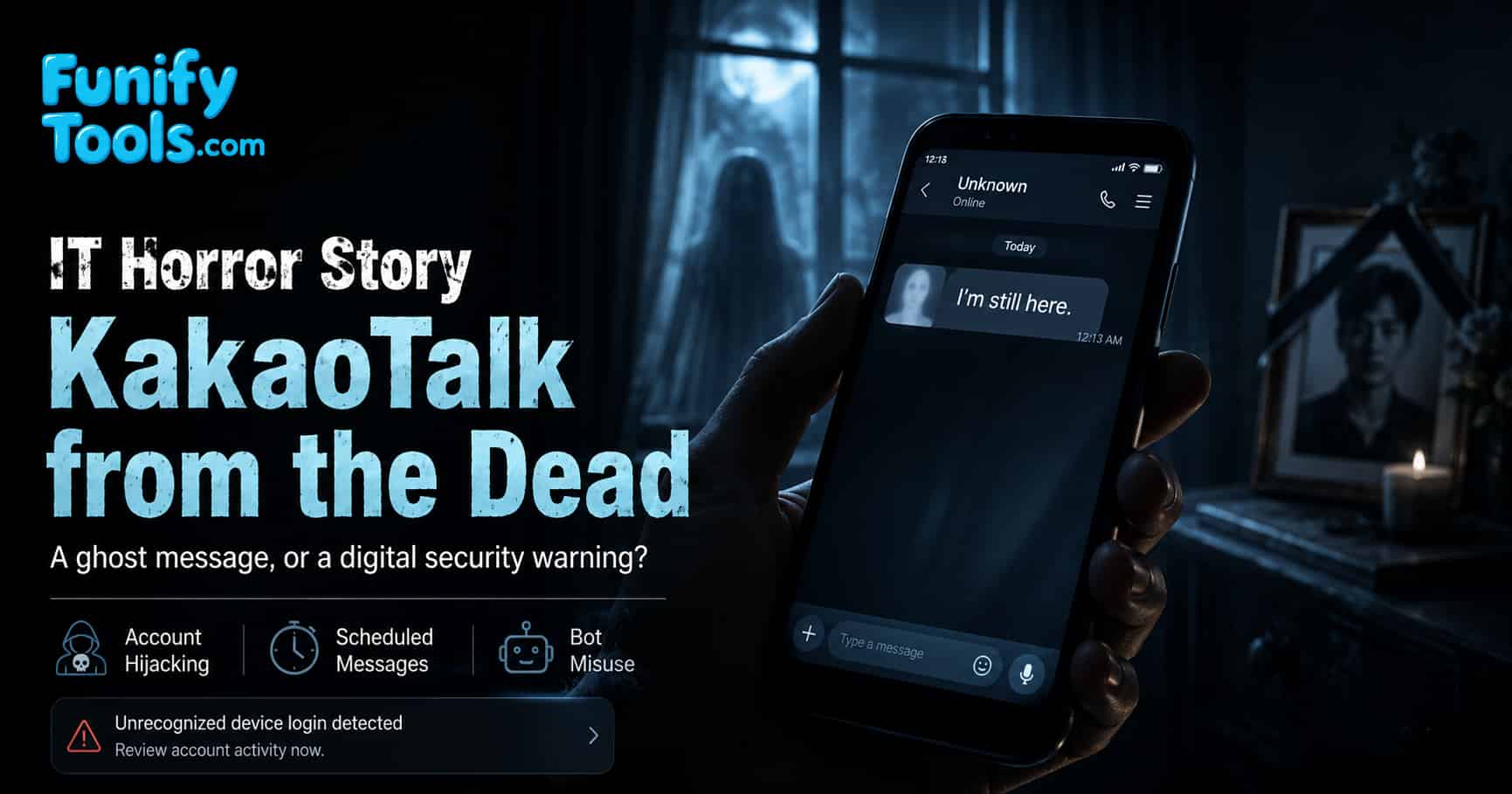
Is this just a ghost story, or something that could really happen? A "message from the dead" sounds impossible at first, but in the digital world it can have surprisingly realistic causes: weak account security, scheduled automations, connected devices, bot misuse, or phishing.
This story begins like horror, but it ends as a reminder that the accounts we leave behind can keep moving even when we are no longer there to control them.
I have been posting mostly serious technical articles lately, so today I wanted to try something a little different.
Imagine this. It is late at night. Your room is quiet, your phone is face down on the desk, and you are just about to sleep. Then the screen lights up. A KakaoTalk notification appears.
At first, you do not think much of it. Messages arrive all the time. But when you see the sender's name, your hand stops. It is a name you have not seen online for months. A person who should not be able to send messages anymore.
"Are you there?"
Only three words. No profile change. No explanation. Just a short message from an account that should have been silent.
Your first reaction might be fear. Your second reaction might be denial. Maybe it is a mistake. Maybe someone else has the phone. Maybe the account was never deleted. But the message sits there, ordinary and terrifying at the same time, because modern apps make the impossible look normal.
That is the strange power of digital life. A profile photo can remain unchanged. A chat room can stay open. Old messages can be searched years later. Even after a person is gone, their accounts, passwords, backups, scheduled tasks, and linked services may still exist somewhere in the background.
How This Could Actually Happen
A message from the dead feels supernatural because messaging apps are personal. We do not see them as abstract systems. We see names, faces, memories, and conversations. But technically, a message is still data sent through an account. If that account is accessible, automated, or compromised, it can still produce activity.
Here are a few realistic ways a creepy message like this could happen.
1) Account Hijacking
If someone hacks into a deceased person's account or guesses their password, they can send messages as if the person were still alive. SNS and messaging platforms like KakaoTalk, Facebook, Instagram, email services, and other social apps can become vulnerable if security settings are weak.
This does not always require advanced hacking. Sometimes the password was reused on many sites. Sometimes it was leaked in an old data breach. Sometimes someone close to the person already knew the password. Sometimes a recovery email or phone number was still accessible. From the outside, the result looks mysterious, but the cause may be painfully ordinary.
Account hijacking is especially disturbing because it does not only affect the account owner. Friends and family may trust messages from that account because the name is familiar. That trust can be abused to request money, send malicious links, collect personal information, or reopen grief in a cruel way.
This is why two-factor authentication matters so much. A password alone is often not enough. If a login also requires a second verification step, it becomes much harder for someone to take over an account quietly.
2) Scheduled Messages
Sometimes, a person may have scheduled a message before passing away. Certain apps and services allow messages, emails, posts, reminders, or notifications to be sent at a future time. If such automation was set up in advance, the message could appear later even though the sender is no longer alive.
This can happen for ordinary reasons. Someone may schedule a birthday greeting, a work reminder, a goodbye note, a marketing post, or a personal message and then forget about it. Some people also use automation tools to send recurring messages, backups, alerts, or calendar-based notifications.
In a sadder and more dramatic sense, it reminds me of the old movie The Letter, starring Choi Jin-sil and Park Shin-yang. A delayed message can feel like a voice crossing time. Depending on the context, it can be touching, confusing, or deeply unsettling.
The important point is that scheduled communication blurs our sense of presence. We usually assume that a message means someone is actively typing right now. But in digital systems, a message can also be the result of a timer, a rule, an automation, or a queue.
3) API and Bot Automation
Some attackers use APIs or automation tools to create bots that send messages automatically. Telegram is well known for bot features, but automation can exist in many services through official APIs, unofficial scripts, browser automation, connected apps, or compromised devices.
In such cases, an account may be used to send messages without the owner's knowledge or consent. A bot can repeat the same message, react to keywords, send links, or contact many people at once. If an old account is connected to such a system, the messages may continue until someone disables the automation.
There are also less malicious cases. A person may have connected a service to reminders, newsletters, smart home alerts, or business tools. After death, illness, or account abandonment, those systems may keep running because no one knows where they were configured.
This is one of the quiet problems of modern digital life. We connect services when we need convenience, but years later it can be difficult to remember what has permission to access what.
4) Stolen Devices and Active Sessions
Another possibility is an active session on a phone, tablet, PC, or web browser. If someone has access to a device that is already logged in, they may not need the password at all. They can open the app and send messages immediately.
This is why device locks, biometric authentication, remote logout, and lost-device controls are important. If a phone is unlocked or a computer browser remains signed in, the account can be used by whoever has physical access.
Many people focus only on passwords, but active sessions are just as important. Checking logged-in devices and removing old sessions can prevent strange activity from forgotten phones, shared computers, or lost devices.
When the Message Contains a Link
The scariest version of this story is not only the message itself. It is the link that might follow.
"I left something for you. Check this."
A message like that can be emotionally powerful. If the sender is someone you miss, your guard may drop. That is exactly why attackers use familiar names and emotional wording. They want you to click before you think.
Some so-called ghost messages are actually phishing attempts. The link may lead to a fake login page, a malware download, a scam form, or a page designed to steal personal information. The emotional shock becomes part of the attack.
If you receive a strange message from an account connected to someone who has passed away, do not click links immediately. Take a screenshot, ask trusted family members or mutual contacts, and check the account through safer channels. A few minutes of caution can prevent a much bigger problem.
Lessons and Digital Safety Tips
-
Strengthen account security. Always enable two-factor authentication when available. A simple password alone is not enough to protect an account, especially if the same password has been reused elsewhere.
-
Use unique passwords. A password manager can help you create and store different passwords for different services. This reduces the damage if one website suffers a data leak.
-
Check logged-in devices. Review active sessions from time to time. If you see an old phone, shared computer, or unfamiliar location, log it out.
-
Manage digital legacy. Platforms like Google, Apple, Facebook, and other major services provide digital legacy or inactive account options. Setting this up in advance allows family members to handle accounts more safely later.
-
Beware of suspicious links. Some so-called ghost messages actually lead to phishing sites. If the message source is unclear, never click the link first. Verify through another method.
-
Talk about accounts before they become a problem. It may feel uncomfortable, but families should know how important accounts, cloud storage, photos, and devices should be handled in an emergency.
Closing Thoughts
A message from the dead may sound like a ghost story, but in reality, it often stems from weak account security and the digital traces we leave behind. A "KakaoTalk from beyond the grave" is not merely a creepy tale. It is a reminder for the living to reflect on the digital shadows we create every day.
The more we live through apps, the more our accounts become extensions of ourselves. They contain our conversations, photos, memories, contacts, purchases, habits, and sometimes even our final words. That makes digital safety more than a technical issue. It becomes part of how we protect the people around us.
So if this story made you feel uneasy, that is not a bad thing. Use that feeling as a reason to check your passwords, turn on two-factor authentication, review old sessions, and think about digital legacy before it becomes urgent.
Sometimes the most frightening message is not proof of the supernatural. Sometimes it is proof that a forgotten account is still open.
This article is also available in Korean: Read the Korean version