How the outcome is decided
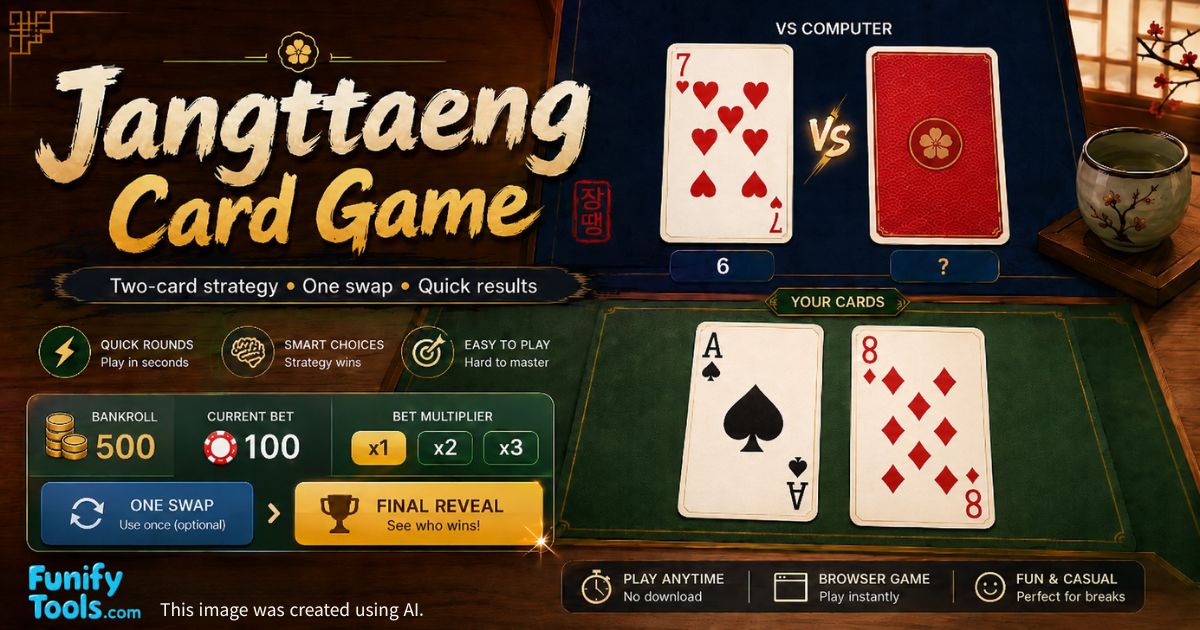
Jangttaeng is a traditional Korean card game that uses a simplified comparison system to determine the winner of each round. The outcome logic follows two main rules applied in order of priority:
Step 1: Pair check The game first checks whether each side holds a pair (two cards with the same number). If both the player and the computer have a pair, the higher pair wins. For example, a pair of 10s beats a pair of 9s. If only one side has a pair, that side wins immediately over any mixed hand, regardless of the card values.
Step 2: Modulo 10 sum When both hands are mixed (no pair on either side), the game adds the two card values together and takes the remainder after dividing by 10 (modulo 10). The side with the higher remainder wins. For instance, a 7 and an 8 total 15, which becomes 5 after modulo 10. This system creates a balanced playing field where no single card guarantees victory and every round offers a fair chance for either side to win.
If both the pair check and the modulo 10 sum result in a tie, the round is declared a draw and the bet is returned to the player's bankroll. This means the house does not automatically win ties, making the game more favorable for the player compared to many traditional casino card games.
Card ranking reference table
| Rank | Hand type | Example | Description |
|---|---|---|---|
| 1 | Pair of 10s | 10 & 10 | The highest possible pair; instant win against any lower pair or mixed hand. |
| 2 | Pair of 9s | 9 & 9 | Second strongest pair; beats all pairs below 9 and all mixed hands. |
| 3 | Pair of 8s | 8 & 8 | Strong mid-range pair; useful benchmark for swap decisions. |
| 4 | Pair of 7s | 7 & 7 | Decent pair; consider keeping unless the visible computer card suggests a higher pair. |
| 5 | Pair of 6s | 6 & 6 | Lower but still playable pair; beats all mixed hands. |
| 6 | Pair of 5s | 5 & 5 | Weak pair; still beats mixed hands but vulnerable to higher pairs. |
| 7 | Pair of 4s | 4 & 4 | Low pair; consider swapping if the visible computer card shows a high value. |
| 8 | Pair of 3s | 3 & 3 | Very low pair; risky to keep against a high visible computer card. |
| 9 | Pair of 2s | 2 & 2 | Lowest possible pair; still beats any mixed hand. |
| 10 | Pair of 1s | 1 & 1 | The lowest pair; beats mixed hands only. |
| 11 | Mixed hand (high sum) | 9 + 8 = 7 | Mixed hand with modulo 10 result of 7 or higher; competitive against other mixed hands. |
| 12 | Mixed hand (low sum) | 2 + 3 = 5 | Mixed hand with modulo 10 result of 5 or lower; consider swapping one card to improve. |
Strategy tips for beginners
While Jangttaeng is largely a game of chance, a few simple guidelines can help you make better decisions during each round:
- Use the visible computer card as your primary clue. The game reveals one computer card before you decide whether to swap. If the visible card is high (8, 9, or 10), the computer may have a strong hand, so consider swapping if your own hand is weak. If the visible card is low (1, 2, or 3), the computer is less likely to hold a pair, and your mixed hand may be sufficient.
- Keep a pair unless the visible computer card suggests a higher pair. Any pair beats any mixed hand, so even a low pair like 2s or 3s is worth keeping. Only consider swapping a pair if the visible computer card matches one of your paired cards, raising the possibility that the computer also holds that pair or a higher one.
- Swap mixed hands with a low modulo 10 result. If your two cards sum to a value that produces a modulo 10 result of 4 or lower (for example, 2 + 2 = 4, or 1 + 3 = 4), swapping one card gives you a chance to improve your total. The risk is balanced by the potential reward of landing a pair or a higher sum.
- Manage your bankroll across multiple rounds. The game starts you with 500 units. Using the x1 bet (100 units) conservatively allows you to play more rounds and learn the game flow. As you become more comfortable, you can increase to x2 or x3 bets for higher potential returns.
- Use Skip when your hand already looks strong. If you have a pair or a high mixed hand (modulo 10 result of 7 or higher), pressing Skip preserves your current hand and avoids the risk of drawing a worse card. A thoughtful Skip can be as valuable as a successful swap.
Where to learn more
Jangttaeng is one of many traditional Korean card games that have gained popularity as casual browser games. If you are interested in exploring similar games or learning more about the cultural context behind Jangttaeng, the following resources can help:
- Search for Korean traditional card games rules on Google to discover other games such as Seotda, Hwatu, and Go-stop that share similarities with Jangttaeng.
- Read about Jangttaeng card game history and culture on Google to understand the origins and cultural significance of this popular Korean pastime.
- Explore browser based card games free online on Google to find other lightweight card games you can play directly in your web browser without any downloads or installations.
This guide is provided for educational and entertainment purposes. The card game on Funifytools uses a simplified rule set inspired by traditional Jangttaeng and should not be used for real-money gambling. Always play responsibly.