What this tool does
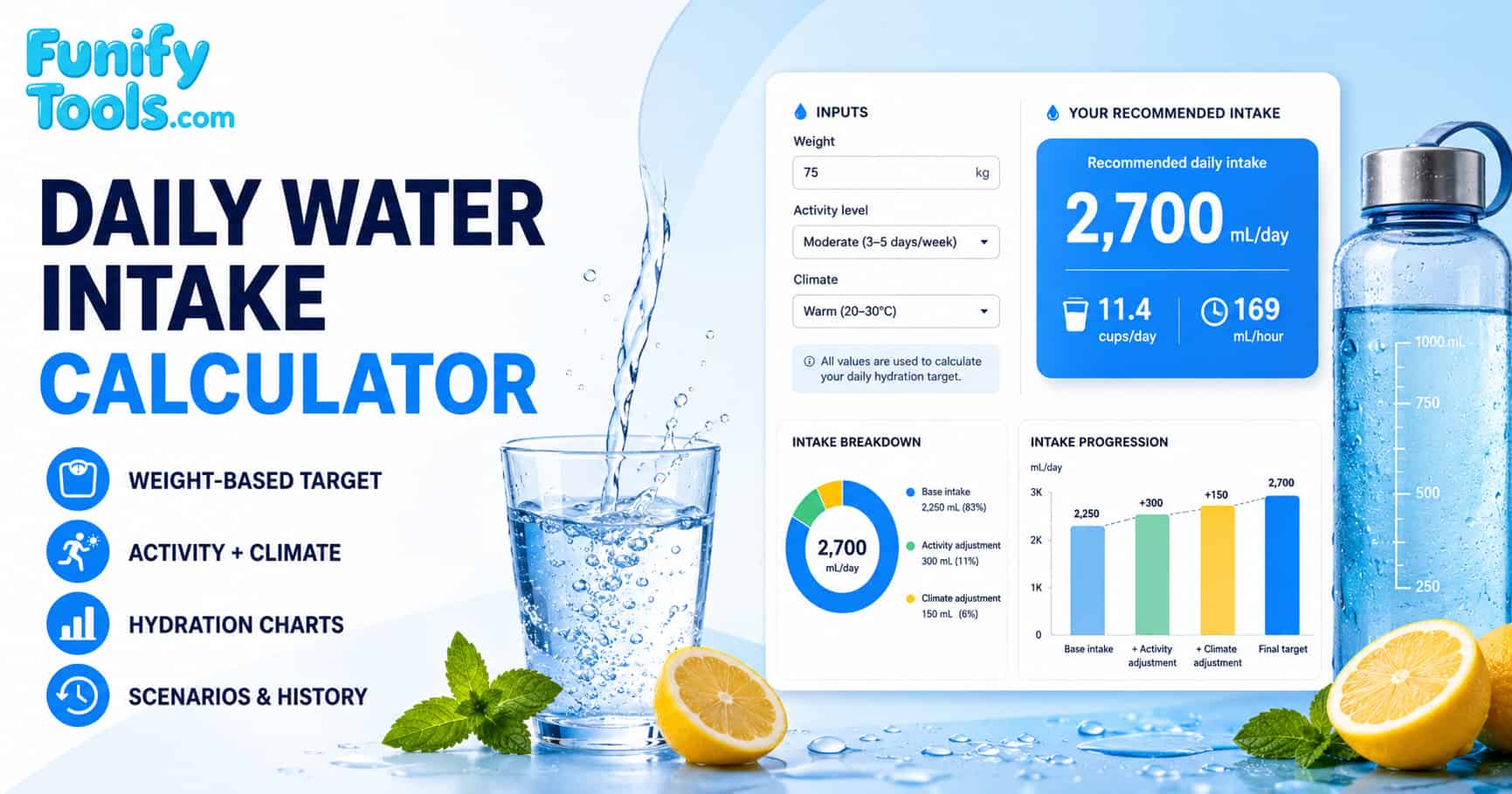
The Daily Water Intake Calculator estimates daily drinking water intake from three simple inputs: body weight, activity level, and climate. It is designed for everyday hydration planning, not for diagnosing dehydration or replacing professional medical guidance. The output combines a daily target in milliliters, an hourly pace reference, a detailed result table, source breakdown charts, a scenario comparison feature, and a saved record that can be opened and edited in Funify Notes. Whether you are planning for a sedentary office day, a moderate workout routine, or an active outdoor session in a hot or dry climate, this tool gives you a clear starting point to maintain proper hydration throughout the day.
Formula and model
The calculator uses a straightforward weight-based hydration model so the result is easy to understand, verify, and compare across different scenarios. The formula display in the result area shows the same logic used by the calculation engine. The result should be treated as a transparent planning estimate, not as a universal medical requirement.
- Weight conversion: pounds × 0.453592 = kilograms. This conversion ensures the formula works correctly regardless of your preferred unit.
- Base intake: weight in kilograms × 30 ml. This baseline is a simple planning starting point, not an official minimum requirement.
- Daily target: base intake + activity adjustment + climate adjustment. The sum gives you a personalized total that accounts for your lifestyle and environment.
- Hourly pace: daily target ÷ 16 waking hours. Spreading your intake across the day prevents overloading your system at any single point and supports steady hydration.
Adjustment table
The table below summarizes the fixed adjustments used in this calculator. These numbers are intentionally simple and transparent so you can easily understand how each choice changes your daily target. They are planning assumptions, not official clinical thresholds.
| Input | Option | Adjustment | When it is useful |
|---|---|---|---|
| Activity | Sedentary | 0 ml | Desk work or little planned exercise with minimal sweat loss. |
| Activity | Moderate | 500 ml | Typical workouts or regular daily movement such as walking or light jogging. |
| Activity | Active | 800 ml | Daily exercise, intense training sessions, or occupations involving heavy physical labor and sweating. |
| Climate | Temperate | 0 ml | Cool or mild indoor and outdoor conditions with moderate humidity and temperature. |
| Climate | Hot | 400 ml | Warm, humid, or sweat-inducing conditions typical of summer weather or tropical climates. |
| Climate | Dry | 300 ml | Dry air, arid climates, desert environments, or heated indoor air during winter months. |
Sample daily water intake by body weight
The table below shows how the baseline water intake changes with body weight for a sedentary person in a temperate climate. These values reflect the base formula (weight in kg × 30 ml) without any activity or climate adjustments. Use this as a quick reference to see how much your weight alone contributes to your daily hydration target. If you are active or live in a hot climate, add the corresponding adjustment from the table above. For a deeper look at how body weight affects hydration recommendations, search how much water should I drink based on my weight for guidance from various health sources.
| Body weight (kg) | Body weight (lb) | Base water intake (ml) | Base water intake (liters) | Approximate cups (240 ml) |
|---|---|---|---|---|
| 50 kg | 110 lb | 1,500 ml | 1.5 L | 6.3 cups |
| 60 kg | 132 lb | 1,800 ml | 1.8 L | 7.5 cups |
| 70 kg | 154 lb | 2,100 ml | 2.1 L | 8.8 cups |
| 80 kg | 176 lb | 2,400 ml | 2.4 L | 10.0 cups |
| 90 kg | 198 lb | 2,700 ml | 2.7 L | 11.3 cups |
| 100 kg | 220 lb | 3,000 ml | 3.0 L | 12.5 cups |
Hydration context
Real hydration needs are influenced by many factors beyond body weight alone. Sweat rate, exercise duration and intensity, sodium and electrolyte losses, caffeine or alcohol consumption, overall diet composition, altitude, humidity, illness, fever, digestive conditions, and certain medications can all affect the amount of water a person needs to drink each day. Pregnant and breastfeeding women also have higher fluid requirements. If you are comparing different daily routines or planning for specific events, keep the same unit of measurement and similar input assumptions so your scenario comparisons remain meaningful and actionable. The scenario comparison feature built into this calculator is designed exactly for that purpose.
Daily water intake comparison by activity level
The table below compares how the daily water target changes across different activity levels for a fixed body weight of 70 kg (154 lb) in a temperate climate. This helps you visualize the impact of exercise and physical activity on your hydration planning. As activity intensity and frequency increase, sweat and respiration can increase fluid loss, so this calculator adds a simple activity adjustment. For exercise-specific guidance, compare this estimate with professional or sport-specific recommendations for pre-exercise, during-exercise, and post-exercise hydration.
| Activity level | Base intake (ml) | Activity adjustment (ml) | Daily total (ml) | Hourly pace (ml/hour) |
|---|---|---|---|---|
| Sedentary | 2,100 | 0 | 2,100 | 131 |
| Moderate | 2,100 | 500 | 2,600 | 163 |
| Active | 2,100 | 800 | 2,900 | 181 |
Daily water intake comparison by climate
The table below compares how the daily water target changes across different climate conditions for a fixed body weight of 70 kg (154 lb) with moderate activity. Hot and dry environments increase fluid loss through sweating and evaporation, which raises the amount of water needed to stay properly hydrated. Use this comparison to plan your water intake when traveling to a different climate or during seasonal weather changes. Even small increases in ambient temperature or decreases in humidity can raise your daily fluid requirements significantly.
| Climate | Base intake (ml) | Activity adjustment (ml) | Climate adjustment (ml) | Daily total (ml) | Hourly pace (ml/hour) |
|---|---|---|---|---|---|
| Temperate | 2,100 | 500 | 0 | 2,600 | 163 |
| Hot | 2,100 | 500 | 400 | 3,000 | 188 |
| Dry | 2,100 | 500 | 300 | 2,900 | 181 |
Practical tips
- Use the total daily target as a planning starting point, then adjust based on your personal thirst signals, sweat output, urine color, meal composition, and any professional guidance you receive.
- Spread your water intake evenly across the day rather than drinking large volumes all at once. Consistent sipping supports better absorption and reduces digestive discomfort.
- Use the hourly pace as a loose sipping reference, not a strict schedule. Your actual needs will vary from hour to hour depending on activity, temperature, and individual factors.
- Add multiple scenarios for sedentary, moderate, active, hot, or dry days to compare how the target changes under different conditions. This helps you prepare for varied daily routines.
- Open the saved Funify Notes result if you want a printable or editable local record that includes all calculation details, chart values, and scenario comparisons for future reference.
The charts in the result area show how much of your daily target comes from the base weight formula and how activity or climate changes the final target. This visual breakdown is useful for understanding whether your result is mostly weight driven or adjustment driven, and it helps you decide which factor to modify if you want to change your target.
References
Mayo Clinic: Water, how much should you drink every day? | NHS: Water, drinks and hydration | National Academies: Dietary Reference Intakes for Water